Red Palm Olein Oil-Enhanced Instant Noodle: A Functional Food Innovation for Diabetes-friendly Formulation
DOI:
https://doi.org/10.22437/ifstj.v9i2.49295Keywords:
antioxidant food, diabetes prevention, functional noodles, konjac, red palm olein oilAbstract
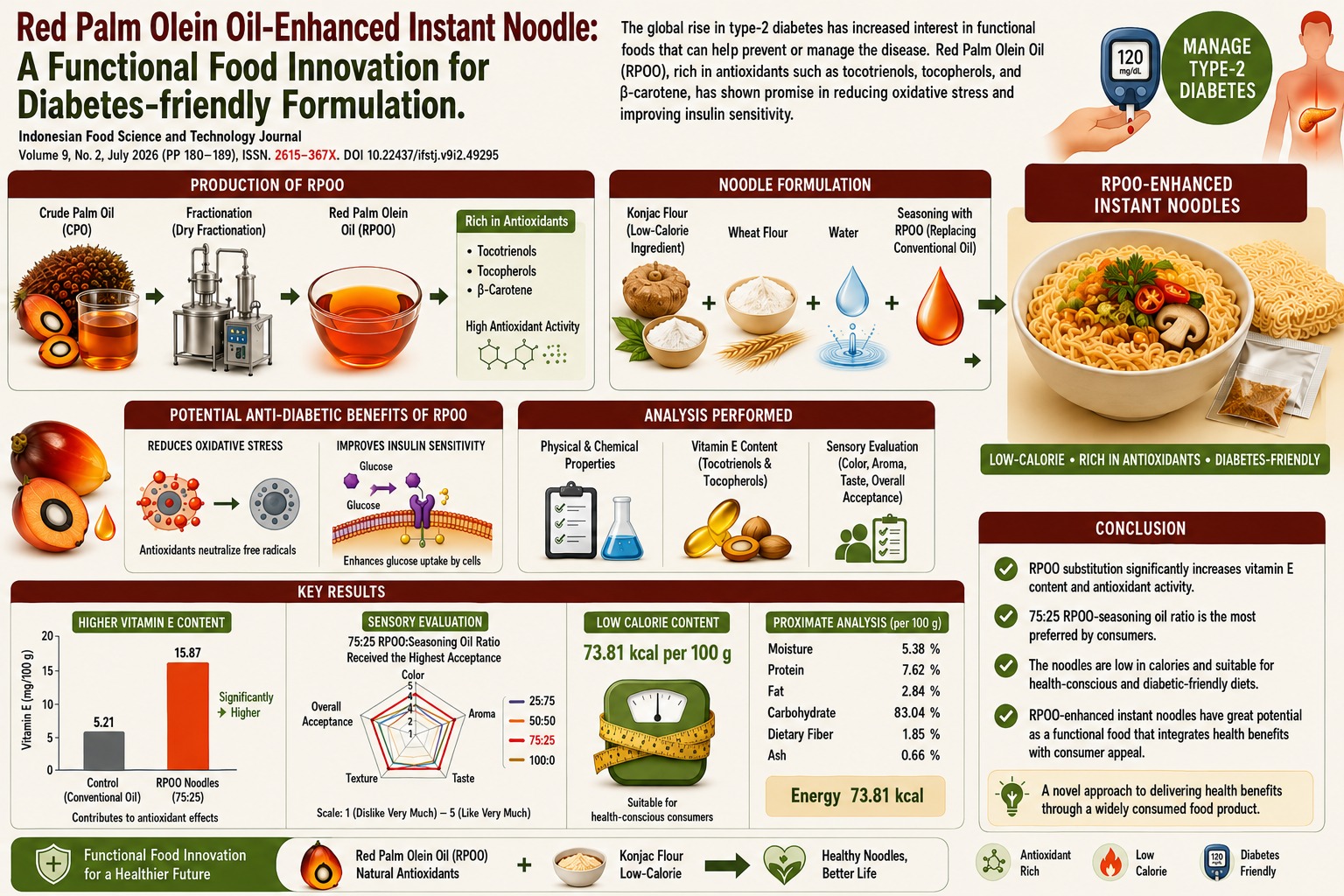
The global rise in type-2 diabetes has increased interest in functional foods that can help prevent or manage the disease. Red Palm Olein Oil (RPOO), rich in antioxidants such as tocotrienols, tocopherols, and β-carotene, has shown promise in reducing oxidative stress and improving insulin sensitivity. This study aimed to develop a low-calorie, functional instant noodle using RPOO to provide anti-diabetic benefits while retaining consumer appeal. Konjac flour, a low-calorie ingredient, was combined with RPOO to create a nutritious noodle product. The production of RPOO involved fractionating crude palm oil (CPO) to yield a product rich in antioxidants, which were measured for their antioxidant activity. The noodles were formulated by replacing conventional oils with RPOO-based seasoning, and their physical, chemical, and sensory properties were analyzed. Results showed that the RPOO-substituted noodles had significantly higher vitamin E content, contributing to antioxidant effects. Sensory evaluation indicated that the 75:25 RPOO-seasoning oil ratio received the highest acceptance regarding color, aroma, and taste. Proximate analysis revealed that the noodles were low in calories (73.81 kcal per 100g), making them suitable for health-conscious consumers. The findings suggest that RPOO-enhanced instant noodles could serve as a functional food for diabetes-friendly formulation, providing a novel approach to integrating health benefits into widely consumed food products.References
[1] K. Jomova, R. Raptova, S. Y. Alomar, S. H. Alwasel, E. Nepovimova, and K. Kuca, Reactive oxygen species , toxicity , oxidative stress , and antioxidants : chronic diseases and aging, vol. 97, no. 10. Springer Berlin Heidelberg, 2023. doi: 10.1007/s00204-023-03562-9.
[2] T. Aryanugraha, D. Sargowo, A. F. Rahimah, and C. T. Tjahjono, “The Role of Antioxidants dan Anti-Inflammatory Agents in Cardiometabolic Disease,” Hear. Sci. J., vol. 5, no. October 2023, pp. 10–13, 2024, doi: https://doi.org/10.21776/ub/hsj.2024.005.01.3.
[3] Y. Kayama, U. Raaz, A. Jagger, M. Adam, and I. N. Schellinger, “Diabetic Cardiovascular Disease Induced by Oxidative Stress,” Int. J. Mol. Sci., vol. 16, pp. 25234–25263, 2015, doi: 10.3390/ijms161025234.
[4] C. Ni, X. Wang, Y. Zhou, Y. Chen, Y. Liu, and Z. Sun, “Association of oxidative balance score , cardiovascular , and all- cause mortality among patients with type 2 diabetes mellitus,” Front. Endocrinol. (Lausanne)., no. August, pp. 1–10, 2024, doi: 10.3389/fendo.2024.1429662.
[5] O. F. Adewale, O. O. Isaac, M. T. Tunmise, and O. O. Omoniyi, “Palm oil and ground nut oil supplementation effects on blood glucose and antioxidant status in alloxan-induced diabetic rats,” no. January, 2019.
[6] S. P. Muharis, A. G. M. Top, D. Murugan, and M. R. Mustafa, “Palm oil tocotrienol fractions restore endothelium dependent relaxation in aortic rings of streptozotocin-induced diabetic and spontaneously hypertensive rats,” Nutr. Res., vol. 30, no. 3, pp. 209–216, 2010, doi: 10.1016/j.nutres.2010.03.005.
[7] R. Dalan et al., “Impact of Vitamin E supplementation on vascular function in haptoglobin genotype strati fi ed diabetes patients ( EVAS Trial ): a randomised controlled trial,” Nutr. Diabetes, vol. Nutrition, 2020, doi: 10.1038/s41387-020-0116-7.
[8] Y. E. Puspitasari, Y. A. Sholichah, N. R. Defransyah, and T. Dwi, “In silico approaches to analyse Acanthus ilicifolius leaves extract as α - glucosidase and α -amylase inhibitors,” Canrea J. Food Technol. Nutr. Culin., vol. 8, no. 2, pp. 425–447, 2025, doi: 10.20956/canrea.v8i2.1165.
[9] L. M. Gomes, A. M. R. Freitas, T. Dias, and R. B. M. Cavalcante, “Vegetables and their by-products: total phenolic compound content, total flavonoids, and antioxidant activity,” Hortic. Bras., vol. 41, pp. 1–5, 2023, doi: 10.1590/s0102-0536-2023-e2572.
[10] G. Chen et al., “Tocotrienol-rich vitamin E improves diabetic nephropathy and persists 6 – 9 months after washout : a phase IIa randomized controlled trial,” pp. 1–16, 2019, doi: 10.1177/2042018819895462.
[11] O. Asbaghi, B. Nazarian, M. Yousefi, J. A. Shoae, and H. Rasekhi, “Effect of vitamin E intake on glycemic control and insulin resistance in diabetic patients : an updated systematic review and meta ‑ analysis of randomized controlled trials,” Nutr. J., vol. 22, no. 10, pp. 1–22, 2023, doi: 10.1186/s12937-023-00840-1.
[12] R. Loganathan, A. H. A. Tarmizi, S. R. Vethakkan, and K. T. Teng, “Retention of carotenes and vitamin e, and physicochemical changes occurring upon heating red palm olein using deep-fat fryer, microwave oven and conventional oven,” J. Oleo Sci., vol. 69, no. 3, pp. 167–183, 2020, doi: 10.5650/jos.ess19209.
[13] B. T. Y. Ping, C. A. C. Idris, and Z. A. Maurad, “Oxidative stability of refined red palm olein under two Malaysian storage conditions,” J. Oleo Sci., vol. 69, no. 10, pp. 1209–1218, 2020, doi: 10.5650/jos.ess20045.
[14] Z. Gao, Y. Zhu, J. Jin, Q. Jin, and X. Wang, “Chemical–Physical Properties of Red Palm Oils and Their Application in the Manufacture of Aerated Emulsions with Improved Whipping Capabilities,” Foods, vol. 12, no. 21, 2023, doi: 10.3390/foods12213933.
[15] L. Agustina, B. Budiyanto, and T. Tutuarima, “Subtitusion of Rpo To Seasoning Oil and Acceptability and Fortification Potency of Vitamin a Trough Chicken Noodle,” J. Agroindustri, vol. 8, no. 2, pp. 150–158, 2019, doi: 10.31186/j.agroind.8.2.150-158.
[16] M. E. Mulyono, M. E. S. Lubis, B. G. Yudanto, and F. R. Panjaitan, “Original article Application of dry fractional crystallisation on High-Oleic Low-Palmitic red palm super olein production,” Int. J. Food Sci. Technol., vol. 58, pp. 3402–3409, 2023, doi: 10.1111/ijfs.16353.
[17] Y. Kurniati and W. H. Susanto, “Pengaruh Basa NaOH dan Kandungan ALB CPO terhadap Kualitas Minyak Kelapa Sawit Pasca Netralisasi,” J. Pangan dan Agroindustri, vol. 3, no. 1, pp. 193–202, 2015.
[18] D. A. Setyawardhani and T. H. Satiawardana, “Innovative approach to vegetable oil production and refining technology in Indonesia : a review,” Discov. Chem. Eng., vol. 4, pp. 1–23, 2025.
[19] I. A. Saputra, B. Budiyanto, and D. Silsia, “The Effect of The Addition of NaOH in Water Degumming and Alkali Refining Process The Quality of Red Palm Oil Olein (RPOO),” J. Agroindustri, vol. 13, no. 1, pp. 85–94, 2023, doi: 10.31186/j.agroind.13.1.85-94.
[20] S. Pootao and K. Kanjanapongkul, “Effects of ohmic pretreatment on crude palm oil yield and key qualities,” J. Food Eng., vol. 190, pp. 94–100, 2016, doi: 10.1016/j.jfoodeng.2016.06.021.
[21] I. Nor Shafizah, R. Irmawati, H. Omar, M. Yahaya, and A. Alia Aina, “Removal of free fatty acid (FFA) in crude palm oil (CPO) using potassium oxide/dolomite as an adsorbent: Optimization by Taguchi method,” Food Chem., vol. 373, no. PB, p. 131668, 2022, doi: 10.1016/j.foodchem.2021.131668.
[22] L. Ifa et al., “Heliyon Analysis of bentonite performance on the quality of re fi ned crude palm oil ’ s color , free fatty acid and carotene : the effect of bentonite concentration and contact time,” Heliyon, vol. 7, no. March, pp. 1–9, 2021, doi: 10.1016/j.heliyon.2021.e07230.
[23] Otuaga, E. Juliana, Okpoghono, Geoarge, and B. Omenebelle, “Proximate Composition, Phytochemicals and Antioxidant Status of Banga Soup ( Elaeis guineensis extract),” J. Sci. Ind. Res. (India)., vol. 4, no. 2, pp. 63–74, 2020.
[24] T. C. Shekhar and G. Anju, “Antioxidant Activity by DPPH Radical Scavenging Method of Ageratum conyzoides,” Am. J. Ethnomedicine, vol. 1, no. 4, pp. 244–249, 2015.
[25] A. Windarsih, Suratno, H. D. Warmiko, A. W. Indrianingsih, A. Rohman, and Y. I. Ulumuddin, “Untargeted metabolomics and proteomics approach using liquid chromatography-Orbitrap high resolution mass spectrometry to detect pork adulteration in Pangasius hypopthalmus meat,” Food Chem., vol. 386, no. July 2021, p. 132856, 2022, doi: 10.1016/j.foodchem.2022.132856.
[26] S. Deeto, S. Thepa, V. Monyakul, and R. Songprakorp, “The experimental new hybrid solar dryer and hot water storage system of thin layer coffee bean dehumidification,” Renew. Energy, vol. 115, pp. 954–968, 2018, doi: 10.1016/j.renene.2017.09.009.
[27] AOAC, Official Methods Of Analysis. Washington, DC: Arlington, 2005.
[28] D. Setyaningsih, A. Apriyantono, and M. P. Sari, Analisis Sensori untuk Industri Pangan dan Agro. Bogor: IPB Press, 2010.
[29] E. Menalla, J. G. Serna, D. Cantero, and M. J. Cocero, “Hydrothermal hydrolysis of triglycerides: Tunable and intensified production of diglycerides, monoglycerides, and fatty acids,” Chem. Eng. J., vol. 493, no. April, 2024, doi: 10.1016/j.cej.2024.152391.
[30] M. Lertcanawanichakul, T. Sahabuddeen, H. Madoromae, and S. Jankhlay, “Red Palm Oil as a Bioactive Ingredient for Cosmeceutical Applications : Antioxidant , Antimicrobial , and Skin- Protective Properties Red Palm Oil as a Bioactive Ingredient for Cosmeceutical Applications : Antioxidant ,” pp. 0–6, 2025, doi: 10.20944/preprints202509.1633.v1.
[31] F. Morcillo, V. Vaissayre, J. Serret, S. Avallone, H. Domonh, and F. Jacob, “Natural diversity in the carotene , tocochromanol and fatty acid composition of crude palm oil,” Food Chem., vol. 365, pp. 1–10, 2021, doi: 10.1016/j.foodchem.2021.130638.
[32] R. Loganathan, K. M. Subramaniam, A. K. Radhakrishnan, Y. M. Choo, and K. T. Teng, “Health-promoting effects of red palm oil: evidence from animal and human studies,” Nutr. Rev., vol. 75, no. 2, pp. 98–113, 2017, doi: 10.1093/nutrit/nuw054.
[33] D. R. Wickramasinghe Mudiyanselage and I. Wickramasinghe, “Comparison of physicochemical characteristics of virgin coconut oils from traditional and hybrid coconut varieties,” J. Agric. Food Res., vol. 12, no. December 2022, p. 100554, 2023, doi: 10.1016/j.jafr.2023.100554.
[34] C. H. Tan et al., “Red Palm Oil : A Review on Processing , Health Benefits and Its Application in Red Palm Oil : A Review on Processing , Health Benefits and Its Application in Food,” no. August 2021, 2022, doi: 10.5650/jos.ess21108.
[35] C. Robichon et al., “Unveiling synergistic antioxidant combinations for α-tocopherol in emulsions: A spectrophotometric-mathematical approach,” Curr. Res. Food Sci., vol. 11, no. July, 2025, doi: 10.1016/j.crfs.2025.101134.
[36] C. K. Sen, S. Khanna, and S. Roy, “Tocotrienols: Vitamin E beyond tocopherols,” Life Sci., vol. 78, no. 18, pp. 2088–2098, 2006, doi: 10.1016/j.lfs.2005.12.001.
[37] W. T. Chong et al., “Optimization of process parameters in preparation of tocotrienol-rich red palm oil-based nanoemulsion stabilized by Tween80-Span 80 using response surface methodology,” PLoS One, vol. 13, no. 8, pp. 1–22, 2018, doi: 10.1371/journal.pone.0202771.
[38] H. Delisle, “The nutritional value of red palm oil,” no. October, pp. 217–232, 2018, doi: 10.19103/as.2017.0018.33.
[39] M. Podda, C. Weber, M. G. Traber, and L. Packer, “Simultaneous determination of tissue tocopherols, tocotrienols, ubiquinols, and ubiquinones,” J. Lipid Res., vol. 37, no. 4, pp. 893–901, 1996, doi: 10.1016/s0022-2275(20)37587-8.
[40] M. G. Traber and J. Atkinson, “Vitamin E, antioxidant and nothing more,” Free Radic. Biol. Med., vol. 43, no. 1, pp. 4–15, 2007, doi: 10.1016/j.freeradbiomed.2007.03.024.
[41] A. Kamal-Eldin and L. Å. Appelqvist, “The chemistry and antioxidant properties of tocopherols and tocotrienols,” Lipids, vol. 31, no. 7, pp. 671–701, 1996, doi: 10.1007/BF02522884.
[42] M. Shafras, R. Sabaragamuwa, and M. Suwair, “Role of dietary antioxidants in diabetes: An overview,” Food Chem. Adv., vol. 4, no. June 2023, p. 100666, 2024, doi: 10.1016/j.focha.2024.100666.
[43] M. T. Fatima, A. A. Bhat, S. Nisar, K. A. Fakhro, and A. S. Al-Shabeeb Akil, “The role of dietary antioxidants in type 2 diabetes and neurodegenerative disorders: An assessment of the benefit profile,” Heliyon, vol. 9, no. 1, p. e12698, 2023, doi: 10.1016/j.heliyon.2022.e12698.
[44] S. Mariyam, S. Jose, S. Kumar, and M. . Parmar, “Super power of antioxidant in oxidative stress and Diabetes Mellitus,” Diabetes Updat., vol. 6, no. 2, pp. 1–4, 2020, doi: 10.15761/du.1000144.
[45] M. Z. Sadikan, N. A. A. Nasir, R. Agarwal, and N. M. Ismail, “Protective effect of palm oil-derived tocotrienol-rich fraction against retinal neurodegenerative changes in rats with streptozotocin-induced diabetic retinopathy,” Biomolecules, vol. 10, no. 4, 2020, doi: 10.3390/biom10040556.
[46] S. B. Budin, F. Othman, S. R. Louis, M. A. Bakar, S. Das, and J. Mohamed, “The effects of palm oil tocotrienol-rich fraction supplementation on biochemical parameters, oxidative stress and the vascular wall of streptozotocin-induced diabetic rats.,” Clinics (Sao Paulo)., vol. 64, no. 3, pp. 235–244, 2009, doi: 10.1590/s1807-59322009000300015.
[47] E. Said, S. Mousa, M. Fawzi, N. A. Sabry, and S. Farid, “Combined effect of high-dose vitamin A, vitamin E supplementation, and zinc on adult patients with diabetes: A randomized trial,” J. Adv. Res., vol. 28, pp. 27–33, 2021, doi: 10.1016/j.jare.2020.06.013.
[48] M. Yupita, B. Budiyanto, and H. Koto, “Substitution of Red Palm Oil Olein (RPOO) as a Source of Provitamin E in Grilled Meatball Sauce,” AGRITROPICA J. Agric. Sci., vol. 5, no. 1, pp. 13–21, 2022, doi: 10.31186/j.agritropica.5.1.13-21.
[49] M. Yupita, B. Budiyanto, and H. Koto, “Substitution of Red Palm Oil Olein ( RPOO ) as a Source of Provitamin E in Grilled Meatball Sauce,” AGRITROPICA J. Agric. Sci., vol. 5, no. 1, pp. 13–21, 2022, doi: https://doi.org/10.31186/J.agritropica.5.1.13-21.
[50] F. A. Matough, S. B. Budin, Z. A. Hamid, M. Abdul-Rahman, N. Al-Wahaibi, and J. Mohammed, “Tocotrienol-rich fraction from palm oil prevents oxidative damage in diabetic rats,” Sultan Qaboos Univ. Med. J., vol. 14, no. 1, pp. 95–103, 2014, doi: 10.12816/0003342.
[51] R. Feng, X. Liu, R. Xu, B. Xu, H. Tao, and B. Zhang, “Konjac Glucomannan Acts as the Skeleton of Emulsion Gel Exhibiting Stable Water Retention by Promoting the Structure Density of Gel Network,” J. Food Sci., vol. 90, no. 9, 2025, doi: https://doi.org/10.1111/1750-3841.70533.
[52] H. N. Jang, T. R. Kumayas, and A. Romulo, “Physicochemical and sensory evaluation of shirataki noodles prepared from porang and tapioca flours,” IOP Conf. Ser. Earth Environ. Sci., vol. 1169, no. 1, 2023, doi: 10.1088/1755-1315/1169/1/012101.
[53] W. Iftari, R. Amalia, A. N. Savitri, and G. Saragih, “Study of The Addition of Red Palm Oil (RPO) to The Sensory and Chemical Characteristics of Beef Sausage,” J. Pangan dan Agroindustri, vol. 10, no. 4, pp. 194–203, 2022.
[54] H.-J. Kim, J. Jin, and K.-T. Lee, “Studies on the Fat Content and Fatty Acid Composition of the Black-bean-sauce Noodles in the Chinese Restaurants,” J. Agric. Sci., vol. 37, no. 2, pp. 261–266, 2010.
[55] S. Zhu et al., “Effects of konjac glucomannan intake patterns on glucose and lipid metabolism of obese mice induced by a high fat diet,” Food Funct., vol. 15, pp. 9116–9135, 2024, doi: http://doi.org/10.1039/D4FO02442G.
Downloads
Published
Issue
Section
License
Copyright (c) 2026 Indonesian Food Science and Technology Journal

This work is licensed under a Creative Commons Attribution 4.0 International License.