Genetic Variants Related to Coffee Consumption and Their Association with Obesity Risk: A Systematic Review
DOI:
https://doi.org/10.22437/ifstj.v9i2.53860Keywords:
Caffeine, Coffee consumption, Genetic, Metabolic health, Obesity, PolymorphismsAbstract
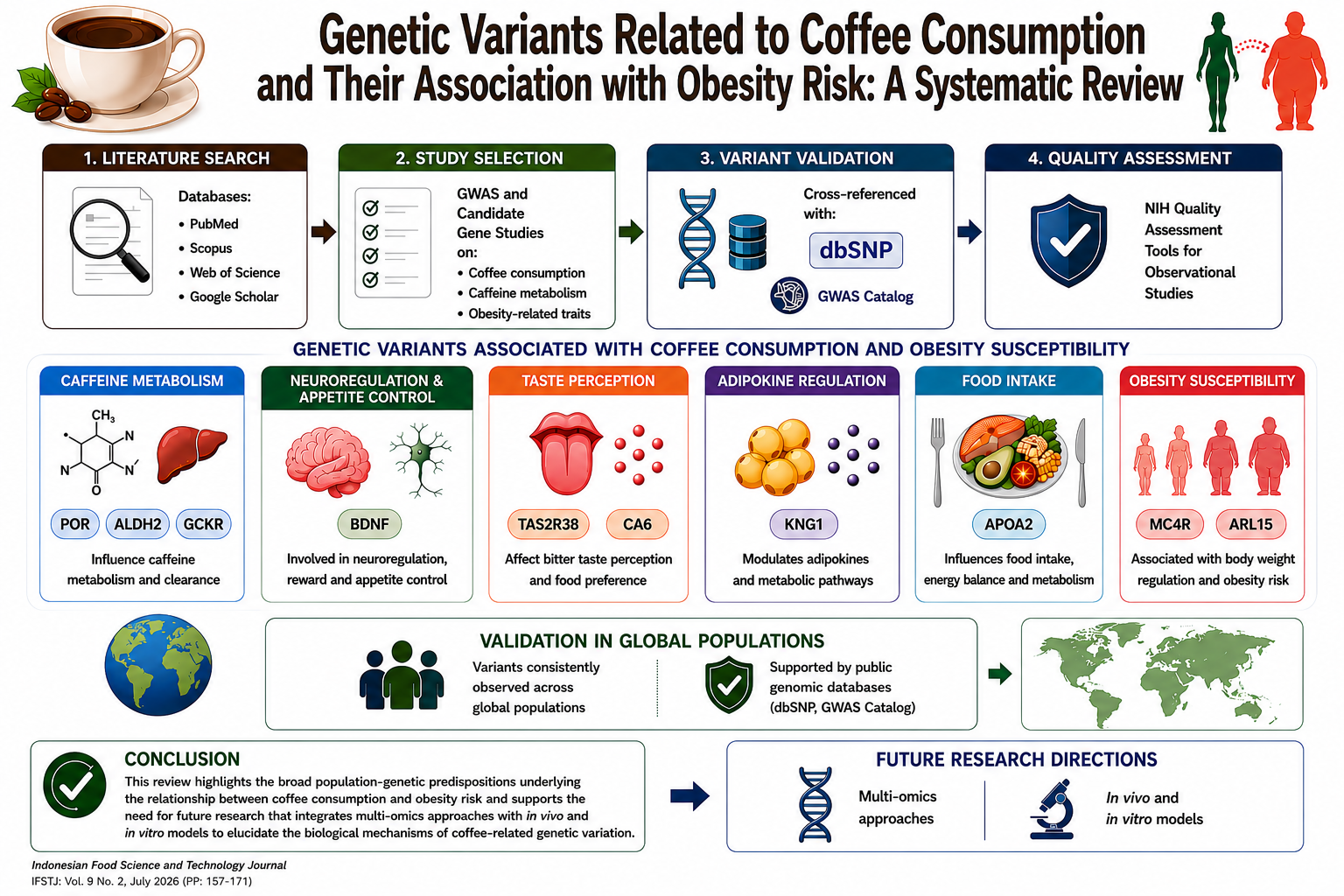
Coffee consumption has been associated with metabolic health and obesity risk, potentially through bioactive compounds that influence energy metabolism. Genetic variation may partly explain interindividual differences in these effects, yet the population-specific relevance of such variants remains unclear. However, the population-specific relevance of these genetic variants remains insufficiently explored. OBJECTIVES: This systematic review synthesizes genetic variants associated with coffee consumption and obesity susceptibility across ethnically diverse populations and validates their relevance in global populations using public genomic databases. METHODS: A comprehensive literature search was conducted in PubMed, Scopus, Web of Science, and Google Scholar to identify genome-wide association studies and candidate gene studies examining genetic variants related to coffee consumption, caffeine metabolism, and obesity-related traits. Identified variants were cross-referenced with dbSNP and the GWAS Catalog to assess allele frequency distributions and genomic support. Study quality was evaluated using the National Institutes of Health assessment tools for observational studies. RESULTS: The review identified genetic variants involved in caffeine metabolism (POR, ALDH2, GCKR), neuroregulation and appetite control (BDNF), taste perception (TAS2R38, CA6), adipokine regulation (KNG1), dietary fat response (APOA2), and obesity susceptibility (MC4R, ARL15). Public genomic database analyses suggest that several variants are consistently observed across global populations, supporting their potential generalizability. CONCLUSION: This review highlights the broad population-genetic predispositions underlying the relationship between coffee consumption and obesity risk and supports the need for future research that integrates multi-omics approaches with in vivo and in vitro models to elucidate the biological mechanisms of coffee-related genetic variation.References
[1] C. Hou et al., “Medical conditions associated with coffee consumption: Disease-trajectory and comorbidity network analyses of a prospective cohort study in UK Biobank,” Am. J. Clin. Nutr., vol. 116, no. 3, pp. 730–740, Sep. 2022, doi: 10.1093/ajcn/nqac148.
[2] “U.S. Food and Drug Administration,” FDA. Accessed: Mar. 17, 2025. [Online]. Available: https://www.fda.gov/
[3] M. C. Cornelis et al., “Genome-wide meta-analysis identifies six novel loci associated with habitual coffee consumption,” Mol. Psychiatry, vol. 20, no. 5, pp. 647–656, May 2015, doi: 10.1038/mp.2014.107.
[4] N. Abdullah et al., “Roasting-Dependent Changes in Antioxidant Activity and Metabolite Profiles of Coffea liberica: Unraveling Bioactive Compounds and Their Functional Properties,” Baghdad Sci. J., vol. 23, no. 1, pp. 219–235, Jan. 2026, doi: 10.21123/2411-7986.5147.
[5] L.-J. Seow, S. Shamlan, and E.-K. Seow, “Influence of roasting degrees on the antioxidant and anti-angiogenic effects of Coffea liberica,” J. Food Meas. Charact., vol. 15, no. 5, pp. 4030–4036, Oct. 2021, doi: 10.1007/s11694-021-00987-7.
[6] M. Henn et al., “Increase from low to moderate, but not high, caffeinated coffee consumption is associated with favorable changes in body fat,” Clin. Nutr., vol. 42, no. 4, pp. 477–485, Apr. 2023, doi: 10.1016/j.clnu.2023.02.004.
[7] S. C. Larsen, M.-L. Mikkelsen, P. Frederiksen, and B. L. Heitmann, “Habitual coffee consumption and changes in measures of adiposity: a comprehensive study of longitudinal associations,” Int. J. Obes., vol. 42, no. 4, pp. 880–886, Apr. 2018, doi: 10.1038/ijo.2017.310.
[8] K. Kempf et al., “Cardiometabolic effects of two coffee blends differing in content for major constituents in overweight adults: a randomized controlled trial,” Eur. J. Nutr., vol. 54, no. 5, pp. 845–854, Aug. 2015, doi: 10.1007/s00394-014-0763-3.
[9] Y. Kim and Y. Je, “Moderate coffee consumption is inversely associated with the metabolic syndrome in the Korean adult population,” Br. J. Nutr., vol. 120, no. 11, pp. 1279–1287, Dec. 2018, doi: 10.1017/S0007114518002635.
[10] T. Watanabe et al., “Coffee and metabolic phenotypes: A cross-sectional analysis of the Japan multi-institutional collaborative cohort (J-MICC) study,” Nutr. Metab. Cardiovasc. Dis., vol. 33, no. 3, pp. 620–630, Mar. 2023, doi: 10.1016/j.numecd.2022.12.019.
[11] M. Henn, A. J. Glenn, W. C. Willett, M. A. Martínez-González, Q. Sun, and F. B. Hu, “Changes in coffee intake, added sugar and long-term weight gain - Results from three large prospective US cohort studies,” Am. J. Clin. Nutr., vol. 118, no. 6, pp. 1164–1171, Dec. 2023, doi: 10.1016/j.ajcnut.2023.09.023.
[12] J. Liu et al., “Application and prospect of metabolomics-related technologies in food inspection,” Food Res. Int., vol. 171, p. 113071, Sep. 2023, doi: 10.1016/j.foodres.2023.113071.
[13] H.-J. Kim, S. Cho, D. R. Jacobs, and K. Park, “Instant coffee consumption may be associated with higher risk of metabolic syndrome in Korean adults,” Diabetes Res. Clin. Pract., vol. 106, no. 1, pp. 145–153, Oct. 2014, doi: 10.1016/j.diabres.2014.07.007.
[14] J. Lee, H. Kim, and J. Kim, “Coffee Consumption and the Risk of Obesity in Korean Women,” Nutrients, vol. 9, no. 12, p. 1340, Dec. 2017, doi: 10.3390/nu9121340.
[15] H. Park and J.-S. Lee, “Association with obesity and abdominal obesity according to the kind and amount of coffee intake in Korean adults: 2013 ~ 2016 Korea National Health and Nutrition Examination Survey,” J. Nutr. Health, vol. 52, no. 4, p. 369, 2019, doi: 10.4163/jnh.2019.52.4.369.
[16] A. E. Haque, N. B. M. Hashim, N. A. B. Ruslan, and M. Haque, “Lifestyle Diseases and Their Association with Coffee Consumption at Ipoh, Malaysia,” Res. J. Pharm. Technol., vol. 8, no. 3, p. 285, 2015, doi: 10.5958/0974-360X.2015.00048.7.
[17] Á. Fernández-Cardero, J. L. Sierra-Cinos, L. Bravo, and B. Sarriá, “Consumption of a coffee rich in phenolic compounds may improve the body composition of people with overweight or obesity: Preliminary insights from a randomized, controlled and blind crossover study,” Nutrients, vol. 16, no. 17, p. 2848, Aug. 2024, doi: 10.3390/nu16172848.
[18] K. G. Gkouskou et al., “CYP1A2 polymorphisms modify the association of habitual coffee consumption with appetite, macronutrient intake, and body mass index: results from an observational cohort and a cross-over randomized study,” Int. J. Obes., vol. 46, no. 1, pp. 162–168, Jan. 2022, doi: 10.1038/s41366-021-00972-6.
[19] G. Nikrandt, J. Mikolajczyk-Stecyna, M. Mlodzik-Czyzewska, and A. Chmurzynska, “Functional single-nucleotide polymorphism (rs762551) in CYP1A2 gene affects white coffee intake in healthy 20- to 40-year-old adults,” Nutr. Res., vol. 105, pp. 77–81, Sep. 2022, doi: 10.1016/j.nutres.2022.06.003.
[20] V. P. Narayan, “Associations of Blood Caffeine and Genetically Predicted Coffee Consumption with Anthropometric Measures of Obesity: A Two Sample Mendelian Randomization Study,” vol. 26, no. 2, 2022.
[21] M. C. Cornelis et al., “Genome-wide association study of caffeine metabolites provides new insights to caffeine metabolism and dietary caffeine-consumption behavior,” Hum. Mol. Genet., p. ddw334, Oct. 2016, doi: 10.1093/hmg/ddw334.
[22] C. Chupeerach et al., “The influence of TAS2R38 bitter taste gene polymorphisms on obesity risk in three racially diverse groups,” BioMedicine, vol. 11, no. 3, pp. 43–49, Aug. 2021, doi: 10.37796/2211-8039.1175.
[23] J. Mikołajczyk-Stecyna, A. M. Malinowska, M. Mlodzik-Czyzewska, and A. Chmurzynska, “Coffee and tea choices and intake patterns in 20-to-40 year old adults,” Food Qual. Prefer., vol. 90, p. 104115, Jun. 2021, doi: 10.1016/j.foodqual.2020.104115.
[24] Y. Wu et al., “Genome-wide association study for adiponectin levels in Filipino women identifies CDH13 and a novel uncommon haplotype at KNG1–ADIPOQ,” Hum. Mol. Genet., vol. 19, no. 24, pp. 4955–4964, Dec. 2010, doi: 10.1093/hmg/ddq423.
[25] M. P. Zumaraga, M. A. Concepcion, C. Duante, and M. Rodriguez, “Next Generation Sequencing of 502 Lifestyle and Nutrition related Genetic Polymorphisms reveals Independent Loci for Low Serum 25-hydroxyvitamin D Levels among Adult Respondents of the 2013 Philippine National Nutrition Survey,” J. ASEAN Fed. Endocr. Soc., vol. 36, no. 1, Art. no. 1, Apr. 2021, doi: 10.15605/jafes.036.01.08.
[26] B. Jafari Azad, M. Yaseri, E. Daneshzad, and F. Koohdani, “Interaction between Apo A-II –265T > C polymorphism and dietary total antioxidant capacity on some oxidative stress and inflammatory markers in patients with type 2 diabetes mellitus,” Br. J. Nutr., vol. 128, no. 1, pp. 13–29, Jul. 2022, doi: 10.1017/S0007114521002993.
[27] M. Kim, S. Lee, E. Cho, K.-W. Hong, S.-J. You, and H. J. Choi, “CETP and APOA2 polymorphisms are associated with weight loss and healthy eating behavior changes in response to digital lifestyle modifications,” Sci. Rep., vol. 13, no. 1, p. 21615, Dec. 2023, doi: 10.1038/s41598-023-48823-w.
[28] Z. Naureen et al., “Genetic test for the prescription of diets in support of physical activity,” Acta Bio Medica Atenei Parm., vol. 91, no. Suppl 13, p. e2020011, 2020, doi: 10.23750/abm.v91i13-S.10584.
[29] A. Mera-Charria et al., “Genetic variant panel allows predicting both obesity risk, and efficacy of procedures and diet in weight loss,” Front. Nutr., vol. 10, Nov. 2023, doi: 10.3389/fnut.2023.1274662.
[30] L. S. Rajcsanyi et al., “Unexpected identification of obesity-associated mutations in LEP and MC4R genes in patients with anorexia nervosa,” Sci. Rep., vol. 14, no. 1, p. 7067, Mar. 2024, doi: 10.1038/s41598-024-57517-w.
[31] V. W. Zhong et al., “A genome-wide association study of bitter and sweet beverage consumption,” Hum. Mol. Genet., vol. 28, no. 14, pp. 2449–2457, Jul. 2019, doi: 10.1093/hmg/ddz061.
[32] P. Suchánek, V. Lánská, and J. A. Hubáček, “Body Composition Changes in Adult Females after Lifestyle Intervention Are Influenced by the NYD-SP18 Variant,” Cent. Eur. J. Public Health, vol. 23, no. Supplement, pp. S19–S22, Nov. 2015, doi: 10.21101/cejph.a4105.
[33] J. Wilk et al., “NYD-SP18 is associated with obesity in the NHLBI Family Heart Study,” Int. J. Obes. 2005, vol. 32, no. 6, pp. 930–935, Jun. 2008, doi: 10.1038/ijo.2008.23.
[34] “Study Quality Assessment Tools,” NHLBI, NIH. Accessed: Dec. 23, 2024. [Online]. Available: https://www.nhlbi.nih.gov/health-topics/study-quality-assessment-tools
[35] T. H. T. Wong, S. Luo, S. L. Au Yeung, and J. C. Y. Louie, “Association between coffee consumption and metabolic syndrome: A cross‐sectional and MENDELIAN randomization study,” J. Diabetes, vol. 16, no. 10, p. e70004, Oct. 2024, doi: 10.1111/1753-0407.70004.
[36] J. Mikołajczyk-Stecyna, A. M. Malinowska, and A. Chmurzynska, “TAS2R38 and CA6 genetic polymorphisms, frequency of bitter food intake, and blood biomarkers among elderly woman,” Appetite, vol. 116, pp. 57–64, Sep. 2017, doi: 10.1016/j.appet.2017.04.029.
[37] K. Rohde et al., “(Epi)genetic regulation of CRTC1 in human eating behaviour and fat distribution,” EBioMedicine, vol. 44, pp. 476–488, May 2019, doi: 10.1016/j.ebiom.2019.05.050.
[38] H. F. L. Muhammad, D. C. Sulistyoningrum, E. Huriyati, Y. Y. Lee, and W. A. Manan Wan Muda, “The Interaction between Coffee: Caffeine Consumption, UCP2 Gene Variation, and Adiposity in Adults—A Cross-Sectional Study,” J. Nutr. Metab., vol. 2019, p. 9606054, Jan. 2019, doi: 10.1155/2019/9606054.
[39] H. Jia et al., “GWAS of habitual coffee consumption reveals a sex difference in the genetic effect of the 12q24 locus in the Japanese population,” BMC Genet., vol. 20, no. 1, p. 61, Dec. 2019, doi: 10.1186/s12863-019-0763-7.
[40] M.-J. Kim, H.-S. Jin, and Y.-B. Eom, “Relationship between HECTD4 gene variants, obesity, and coffee consumption,” Eur. J. Clin. Nutr., vol. 79, no. 3, pp. 200–206, Mar. 2025, doi: 10.1038/s41430-024-01541-6.
[41] S. Kim and D. Shin, “Causal effect of coffee consumption on metabolic syndrome in Korean adults: a 2-sample Mendelian randomization study,” Nutr. Res. Pract., vol. 19, no. 6, p. 943, 2025, doi: 10.4162/nrp.2025.19.6.943.
[42] H. Nakagawa-Senda et al., “A genome-wide association study in the Japanese population identifies the 12q24 locus for habitual coffee consumption: The J-MICC Study,” Sci. Rep., vol. 8, no. 1, p. 1493, Jan. 2018, doi: 10.1038/s41598-018-19914-w.
[43] L. Phan et al., “The evolution of dbSNP: 25 years of impact in genomic research,” Nucleic Acids Res., vol. 53, no. D1, pp. D925–D931, Jan. 2025, doi: 10.1093/nar/gkae977.
[44] J. J.-L. Low, B. J.-W. Tan, L.-X. Yi, Z.-D. Zhou, and E.-K. Tan, “Genetic susceptibility to caffeine intake and metabolism: a systematic review,” J. Transl. Med., vol. 22, no. 1, p. 961, Oct. 2024, doi: 10.1186/s12967-024-05737-z.
[45] B. Oneda, S. Crettol, E. Jaquenoud Sirot, M. Bochud, N. Ansermot, and C. B. Eap, “The P450 oxidoreductase genotype is associated with CYP3A activity in vivo as measured by the midazolam phenotyping test,” Pharmacogenet. Genomics, vol. 19, no. 11, pp. 877–883, Nov. 2009, doi: 10.1097/FPC.0b013e32833225e7.
[46] F. Z. Burkhard, S. Parween, S. S. Udhane, C. E. Flück, and A. V. Pandey, “P450 Oxidoreductase deficiency: Analysis of mutations and polymorphisms,” J. Steroid Biochem. Mol. Biol., vol. 165, pp. 38–50, Jan. 2017, doi: 10.1016/j.jsbmb.2016.04.003.
[47] X. Xiao et al., “Functional POR A503V is associated with the risk of bladder cancer in a Chinese population,” Sci. Rep., vol. 5, no. 1, p. 11751, Jun. 2015, doi: 10.1038/srep11751.
[48] R. Fatma, W. Chauhan, M. H. Shahi, and M. Afzal, “Association of BDNF gene missense polymorphism rs6265 (Val66Met) with three quantitative traits, namely, intelligence quotient, body mass index, and blood pressure: A genetic association analysis from North India,” Front. Neurol., vol. 13, p. 1035885, Jan. 2023, doi: 10.3389/fneur.2022.1035885.
[49] F. Abaj, M. Rafiee, and F. Koohdani, “Interaction between dietary total antioxidant capacity and BDNF Val66Met polymorphism on lipid profiles and atherogenic indices among diabetic patients,” Sci. Rep., vol. 11, no. 1, p. 19108, Sep. 2021, doi: 10.1038/s41598-021-98663-9.
[50] L. Han et al., “Genetic variation of habitual coffee consumption and glycemic changes in response to weight-loss diet intervention: the Preventing Overweight Using Novel Dietary Strategies (POUNDS LOST) trial,” Am. J. Clin. Nutr., vol. 106, no. 5, pp. 1321–1326, Nov. 2017, doi: 10.3945/ajcn.117.156232.
[51] N. Matoba et al., “GWAS of 165,084 Japanese individuals identified nine loci associated with dietary habits,” Nat. Hum. Behav., vol. 4, no. 3, pp. 308–316, Jan. 2020, doi: 10.1038/s41562-019-0805-1.
[52] National Center for Biotechnology Information, “TAS2R38 - taste 2 receptor member 38 (human),” PubChem Gene Summary for Gene 5726. Accessed: Mar. 23, 2025. [Online]. Available: https://pubchem.ncbi.nlm.nih.gov/gene/TAS2R38/human
[53] J.-H. Choi, “Variation in the TAS2R38 Bitterness Receptor Gene Was Associated with Food Consumption and Obesity Risk in Koreans,” Nutrients, vol. 11, no. 9, Art. no. 9, Sep. 2019, doi: 10.3390/nu11091973.
[54] C. Calò et al., “Polymorphisms in TAS2R38 and the taste bud trophic factor, gustin gene co-operate in modulating PROP taste phenotype,” Physiol. Behav., vol. 104, no. 5, pp. 1065–1071, Oct. 2011, doi: 10.1016/j.physbeh.2011.06.013.
[55] M. Melis et al., “The Gustin (CA6) Gene Polymorphism, rs2274333 (A/G), as a Mechanistic Link between PROP Tasting and Fungiform Taste Papilla Density and Maintenance,” PLOS ONE, vol. 8, no. 9, p. e74151, Sep. 2013, doi: 10.1371/journal.pone.0074151.
[56] C. Masi, C. Dinnella, E. Monteleone, and J. Prescott, “The impact of individual variations in taste sensitivity on coffee perceptions and preferences,” Physiol. Behav., vol. 138, pp. 219–226, Jan. 2015, doi: 10.1016/j.physbeh.2014.10.031.
[57] G. Subramanian, V. Ponnusamy, K. Vasanthakumar, P. Panneerselvan, V. Krishnan, and S. Subramaniam, “The gustin gene variation at rs2274333 and PROP taster status affect dietary fat perception: a stepwise multiple regression model study,” J. Nutr. Biochem., vol. 128, p. 109619, Jun. 2024, doi: 10.1016/j.jnutbio.2024.109619.
[58] National Center for Biotechnology Information, “KNG1 - kininogen 1 (human),” PubChem Gene Summary for Gene 3827. Accessed: Mar. 23, 2025. [Online]. Available: https://pubchem.ncbi.nlm.nih.gov/gene/KNG1/human
[59] National Center for Biotechnology Information, “APOA2 apolipoprotein A2 [Homo sapiens (human)],” National Library of Medicine. Accessed: Mar. 23, 2025. [Online]. Available: https://www.ncbi.nlm.nih.gov/gene/336
[60] I. M. Heid et al., “Association of the MC4R V103I Polymorphism With the Metabolic Syndrome: The KORA Study,” Obesity, vol. 16, no. 2, pp. 369–376, Feb. 2008, doi: 10.1038/oby.2007.21.
[61] Alliance of Genome Resources, “ARL 15 Homo Sapiens,” Alliance of Genome Resources Consortium. Accessed: Mar. 23, 2025. [Online]. Available: https://www.alliancegenome.org/gene/HGNC:25945
[62] M. Heitkamp et al., “Obesity Genes and Weight Loss During Lifestyle Intervention in Children With Obesity,” JAMA Pediatr., vol. 175, no. 1, p. e205142, Jan. 2021, doi: 10.1001/jamapediatrics.2020.5142.
[63] J. A. Hubacek et al., “Lack of Association between NYD-SP18 Variant and Obesity. The Health Alcohol and Psychosocial Factors in Eastern Europe Study,” Ann. Nutr. Metab., vol. 68, no. 4, pp. 244–248, May 2016, doi: 10.1159/000445982.
Downloads
Published
Issue
Section
License
Copyright (c) 2026 Indonesian Food Science and Technology Journal

This work is licensed under a Creative Commons Attribution 4.0 International License.