Crackers Made from Nagara Bean (Vigna unguiculata L.) and Three-Spot Gourami (Trichopodus trichopterus) Flours as Complementary Food for Stunting Prevention
DOI:
https://doi.org/10.22437/ifstj.v9i2.47896Keywords:
Crackers, Nagara beans, Three spot gourami, StuntingAbstract
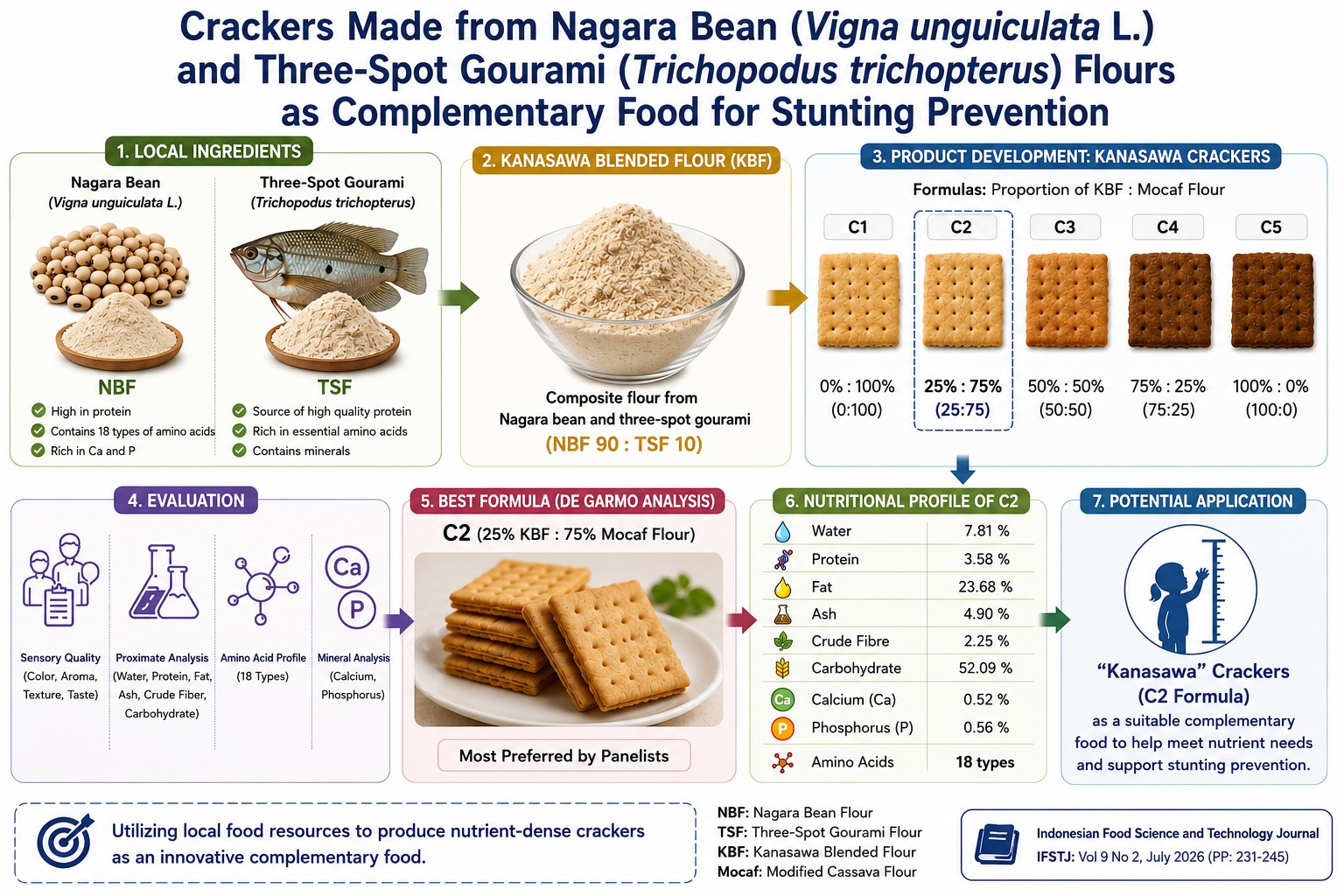
Nagara beans (Vigna unguiculata L.) (NB) and three-spot gourami (Trichopodus trichopterus) (TS) can be used as blended flour, namely “Kanasawa” blended flour (KBF). The KBF is developed into complementary food products, such as crackers, namely “Kanasawa Crackers”, to prevent stunting. This study aimed to investigate the sensory quality, proximate and amino acids profile, Calcium and Phosphorus levels of “Kanasawa Crackers” from KBF. This study is an experimental research that used a Complete Random Design with five formulas of proportion between KBF and mocaf flour, namely: C1 (0:100), C2 (25:75), C3 (50:50), C4 (75:25), C5 (100:0). The best crackers formula was selected using de Garmo analysis. The most preferred cracker product is C2. The best Kanasawa crackers formula consisted of 7.81% water, 3.58% protein, 23.68% fat, 4.90% ash, 2.25% crude fibre, 52.09% carbohydrate, 18 types of amino acid, 0.52% Calcium, and 0.56% Phosphorus. “Kanasawa Crackers” with a KBF-to-mocaf flour ratio of 25:75 are suitable as a complementary food to prevent stunting.
References
[1] E. F. Grathima, E. Yunitasari, and R. Indarwati, “The Impact Of Complementary Food Interventions On Adolescence Stunting Prevention: A Systematic Review,” Indonesian Journal of Community Health Nursing, vol. 9, no. 2, pp. 62–66, Aug. 2024, doi: https://doi.org/10.20473/ijchn.v9i2.47246.
[2] M. D. Andrestian, Z Dewi, N Oktiyani, and N Noraini, “‘Kanasawa’ composite flour from Nagara beans (Vigna unguiculata L.) and snake-skin gouramy fish (Trichopodus trichopterus) as calcium and phosphorus source,” IOP Conference Series Earth and Environmental Science, vol. 1482, no. 1, pp. 012041–012041, Apr. 2025, doi: https://doi.org/10.1088/1755-1315/1482/1/012041.
[3] R Hustiany, “Sustainability of protein potential in Nagara beans (Vigna unguiculata ssp Cylindrica) from South Kalimantan,” IOP Conference Series Earth and Environmental Science, vol. 1302, no. 1, pp. 012085–012085, Feb. 2024, doi: https://doi.org/10.1088/1755-1315/1302/1/012085.
[4] R Hustiany, “Sustainability of protein potential in Nagara beans (Vigna unguiculata ssp Cylindrica) from South Kalimantan,” IOP Conference Series Earth and Environmental Science, vol. 1302, no. 1, pp. 012085–012085, Feb. 2024, doi: https://doi.org/10.1088/1755-1315/1302/1/012085.
[5] M. D. Andrestian, Z Dewi, N Oktiyani, and N Noraini, “‘Kanasawa’ composite flour from Nagara beans (Vigna unguiculata L.) and snake-skin gouramy fish (Trichopodus trichopterus) as calcium and phosphorus source,” IOP Conference Series Earth and Environmental Science, vol. 1482, no. 1, pp. 012041–012041, Apr. 2025, doi: https://doi.org/10.1088/1755-1315/1482/1/012041.
[6] W. P. Putra, R. Nopianti, and H. Herpandi, “Kandungan Gizi dan Profil Asam Amino Tepung Ikan Sepat Siam (Trichigaster pectoralis),” Jurnal FishtecH, vol. 6, no. 2, pp. 174–185, Jul. 2018, doi: https://doi.org/10.36706/fishtech.v6i2.5849.
[7] Purnomo et al., “Three-Spot Gourami (Trichogaster trichopterus) Chips With Different And Duration Cooking Method,” DOAJ (DOAJ: Directory of Open Access Journals), Aug. 2022.
[8] H. Syandri, A. Azrita, E. Sumiarsih, and E. Elfiondri, “Nutrient loading and farm characteristics of giant gourami fish aquaculture systems in Lake Maninjau, Indonesia: basic knowledge of production performance,” F1000Research, vol. 10, pp. 378–378, Sep. 2021, doi: https://doi.org/10.12688/f1000research.52613.2.
[9] H. L. Hoon. "Composite flour as a new approach to improve the nutritional value of foods: Product quality challenges." 2018. 141-174.
[10] M. D. Andrestian, Z Dewi, N Oktiyani, and N Noraini, “‘Kanasawa’ composite flour from Nagara beans (Vigna unguiculata L.) and snake-skin gouramy fish (Trichopodus trichopterus) as calcium and phosphorus source,” IOP Conference Series Earth and Environmental Science, vol. 1482, no. 1, pp. 012041–012041, Apr. 2025, doi: https://doi.org/10.1088/1755-1315/1482/1/012041.
[11] M. D. Andrestian, Z Dewi, N Oktiyani, and N Noraini, “‘Kanasawa’ composite flour from Nagara beans (Vigna unguiculata L.) and snake-skin gouramy fish (Trichopodus trichopterus) as calcium and phosphorus source,” IOP Conference Series Earth and Environmental Science, vol. 1482, no. 1, pp. 012041–012041, Apr. 2025, doi: https://doi.org/10.1088/1755-1315/1482/1/012041.
[12] W. B. Nagessa, B. Chambal, and C. Macuamule, “Effects of processing methods on phytate and tannin content of black small common beans (Phaseolus vulgaris L.) cultivated in Mozambique,” Cogent Food & Agriculture, vol. 9, no. 2, 2023, doi: 10.1080/23311932.2023.2289713
[13] S. Abdallah, D. Yahaya, and M. Alhassan, “Effects of processing techniques on the nutritional quality of cowpea (Vigna unguiculata L.) varieties,” J. Agric. Food Environ., vol. 3, no. 2, pp. 34–39, 2022, doi: 10.47440/JAFE.2022.3207.
[14] B. H. Vagadia, S. K. Vanga, A. Singh, Y. Gariepy, and V. Raghavan, “Comparison of conventional and microwave treatment on soymilk for inactivation of trypsin inhibitors and in vitro protein digestibility,” Foods, vol. 7, no. 1, p. 6, 2018, doi: 10.3390/foods7010006.
[15] C. C. Tadini and J. A. W. Gut, “The importance of heating unit operations in the food industry to obtain safe and high-quality products,” Front. Nutr., vol. 9, p. 853638, 2022, doi: 10.3389/fnut.2022.853638.
[16] W. Ramadhani, I. Indrawan, and S. Seveline, “Formulasi Crackers Mocaf Dengan Penambahan Tepung Udang Rebon Serta Karakteristiknya,” Jurnal Bioindustri, vol. 4, no. 2, pp. 93–108, May 2022, doi: https://doi.org/10.31326/jbio.v4i2.1238
[17] E.P. De Garmo, W.G. Sullivan, Canada, J.R. Engineering Economy The 7th Edition Macamillan Publishing Comp. New York (1984)
[18] Badan Standardisasi Nasional, SNI 01-2891-1992: Cara Uji Makanan dan Minuman. Jakarta, Indonesia: Badan Standardisasi Nasional, 1992.
[19] Association of Official Analytical Chemists (AOAC), Official Methods of Analysis of AOAC International, 19th ed. Gaithersburg, MD, USA: AOAC International, 2012.
[20] Badan Standardisasi Nasional, SNI 01-2891-1992: Cara Uji Makanan dan Minuman. Jakarta, Indonesia: Badan Standardisasi Nasional, 1992.
[21] Badan Standardisasi Nasional, SNI 01-2891-1992: Cara Uji Makanan dan Minuman. Jakarta, Indonesia: Badan Standardisasi Nasional, 1992.
[22] Association of Official Analytical Chemists (AOAC), Official Methods of Analysis of AOAC International, 18th ed. Gaithersburg, MD, USA: AOAC International, 2005.
[23] Badan Standardisasi Nasional, SNI 01-2891-1992: Cara Uji Makanan dan Minuman. Jakarta, Indonesia: Badan Standardisasi Nasional, 1992.
[24] Association of Official Analytical Chemists (AOAC), Official Methods of Analysis of AOAC International, 18th ed. Gaithersburg, MD, USA: AOAC International, 2005.
[25] Badan Standardisasi Nasional, SNI 2970:2015: Biskuit. Jakarta, Indonesia: Badan Standardisasi Nasional, 2015.
[26] Badan Standardisasi Nasional, SNI 01-2891-1992: Cara Uji Makanan dan Minuman. Jakarta, Indonesia: Badan Standardisasi Nasional, 1992.
[27] Association of Official Analytical Chemists (AOAC), Official Methods of Analysis of AOAC International, 20th ed. Gaithersburg, MD, USA: AOAC International, 2015.
[28] Association of Official Analytical Chemists (AOAC), Official Methods of Analysis of AOAC International, 19th ed. Gaithersburg, MD, USA: AOAC International, 2012.
[29] ICI Instrument Method, In-House Method for Amino Acid Analysis. Jakarta, Indonesia: ICI Instrument, 1988.
[30] G. F. Ünal Şengör, M. O. Balaban, B. Topaloğlu, Z. Ayvaz, Z. Ceylan, and H. Doğruyol, “Color assessment by different techniques of gilthead seabream (Sparus aurata) during cold storage,” vol. 39, no. 3, pp. 696–703, Sep. 2019, doi: https://doi.org/10.1590/fst.02018.
[31] D. Arepally, R. S. Reddy, T. K. Goswami, and A. K. Datta, “Biscuit baking: A review,” LWT, vol. 131, p. 109726, 2020, doi: 10.1016/j.lwt.2020.109726.
[32] R. E. E. Tay, T. Agatha, G. Somang, O. Yuliarti, and E. L. L. Tan, “Structuring wheat flour-based crackers using whey protein isolate,” Int. Dairy J., vol. 128, p. 105314, 2022, doi: 10.1016/j.idairyj.2021.105314.
[33] Fatma Laili Khoirunnida, Harijono Harijono, S.-Y. Hu, and J. Lin, “Physicochemical Characteristics of Mocaf Flour and Rice Flour-Based Gluten-Free Cookies,” International Journal of Current Science Research and Review, vol. 07, no. 12, Dec. 2024, doi: https://doi.org/10.47191/ijcsrr/v7-i12-28.
[34] U. Ayu, W. Estuti, and U. Kunaepah. “Use of Local Food Ingredients MOCAF (Modified Cassava Flour) and Rebon (Planktonic Shrimp) in Cookies as an Alternative Supplementary Food for Children. International Journal of Innovation, Creativity and Change”. 2020. Special Edition: Safe Communities.
[35] M. D. Andrestian, Z Dewi, N Oktiyani, and N Noraini, “‘Kanasawa’ composite flour from Nagara beans (Vigna unguiculata L.) and snake-skin gouramy fish (Trichopodus trichopterus) as calcium and phosphorus source,” IOP Conference Series Earth and Environmental Science, vol. 1482, no. 1, pp. 012041–012041, Apr. 2025, doi: https://doi.org/10.1088/1755-1315/1482/1/012041.
[36] J. Lee, S. Roux, E. Le Roux, S. Keller, B. Rega, and C. Bonazzi, “Unravelling caramelization and Maillard reactions in glucose and glucose + leucine model cakes: Formation and degradation kinetics of precursors, α-dicarbonyl intermediates and furanic compounds during baking,” Food Chemistry, vol. 376, p. 131917, May 2022, doi: https://doi.org/10.1016/j.foodchem.2021.131917
[37] H. Cheng, J. Mei, and J. Xie, “Analysis of key volatile compounds and quality properties of tilapia (Oreochromis mossambicus) fillets during cold storage: Based on thermal desorption coupled with gas chromatography-mass spectrometry (TD-GC-MS),” LWT, vol. 184, p. 115051, Jul. 2023, doi: https://doi.org/10.1016/j.lwt.2023.115051.
[38] I. Djekic, J. M. Lorenzo, P. E. S. Munekata, M. Gagaoua, and I. Tomasevic, “Review on characteristics of trained sensory panels in food science,” Journal of Texture Studies, vol. 52, no. 4, pp. 501–509, Jun. 2021, doi: https://doi.org/10.1111/jtxs.12616.
[39] Sandra, L. G. Dias, and A. Teixeira, “Emerging Methods for the Evaluation of Sensory Quality of Food: Technology at Service,” Current Food Science and Technology Reports, Jan. 2024, doi: https://doi.org/10.1007/s43555-024-00019-7
[40] A. Noviana, E. Palupi, P.E. Giriwono, and R. Rimbawan, “Decreasing fishy odour from catfish (Clarias sp.) flour as a food ingredient by using various soaking solutions,” Food Research, vol. 8, no. 1, pp. 349–358, Feb. 2024, doi: https://doi.org/10.26656/fr.2017.8(1).123
[41] J. Luo, D. Frank, and J. Arcot, “Creating alternative seafood flavour from non-animal ingredients: A review of key flavour molecules relevant to seafood,” Food Chemistry X, pp. 101400–101400, Apr. 2024, doi: https://doi.org/10.1016/j.fochx.2024.101400.
[42] H. Phetsang, W. Panpipat, A. Panya, N. Phonsatta, and M. Chaijan, “Occurrence and Development of Off-Odor Compounds in Farmed Hybrid Catfish (Clarias macrocephalus × Clarias gariepinus) Muscle during Refrigerated Storage: Chemical and Volatilomic Analysis,” Foods, vol. 10, no. 8, pp. 1841–1841, Aug. 2021, doi: https://doi.org/10.3390/foods10081841.
[43] M. Liu, X. Zhao, M. Zhao, X. Liu, Y. Pang, and M. Zhang, “Characterization of the Key Aroma Constituents in Fried Tilapia through the Sensorics Concept,” Foods, vol. 11, no. 4, p. 494, Feb. 2022, doi: https://doi.org/10.3390/foods11040494.
[44] H. Cheng, J. Mei, and J. Xie, “Analysis of key volatile compounds and quality properties of tilapia (Oreochromis mossambicus) fillets during cold storage: Based on thermal desorption coupled with gas chromatography-mass spectrometry (TD-GC-MS),” LWT, vol. 184, p. 115051, Jul. 2023, doi: https://doi.org/10.1016/j.lwt.2023.115051.
[45] C. Trindler, K. Annika Kopf-Bolanz, and C. Denkel, “Aroma of peas, its constituents and reduction strategies – Effects from breeding to processing,” Food Chemistry, vol. 376, p. 131892, May 2022, doi: https://doi.org/10.1016/j.foodchem.2021.131892.
[46] A. Karolkowski, E. Guichard, L. Briand, and C. Salles, “Volatile Compounds in Pulses: A Review,” Foods, vol. 10, no. 12, p. 3140, Dec. 2021, doi: https://doi.org/10.3390/foods10123140.
[47] T. Manouel, B. G. Subasi, and M. Abdollahi, “Impacts of Harvest Year and Cultivation Location on Off-Flavor Compounds and Functionality of Pea Protein Isolate,” Foods, vol. 13, no. 21, pp. 3423–3423, Oct. 2024, doi: https://doi.org/10.3390/foods13213423.
[48] A. Karolkowski, E. Guichard, L. Briand, and C. Salles, “Volatile Compounds in Pulses: A Review,” Foods, vol. 10, no. 12, p. 3140, Dec. 2021, doi: https://doi.org/10.3390/foods10123140.
[49] P. Khrisanapant, B. Kebede, S. Y. Leong, and I. Oey, “Effects of Hydrothermal Processing on Volatile and Fatty Acids Profile of Cowpeas (Vigna unguiculata), Chickpeas (Cicer arietinum) and Kidney Beans (Phaseolus vulgaris),” Molecules/Molecules online/Molecules annual, vol. 27, no. 23, pp. 8204–8204, Nov. 2022, doi: https://doi.org/10.3390/molecules27238204.
[50] G. Kapravelou, R. Martínez, J. Martino, J. Porres, and I. Fernández-Fígares, “Natural Fermentation of Cowpea (Vigna unguiculata) Flour Improves the Nutritive Utilization of Indispensable Amino Acids and Phosphorus by Growing Rats,” Nutrients, vol. 12, no. 8, pp. 2186–2186, Jul. 2020, doi: https://doi.org/10.3390/nu12082186
[51] S. Rustagi, “Food Texture and Its Perception, Acceptance and Evaluation,” Biosciences Biotechnology Research Asia, vol. 17, no. 03, pp. 651–658, Sep. 2020, doi: https://doi.org/10.13005/bbra/2869.
[52] B. N. Gürbüz, L. M. Pastrana, R. N. Pereira, and M. A. Cerqueira, “Alternative Protein-Based Meat and Fish Analogs by Conventional and Novel Processing Technologies: A Systematic Review and Bibliometric Analysis,” Foods, vol. 14, no. 3, p. 498, Feb. 2025, doi: https://doi.org/10.3390/foods14030498.
[53] N. Buamard, A. Singh, and S. Benjakul, “Improvement of Surimi Gel Quality Using Protein Cross-Linker, Hydrocolloids and Protease Inhibitor,” Turkish Journal of Fisheries and Aquatic Sciences, vol. 24, no. 3, Jan. 2024, doi: https://doi.org/10.4194/trjfas24808.
[54] H. Herdina, A. Putri, E. Handayani, S. Rohmawati, N. K. Isfanaya, and T. Sopandi. “Evaluation of the Nutritional Composition of Fish Meal Production”. SSRG International Journal of Agriculture & Environmental Science. 2024. Volume 11 Issue 4, 42-46.
[55] P. Petikirige, J. Jasmine, A. Karim, and G. Millar. “Review: Effect of drying techniques on quality and sensory properties of tropical fruits”. International Journal of Food Science and Technology. 2022. 57, 6963–6979.
[56] E. M. Gonçalves et al., “Influence of Air-Drying Conditions on Quality, Bioactive Composition and Sensorial Attributes of Sweet Potato Chips,” Foods, vol. 12, no. 6, p. 1198, Jan. 2023, doi: https://doi.org/10.3390/foods12061198.
[57] N. Nurfaidah, A. N. Asikin, K. Kasmiati, and A. Angraeni, “Amino acid profile and potential utilization purposes of albumin from four types of freshwater fish in Makassar, South Sulawesi, Indonesia,” Biodiversitas Journal of Biological Diversity, vol. 25, no. 11, Nov. 2024, doi: https://doi.org/10.13057/biodiv/d251119.
[58] Z. J. Artina, D. F. Ayu, and Rahmayuni Rahmayuni, “The Crackers of Modified Cassava Flour (MOCAF) and Cowpea Flour: Chemical and Sensory Properties,” Agritekno: Jurnal Teknologi Pertanian, vol. 12, no. 1, pp. 57–64, Mar. 2023, doi: https://doi.org/10.30598/jagritekno.2023.12.1.57.
[59] B. Syed, Dr. K. Gadhe, Dr. V. Pawar, R. Dhabale, and R. Pandey, “Development and sensory evaluation of bakery products incorporated with pearl millet and cowpea flour,” International Journal of Advanced Biochemistry Research, vol. 8, no. 10, pp. 648–651, Oct. 2024, doi: https://doi.org/10.33545/26174693.2024.v8.i10i.2572.
[60] S. R. Kesselly, R. Mugabi, and Y. B. Byaruhanga, “Effect of soaking and extrusion on functional and pasting properties of cowpeas flour,” Scientific African, vol. 19, p. e01532, Mar. 2023, doi: https://doi.org/10.1016/j.sciaf.2022.e01532.
[61] N. Belc, D. E. Duta, A. Culetu, and G. D. Stamatie, “Type and Amount of Legume Protein Concentrate Influencing the Technological, Nutritional, and Sensorial Properties of Wheat Bread,” Applied Sciences, vol. 11, no. 1, p. 436, Jan. 2021, doi: https://doi.org/10.3390/app11010436.
[62] K. Arora dkk. , “Karakteristik fisikokimia, nutrisi, dan fungsional bahan bebas gluten serta dampaknya terhadap tekstur roti,” vol. 177, hlm. 114566–114566, Maret 2023, doi: https://doi.org/10.1016/j.lwt.2023.114566.
[63] N. Goldstein and R. Reifen, “The potential of legume-derived proteins in the food industry,” Grain & Oil Science and Technology, vol. 5, no. 4, Jun. 2022, doi: https://doi.org/10.1016/j.gaost.2022.06.002
[64] T. Bojňanská, J. Musilová, and A. Vollmannová, “Effects of Adding Legume Flours on the Rheological and Breadmaking Properties of Dough,” Foods, vol. 10, no. 5, p. 1087, May 2021, doi: https://doi.org/10.3390/foods10051087.
[65] Hasmadi, M., Noorfarahzilah, M., Noraidah, H., Zainol, M. K., & Jahurul, M. H. A. (2020). Functional properties of composite flour: A review. Food Research, 4(6), 1820-1831.
[66] A. Aydogdu, G. Sumnu, and S. Sahin, “Effects of addition of different fibers on rheological characteristics of cake batter and quality of cakes,” Journal of Food Science and Technology, vol. 55, no. 2, pp. 667–677, Dec. 2017, doi: https://doi.org/10.1007/s13197-017-2976-y.
[67] T. Bojňanská, J. Musilová, and A. Vollmannová, “Effects of Adding Legume Flours on the Rheological and Breadmaking Properties of Dough,” Foods, vol. 10, no. 5, p. 1087, May 2021, doi: https://doi.org/10.3390/foods10051087
[68] Chaima Neji, Jyoti Semwal, Endre Máthé, and Péter Sípos, “Dough Rheological Properties and Macronutrient Bioavailability of Cereal Products Fortified through Legume Proteins,” Processes, vol. 11, no. 2, pp. 417–417, Jan. 2023, doi: https://doi.org/10.3390/pr11020417.
[69] E. M. Gonçalves et al., “Influence of Air-Drying Conditions on Quality, Bioactive Composition and Sensorial Attributes of Sweet Potato Chips,” Foods, vol. 12, no. 6, p. 1198, Jan. 2023, doi: https://doi.org/10.3390/foods12061198
[70] H. Gliguem, F. Khamassi, A. Hanafi, W. Hajji, M. H. Esseghaier, and S. Bellagha, “Legume Flour Enrichment of Cereal Products: Effects on Consumer Perception and Physical Quality,” Acta Scientifci Nutritional Health, vol. 6, no. 1, pp. 03-14, Jan. 2022, doi: https://doi.org/10.31080/asnh.2022.06.0972.
[71] N. S. Affrifah, R. D. Phillips, and F. K. Saalia, “Cowpeas: Nutritional profile, processing methods and products—A review,” Legume Science, vol. 4, no. 3, Nov. 2021, doi: https://doi.org/10.1002/leg3.131.
[72] N. A. Mahmudah et al., “Potential of Leucaena leucocephala (white leadtree) seed flour as a functional food with umami taste,” Food Research, vol. 8, no. 4, pp. 53–60, Jul. 2024, doi: https://doi.org/10.26656/fr.2017.8(4).318.
[73] N. A. Mahmudah et al., “Potential of Leucaena leucocephala (white leadtree) seed flour as a functional food with umami taste,” Food Research, vol. 8, no. 4, pp. 53–60, Jul. 2024, doi: https://doi.org/10.26656/fr.2017.8(4).318.
[74] H. J. Clarke, W. P. McCarthy, M. G. O’Sullivan, J. P. Kerry, and K. N. Kilcawley, “Oxidative Quality of Dairy Powders: Influencing Factors and Analysis,” Foods, vol. 10, no. 10, p. 2315, Sep. 2021, doi: https://doi.org/10.3390/foods10102315.
[75] T. Wu, M. Wang, P. Wang, H. Tian, and P. Zhan, “Advances in the Formation and Control Methods of Undesirable Flavors in Fish,” Foods, vol. 11, no. 16, p. 2504, Aug. 2022, doi: https://doi.org/10.3390/foods11162504.
[76] A. Noviana, E. Palupi, P.E. Giriwono, and R. Rimbawan, “Decreasing fishy odour from catfish (Clarias sp.) flour as a food ingredient by using various soaking solutions,” Food Research, vol. 8, no. 1, pp. 349–358, Feb. 2024, doi: https://doi.org/10.26656/fr.2017.8(1).123.
[77] T. Aspevik, S. Steinsholm, B. Vang, M. Carlehög, J. A. Arnesen, and K. Kousoulaki, “Nutritional and Sensory Properties of Protein Hydrolysates Based on Salmon (Salmo salar), Mackerel (Scomber scombrus), and Herring (Clupea harengus) Heads and Backbones,” Frontiers in Nutrition, vol. 8, Dec. 2021, doi: https://doi.org/10.3389/fnut.2021.695151.
[78] M. Vogelsang-O’Dwyer, A. W. Sahin, E. K. Arendt, and E. Zannini, “Enzymatic Hydrolysis of Pulse Proteins as a Tool to Improve Techno-Functional Properties,” Foods, vol. 11, no. 9, p. 1307, Apr. 2022, doi: https://doi.org/10.3390/foods11091307.
[79] A. Karolkowski, E. Guichard, L. Briand, and C. Salles, “Volatile Compounds in Pulses: A Review,” Foods, vol. 10, no. 12, p. 3140, Dec. 2021, doi: https://doi.org/10.3390/foods10123140
[80] A. Noviana, E. Palupi, P.E. Giriwono, and R. Rimbawan, “Decreasing fishy odour from catfish (Clarias sp.) flour as a food ingredient by using various soaking solutions,” Food Research, vol. 8, no. 1, pp. 349–358, Feb. 2024, doi: https://doi.org/10.26656/fr.2017.8(1).123
[81] J. Luo, D. Frank, and Jayashree Arcot, “Creating alternative seafood flavour from non-animal ingredients: A review of key flavour molecules relevant to seafood,” Food Chemistry X, pp. 101400–101400, Apr. 2024, doi: https://doi.org/10.1016/j.fochx.2024.101400
[82] H. Phetsang, W. Panpipat, A. Panya, N. Phonsatta, and M. Chaijan, “Occurrence and Development of Off-Odor Compounds in Farmed Hybrid Catfish (Clarias macrocephalus × Clarias gariepinus) Muscle during Refrigerated Storage: Chemical and Volatilomic Analysis,” Foods, vol. 10, no. 8, pp. 1841–1841, Aug. 2021, doi: https://doi.org/10.3390/foods10081841.
[83] M. Mozzon, R. Foligni, C. Mannozzi, and S. Vittori, “Assessment of lipid oxidation in fish and fish products processed by cold plasma technologies,” Applied Food Research, vol. 4, no. 2, p. 100646, Dec. 2024, doi: https://doi.org/10.1016/j.afres.2024.100646.
[84] X. Miao, S. Li, S. Shang, N. Sun, X. Dong, and P. Jiang, “Characterization of volatile flavor compounds from fish maw soaked in five different seasonings,” Food Chemistry: X, vol. 19, p. 100805, Jul. 2023, doi: https://doi.org/10.1016/j.fochx.2023.100805.
[85] H. Phetsang, W. Panpipat, A. Panya, N. Phonsatta, and M. Chaijan, “Occurrence and Development of Off-Odor Compounds in Farmed Hybrid Catfish (Clarias macrocephalus × Clarias gariepinus) Muscle during Refrigerated Storage: Chemical and Volatilomic Analysis,” Foods, vol. 10, no. 8, pp. 1841–1841, Aug. 2021, doi: https://doi.org/10.3390/foods10081841.
[86] Badjona, Abraham, et al. "Faba bean flavor effects from processing to consumer acceptability." Foods 12.11 (2023): 2237.
[87] A. Lippolis, Roland, Ornela Bocova, L. Pouvreau, and L. M. Trindade, “The challenge of breeding for reduced off-flavor in faba bean ingredients,” Frontiers in plant science, vol. 14, Oct. 2023, doi: https://doi.org/10.3389/fpls.2023.1286803.
[88] De Garmo, E.P., Sullivan W.G., Canada, J.R. Engineering Economy The 7th Edition Macamillan Publishing Comp. New York (1984).
[89] K. M. Appleton et al., “Sensory and physical characteristics of foods that impact food intake without affecting acceptability: Systematic review and meta‐analyses,” Obesity Reviews, vol. 22, no. 8, Mar. 2021, doi: https://doi.org/10.1111/obr.13234.
[90] B. K. Abebe and M. T. Alemayehu, “A review of the nutritional use of cowpea (Vigna unguiculata L. Walp) for human and animal diets,” Journal of Agriculture and Food Research, vol. 10, p. 100383, Dec. 2022, doi: https://doi.org/10.1016/j.jafr.2022.100383.
[91] A. H. Bakare et al., “Nutritional, Texture, and Sensory Properties of composite biscuits produced from breadfruit and wheat flours enriched with edible fish meal,” Food Science & Nutrition, vol. 8, no. 11, pp. 6226–6246, Nov. 2020, doi: https://doi.org/10.1002/fsn3.1919.
[92] Badan Standarisasi Nasional. 2011. SNI 01-2973. Syarat Mutu Cookies. BSN. Jakarta
[93] S. Réhault-Godbert, N. Guyot, and Y. Nys, “The golden egg: Nutritional value, bioactivities, and emerging benefits for human health,” Nutrients, vol. 11, no. 3, p. 684, 2019, doi: 10.3390/nu11030684.
[94] J. Painter, “A nutritional and environmental impact comparison of skim dairy milk and plant beverages: A review,” Med. Res. Arch., vol. 13, no. 4, 2025, doi: 10.18103/mra.v13i4.6498.
[95] C. Weber, L. Harnack, A. Johnson, B. Jasthi, J. Pettit, and J. Stevenson, “Nutrient comparisons of margarine/margarine-like products, butter blend products and butter in the US marketplace in 2020 post-FDA ban on partially hydrogenated oils,” Public Health Nutr., vol. 25, no. 5, pp. 1–8, 2021, doi: 10.1017/S1368980021004511.
[96] Z. Kusnul and E. Rahmawati, “Pendampingan Keluarga Balita dalam Pemenuhan Nutrisi pada Anak Beresiko Stunting Di Dusun Cangkring Desa Pelem Kecamatan Pare Kabupaten Kediri,” Jurnal Abdimas Pamenang, vol. 1, no. 1, pp. 5–9, Dec. 2022, doi: https://doi.org/10.53599/jap.v1i1.119.
[97] K. Giannoutsos, D. I. Koukoumaki, V. Bountziouka, T. Poriazi, M. Papageorgiou, D. Sarris, K. Gkatzionis, and E. Naziri, “Quality properties of crackers enriched with composite flours: Effect on dough and final product,” Appl. Sci., vol. 15, no. 23, p. 12361, 2025, doi: 10.3390/app152312361.
[98] Badan Standardisasi Nasional. 1992. Standar Nasional Indonesia (SNI): Mutu dan Cara Uji Biskuit. Jakarta: Badan Standardisasi Nasional.
[99] H. Mamat and S. E. Hill, “Effect of fat types on the structural and textural properties of dough and semi-sweet biscuit,” J. Food Sci. Technol., vol. 51, no. 9, pp. 1998–2005, 2014, doi: 10.1007/s13197-012-0708-x.
[100] D. M. Abebe and E. O. Keyata, “Effects of blending ratios and baking temperature on physicochemical properties and sensory acceptability of biscuits prepared from pumpkin, common bean, and wheat composite flour,” Heliyon, vol. 8, no. 10, p. e10848, 2022, doi: 10.1016/j.heliyon.2022.e10848.
[101] E. A. Irondi, K. K. Olatoye, H. T. Abdulameed, et al., “Physicochemical, in vitro starch digestibility and sensory characteristics of biofortified yellow maize–cowpea composite flours and biscuits,” Food Prod. Process. Nutr., vol. 6, p. 15, 2024, doi: 10.1186/s43014-023-00201-9.
[102] Z. Kusnul and E. Rahmawati, “Pendampingan Keluarga Balita dalam Pemenuhan Nutrisi pada Anak Beresiko Stunting Di Dusun Cangkring Desa Pelem Kecamatan Pare Kabupaten Kediri,” Jurnal Abdimas Pamenang, vol. 1, no. 1, pp. 5–9, Dec. 2022, doi: https://doi.org/10.53599/jap.v1i1.119.
[103] A. E. Ujong, N. J. T. Emelike, F. I. Woka, and F. O. JNR, “Formulation of fiber enriched crackers biscuit: Effect on nutritional composition, physical and sensory properties,” Heliyon, vol. 9, p. e15941, 2023, doi: 10.1016/j.heliyon.2023.e15941.
[104] A. Abdullah, N. Nurjanah, A. V. Seulalae, and A. N. Firdaos, “Chemical composition, mineral, and vitamin of prebiotic crackers with addition of seaweed salt,” J. Pengolahan Hasil Perikanan Indones., vol. 26, no. 1, pp. 153–163, 2023, doi: 10.17844/.
[105] A. E. Ujong, N. J. T. Emelike, F. I. Woka, and F. O. JNR, “Formulation of fiber enriched crackers biscuit: Effect on nutritional composition, physical and sensory properties,” Heliyon, vol. 9, p. e15941, 2023, doi: 10.1016/j.heliyon.2023.e15941.
[106] C. R. Utami and N. Fitriyani, “Antioxidant activity and organoleptic quality of crackers with differences in the addition of black glutinous tape and baking powder,” J. Nat. Sci. Learn., vol. 2, no. 2, pp. 1–9, 2023, doi: 10.30742/jnsl.v2i2.85.
[107] A. E. Ujong, N. J. T. Emelike, F. I. Woka, and F. O. JNR, “Formulation of fiber enriched crackers biscuit: Effect on nutritional composition, physical and sensory properties,” Heliyon, vol. 9, p. e15941, 2023, doi: 10.1016/j.heliyon.2023.e15941.
[108] M. H. J. Shovon, D. A. Khan, M. M. I. Tareq, et al., “A comprehensive assessment of VCAN transcriptional expression and evaluation as an effective prognostic biomarker against breast cancer: In silico study,” Bull. Natl. Res. Cent., vol. 47, p. 83, 2023, doi: 10.1186/s42269-023-01062-5.
[109] Y. Sutriono and U. Pato, “Pemanfaatan Buah Terung Belanda dan Kulit Pisang Kepok dalam Pembuatan Selai,” Jurnal Online Mahasiswa Fakultas Pertanian Universitas Riau, vol. 3, no. 2, pp. 1–13, Nov. 2016.
[110] T. T. T. Tran, L. H. N. Ngo, N. M. N. Ton, T. H. N. Le, T. T. Le, and V. V. M. Le, “High-fiber crackers supplemented with asparagus hard-stem: Impacts of supplementation ratios and water amounts in cracker recipe on the product quality,” Pol. J. Food Nutr. Sci., vol. 74, no. 2, pp. 162–168, 2024, doi: 10.31883/pjfns/188110.
[111] A. E. Ujong, N. J. T. Emelike, F. I. Woka, and F. O. JNR, “Formulation of fiber enriched crackers biscuit: Effect on nutritional composition, physical and sensory properties,” Heliyon, vol. 9, p. e15941, 2023, doi: 10.1016/j.heliyon.2023.e15941.
[112] S. Lin, “Dietary fiber in bakery products: Source, processing, and function,” in Advances in Food and Nutrition Research, vol. 99, W. Zhou and J. Gao, Eds. Academic Press, 2022, pp. 37–100, doi: 10.1016/bs.afnr.2021.12.001.
[113] S. N. Utami et al., “Characteristics of crackers fortified with the sailfin catfish (Pterygoplichthys pardalis) bone meal,” Egypt. J. Aquat. Biol. Fish., vol. 28, no. 4, pp. 401–414, 2024, doi: 10.21608/ejabf.2024.368365.
[114] A. T. Idowu, S. Benjakul, S. Sinthusamran, J. Pongsetkul, T. Sae-Leaw, and P. Sookchoo, “Whole wheat cracker fortified with biocalcium and protein hydrolysate powders from salmon frame: Characteristics and nutritional value,” Food Qual. Saf., vol. 3, no. 3, pp. 191–199, 2019, doi: 10.1093/fqsafe/fyz012.
[115] S. N. Utami et al., “Characteristics of crackers fortified with the sailfin catfish (Pterygoplichthys pardalis) bone meal,” Egypt. J. Aquat. Biol. Fish., vol. 28, no. 4, pp. 401–414, 2024, doi: 10.21608/ejabf.2024.368365.
[116] S. Benjakul and S. Karnjanapratum, “Characteristics and nutritional value of whole wheat cracker fortified with tuna bone bio-calcium powder,” Food Chem., vol. 259, pp. 181–187, 2018, doi: 10.1016/j.foodchem.2018.03.124.
[117] M. M. Salama, S. M. Ghanem, M. M. Kadry, et al., “Utilization of chicken eggshells as a source of calcium to enhance the nutritional value and quality characteristics of crackers,” Discov. Food, vol. 5, p. 167, 2025, doi: 10.1007/s44187-025-00467-7.
[118] Z. Mushthofa, & S. Achadiyah, Perbandingan Tepung Mocaf dan Tepung Tapioka dalam Pembuatan Siomai dengan Penambahan Tepung Jamur Tiram (Pleurotus ostreatus) sebagai Sumber Protein. Agroforetech, 2023. 1(2), 1147-1168.
[119] E. M. Sari, M. Juffrie, N. Nurani, and M. N. Sitaresmi, “Asupan protein, kalsium dan fosfor pada anak stunting dan tidak stunting usia 24-59 bulan,” Jurnal Gizi Klinik Indonesia, vol. 12, no. 4, p. 152, Apr. 2016, doi: https://doi.org/10.22146/ijcn.23111.
[120] B. Shkembi and T. Huppertz, “Calcium Absorption from Food Products: Food Matrix Effects,” Nutrients, vol. 14, no. 1, p. 180, Dec. 2021, doi: https://doi.org/10.3390/nu14010180.
[121] C. E. Suksesty, H. Hikmah, and E. M. Afrilia, “Efektifitas Program Pemberian Makanan Tambahan Menggunakan Kombinasi Jus Kacang Hijau Dan Telur Ayam Rebus Terhadap Perubahan Status Gizi Stunting Di Kabupaten Pandeglang,” IMJ (Indonesian Midwifery Journal), vol. 3, no. 2, Jan. 2020, doi: https://doi.org/10.31000/imj.v3i2.3869.
[122] E. M. Sari, M. Juffrie, N. Nurani, and M. N. Sitaresmi, “Asupan protein, kalsium dan fosfor pada anak stunting dan tidak stunting usia 24-59 bulan,” Jurnal Gizi Klinik Indonesia, vol. 12, no. 4, p. 152, Apr. 2016, doi: https://doi.org/10.22146/ijcn.23111.
[123] A. Sulistianingsih and D. Ari, “Kurangnya Asupan Makan Sebagai Penyebab Kejadian Balita Pendek (Stunting),” vol. 5, no. 1, p. 77123, Jan. 2016.
Downloads
Published
Issue
Section
License
Copyright (c) 2026 Indonesian Food Science and Technology Journal

This work is licensed under a Creative Commons Attribution 4.0 International License.