Chemical Characteristics, Glycemic Index, and Glycemic Load of Instant Potato Cream Soup with Quail Egg Flour, Tempeh, Soy Protein Isolate
DOI:
https://doi.org/10.22437/ifstj.v9i2.46581Abstract
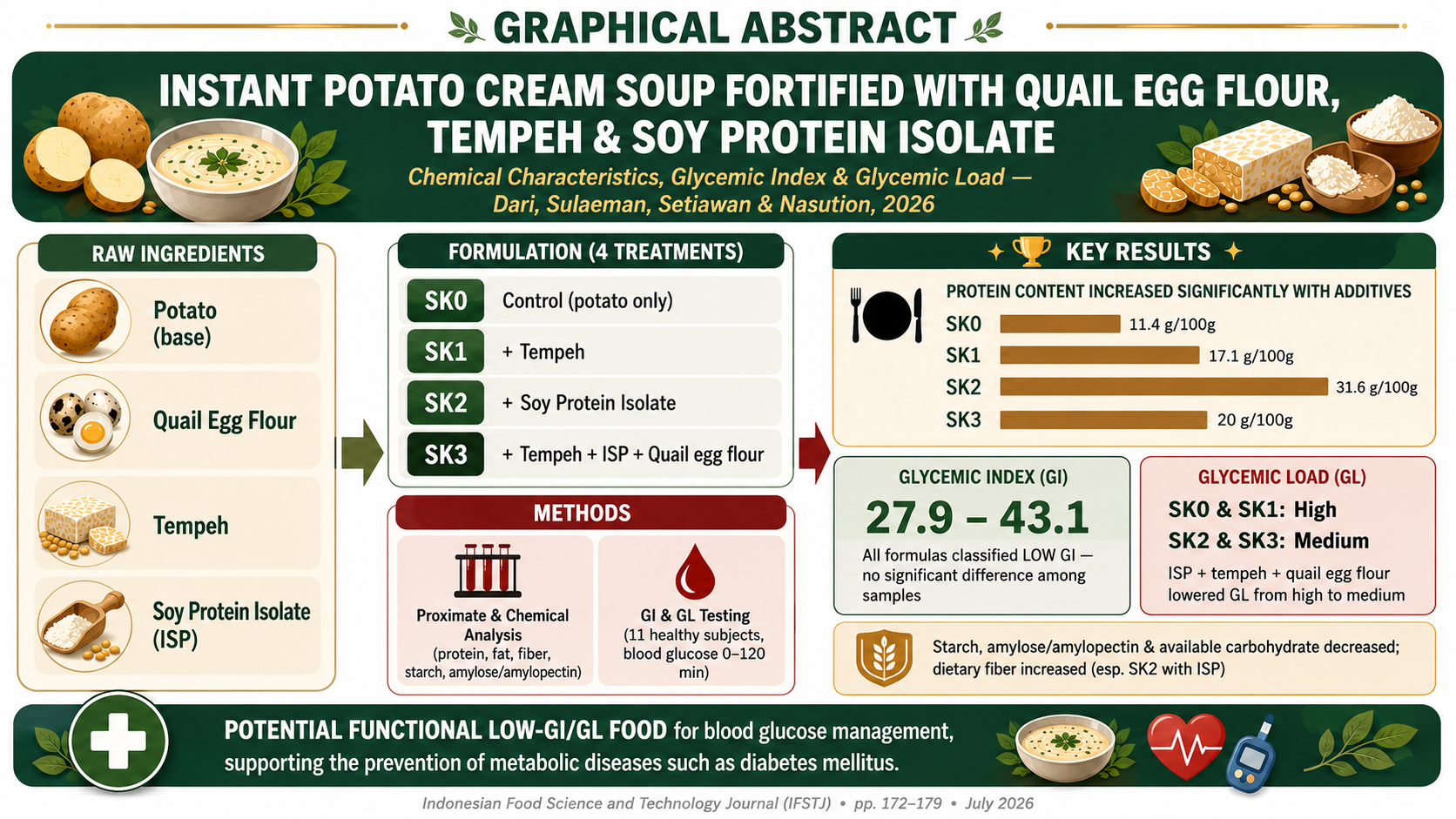
Managing blood glucose levels by selecting foods with a low glycemic index (GI) and glycemic load (GL) is important in preventing and controlling metabolic diseases such as diabetes mellitus. This study aimed to determine the chemical characteristics, GI, and GL of four instant potato cream soup formulations using quail egg flour, tempeh, and soy protein isolate (ISP) as additives. Adding these ingredients aims to increase the product's nutritional content and modify its glycemic response. This study used an experimental design with a complete randomized design (CRD). The results showed that adding tempeh, ISP, and quail egg flour increased the products' protein and dietary Fiber proportion. The GI values of the four products were low. High GI values were found in the control formulation (SK0) and SK1 (tempeh addition). Formulations with the addition of ISP (SK2) and SK3, as well as tempeh, ISP, and quail egg flour, produced medium-category GL and have the potential to support more effective blood glucose management. In conclusion, this modification has potential in the development of innovative functional food products based on natural ingredients that are healthier and suitable for blood sugar management, as well as supporting the prevention of metabolic diseases.References
[1] Y. L. Ou, M. Y. Lee, I. T. Lin, W. L. Wen, W. H. Hsu, and S. C. Chen, “Obesity-related indices are associated with albuminuria and advanced kidney disease in type 2 diabetes mellitus,” Ren. Fail., vol. 43, no. 1, pp. 1250–1258, 2021, doi: 10.1080/0886022X.2021.1969247.
[2] M. Peres, H. S. Costa, M. A. Silva, and T. G. Albuquerque, “The Health Effects of Low Glycemic Index and Low Glycemic Load Interventions on Prediabetes and Type 2 Diabetes Mellitus: A Literature Review of RCTs,” Dec. 01, 2023, Multidisciplinary Digital Publishing Institute (MDPI). doi: 10.3390/nu15245060.
[3] I. Kalaitzopoulou, X. Theodoridis, E. Kotzakioulafi, K. Evripidou, and M. Chourdakis, “The Effectiveness of a Low Glycemic Index/Load Diet on Cardiometabolic, Glucometabolic, and Anthropometric Indices in Children with Overweight or Obesity: A Systematic Review and Meta-Analysis,” Children, vol. 10, p. 1481, Jan. 2023, doi: 10.3390/children10091481.
[4] C. H. Crisosto, I. R. Donis-Gonzalez, S. C. Wang, and B. D. Lampinen, “Removing English Walnut (Juglans Regia) Ready-to-Use Shelled Walnuts Consumption Barriers,” Aug. 01, 2023, Multidisciplinary Digital Publishing Institute (MDPI). doi: 10.3390/horticulturae9080891.
[5] L. Smith et al., “Food insecurity (hunger) and fast-food consumption among 180 164 adolescents aged 12-15 years from sixty-eight countries,” British Journal of Nutrition, vol. 127, no. 3, pp. 470–477, Feb. 2022, doi: 10.1017/S0007114521001173.
[6] V. Fajardo et al., “Updated food composition database for cereal-based gluten free products in spain: Is reformulation moving on?,” Nutrients, vol. 12, no. 8, pp. 1–17, Aug. 2020, doi: 10.3390/nu12082369.
[7] D. F. Willer, R. J. Nicholls, and D. C. Aldridge, “Opportunities and challenges for upscaled global bivalve seafood production,” Nat. Food, vol. 2, no. 12, pp. 935–943, 2021, doi: 10.1038/s43016-021-00423-5.
[8] W. Puspita, A. Sulaeman, and E. Damayanthi, “Snack bar berbahan pati sagu (Metroxylon sp.), tempe, dan beras hitam sebagai pangan fungsional berindeks glikemik rendah,” 2019. [Online]. Available: https://ejournal.undip.ac.id/index.php/jgi/
[9] R. P. Damayati, K. Roosita, and A. Sulaeman, “Effect of Galohgor Cookies and Powder Drinks on Visceral Adipose Tissue and Lipid Profile in Patients with Type 2 Diabetes Mellitus,” Jurnal Gizi dan Pangan, vol. 13, no. 3, pp. 137–144, Nov. 2018, doi: 10.25182/jgp.2018.13.3.137-144.
[10] B. Setiawan, S. S. Aulia, T. Sinaga, and A. Sulaeman, “Nutritional content and characteristics of pumpkin cream soup with Tempeh addition as supplementary food for elderly,” Int. J. Food Sci., vol. 2021, 2021, doi: 10.1155/2021/6976357.
[11] S. Maya, A. Sulaeman, and T. Sinaga, “Alternative Snack for Diabetic Patients from Sago (Metroxylon sp.) Starch and Tempe,” Jurnal Gizi dan Pangan, pp. 27–36, Mar. 2020, doi: 10.25182/jgp.2020.15.1.27-36.
[12] W. S. Irwan, B. Setiawan, and A. Sulaeman, “The potential of instant pumpkin based soup in diabetic treatment,” Proceedings of the Nutrition Society, vol. 82, no. OCE1, 2023, doi: 10.1017/s0029665123000198.
[13] S. A. Fleming and J. R. Morris, “Perspective: Potatoes, Quality Carbohydrates, and Dietary Patterns,” Advances in Nutrition, vol. 15, no. 1, Jan. 2024, doi: 10.1016/j.advnut.2023.10.010.
[14] M. K. Lal et al., “Impact of Starch Storage Condition on Glycemic Index and Resistant Starch of Cooked Potato (Solanum tuberosum) Tubers,” Starch - Stärke, vol. 73, no. 1–2, p. 1900281, 2021, doi: https://doi.org/10.1002/star.201900281.
[15] F. G. do Prado, M. G. B. Pagnoncelli, G. V. de Melo Pereira, S. G. Karp, and C. R. Soccol, “Fermented Soy Products and Their Potential Health Benefits: A Review,” Aug. 01, 2022, MDPI. doi: 10.3390/microorganisms10081606.
[16] C. A. A. Amadeu, S. M. Martelli, and F. M. Vanin, “Nutritional aspects of composite flours for baked and extruded products: A review,” Cereal Chem., 2024, [Online]. Available: https://api.semanticscholar.org/CorpusID:267708906
[17] K. K. Ma, L. Grossmann, A. A. Nolden, D. J. McClements, and A. J. Kinchla, “Functional and physical properties of commercial pulse proteins compared to soy derived protein,” Future Foods, vol. 6, Dec. 2022, doi: 10.1016/j.fufo.2022.100155.
[18] M. He et al., “Effects of glycation and acylation on the structural characteristics and physicochemical properties of soy protein isolate,” J. Food Sci., vol. 86, no. 5, pp. 1737–1750, 2021, doi: https://doi.org/10.1111/1750-3841.15688.
[19] S. Wang et al., “Protective effect of soy isolate protein against streptozotocin induced gestational diabetes mellitus via TLR4/MyD88/NF-κB signaling pathway,” Biomedicine and Pharmacotherapy, vol. 168, Dec. 2023, doi: 10.1016/j.biopha.2023.115688.
[20] S. Dwivedi, V. Singh, K. Sharma, A. Sliti, M. Baunthiyal, and J.-H. Shin, “Significance of Soy-Based Fermented Food and Their Bioactive Compounds Against Obesity, Diabetes, and Cardiovascular Diseases,” Plant Foods for Human Nutrition, vol. 79, pp. 1–11, Dec. 2023, doi: 10.1007/s11130-023-01130-1.
[21] D. W. Dari, A. Sulaeman, B. Setiawan, and Z. Nasution, “Exploring the sensory characteristics of instant potato cream soup using hedonic test and Quantitative Descriptive Analysis (QDA),” in BIO Web of Conferences, EDP Sciences, Aug. 2025. doi: 10.1051/bioconf/202518604009.
[22] ISO, in: ISO 26642 Food products-Determination of the Glycemic Index (GI) and Recommendation for Food Classification. . Geneva (CH): International Organization for Standardization, 2010.
[23] F. Brouns et al., “Glicemic Index Methodology,” Nutr. Res. Rev., vol. 18, pp. 145–171, 2005.
[24] R. Farooq et al., “Characterization and valorization of soybean residue (okara) for the development of synbiotic ice cream,” Food Sci. Nutr., vol. 11, no. 10, pp. 6571–6581, Oct. 2023, doi: 10.1002/fsn3.3606.
[25] G. Nakov et al., “Effect of Tomato Pomace Addition on Chemical, Technological, Nutritional, and Sensorial Properties of Cream Crackers,” Antioxidants, vol. 11, no. 11, Nov. 2022, doi: 10.3390/antiox11112087.
[26] H. Goktas, “Enrichment of antioxidant activity of ice cream samples with addition of rowanberry (Sorbus aucuparia L.) pulp and production of functional probiotic ice cream with using L. rhamnosus,” Int. J. Food Sci. Technol., vol. 58, no. 11, pp. 5962–5971, Nov. 2023, doi: 10.1111/ijfs.16701.
[27] Y. Ren, F. Jia, and D. Li, “Ingredients, structure and reconstitution properties of instant powder foods and the potential for healthy product development: A comprehensive review,” Food Funct., vol. 15, Dec. 2023, doi: 10.1039/D3FO04216B.
[28] R. Y. Pismag, J. D. Rivera, J. L. Hoyos, J. E. Bravo, and D. F. Roa, “Effect of extrusion cooking on physical and thermal properties of instant flours: a review,” 2024, Frontiers Media SA. doi: 10.3389/fsufs.2024.1398908.
[29] N. Gul, K. Muzaffar, S. Z. Shah, A. Assad, H. Makroo, and B. Dar, “Deep learning hyperspectral imaging: a rapid and reliable alternative to conventional techniques in the testing of food quality and safety,” Quality Assurance and Safety of Crops & Foods, vol. 16, pp. 78–97, Feb. 2024, doi: 10.15586/qas.v16i1.1392.
[30] A. Drewnowski, P. Detzel, and P. Klassen-Wigger, “Food and Nutrition Policy. Perspective: Achieving Sustainable Healthy Diets Through Formulation and Processing of Foods,” American, Apr. 2022.
[31] K. Gutiérrez-Luna, D. Ansorena, and I. Astiasarán, “Flax and hempseed oil functional ingredient stabilized by inulin and chia mucilage as a butter replacer in muffin formulations,” J. Food Sci., vol. 85, no. 10, pp. 3072–3080, Oct. 2020, doi: https://doi.org/10.1111/1750-3841.15407.
[32] C. Pérez-Monter et al., “Inulin Improves Diet-Induced Hepatic Steatosis and Increases Intestinal Akkermansia Genus Level,” Int. J. Mol. Sci., vol. 23, no. 2, Jan. 2022, doi: 10.3390/ijms23020991.
[33] C. N. Schädle, S. Bader-Mittermaier, and S. Sanahuja, “The Effect of Corn Dextrin on the Rheological, Tribological, and Aroma Release Properties of a Reduced-Fat Model of Processed Cheese Spread,” Molecules, vol. 27, no. 6, Mar. 2022, doi: 10.3390/molecules27061864.
[34] D. Gajowniczek-Ałasa, D. Szwajgier, and E. Baranowska-Wójcik, “Plant Soup Formulations Show Cholinesterase Inhibition Potential in the Prevention of Alzheimer’s Disease,” Curr. Alzheimer Res., vol. 21, Mar. 2024, doi: 10.2174/0115672050306101240321050146.
[35] N. Chakraborty and R. Chakraborty, “Innovative Ingredients Fortified Nutrients Enriched Biscuits and Cookies: Quality and Sensory Analyses,” Curr. Nutr. Food Sci., vol. 19, Nov. 2022, doi: 10.2174/1573401319666221104100217.
[36] Z. J. Tan, M. F. Abu Bakar, S. Y. Lim, and H. Sutimin, “Nutritional composition and sensory evaluation of Tempeh from different combinations of beans,” Food Res., vol. 8, no. 2, pp. 138–146, Apr. 2024, doi: 10.26656/fr.2017.8(2).088.
[37] S. M. Gomes, R. Miranda, and L. Santos, “Sustainable Cosmetics: Valorisation of Kiwi (Actinidia deliciosa) By-Products by Their Incorporation into a Moisturising Cream,” Sustainability (Switzerland), vol. 15, no. 19, Oct. 2023, doi: 10.3390/su151914059.
[38] B. De, A. Shrivastav, T. Das, and T. K. Goswami, “Physicochemical and nutritional assessment of soy milk and soymilk products and comparative evaluation of their effects on blood gluco-lipid profile,” Applied Food Research, vol. 2, no. 2, Dec. 2022, doi: 10.1016/j.afres.2022.100146.
[39] G. Scott and J. M. Awika, “Effect of protein–starch interactions on starch retrogradation and implications for food product quality,” May 01, 2023, John Wiley and Sons Inc. doi: 10.1111/1541-4337.13141.
[40] K. Xiong et al., “Screening of dominant strains in red sour soup from Miao nationality and the optimization of inoculating fermentation conditions,” Food Sci. Nutr., vol. 9, no. 1, pp. 261–271, Jan. 2021, doi: 10.1002/fsn3.1992.
[41] J. Amyoony, T. Dabas, M. Gorman, R. Moss, and M. B. McSweeney, “Sensory properties of thickened tomato soup enhanced with different sources of protein (whey, soy, hemp, and pea),” J. Texture Stud., vol. 55, no. 1, Feb. 2024, doi: 10.1111/jtxs.12807.
[42] Y. Lv et al., “Gel properties of okara dietary fiber-fortified soy protein isolate gel with/without NaCl,” J. Sci. Food Agric., vol. 103, no. 1, pp. 411–419, 2023, doi: https://doi.org/10.1002/jsfa.12155.
[43] S. H. Lee, S. Lee, S. H. Lee, H. J. Kim, D. Singh, and C. H. Lee, “Integrated metabolomics and volatolomics for comparative evaluation of fermented soy products,” Foods, vol. 10, no. 11, 2021, doi: 10.3390/foods10112516.
[44] S. H. Lee, S. Lee, S. H. Lee, H. J. Kim, D. Singh, and C. H. Lee, “Integrated metabolomics and volatolomics for comparative evaluation of fermented soy products,” Foods, vol. 10, no. 11, Nov. 2021, doi: 10.3390/foods10112516.
[45] J. Fernández-López et al., “Vegetable soups and creams: Raw materials, processing, health benefits, and innovation trends,” Plants, vol. 9, no. 12, pp. 1–33, Dec. 2020, doi: 10.3390/plants9121769.
[46] Amelly, J. Lee, H. Jang, D. Kang, I. Kim, and J. H. Ha, “Physicochemical Properties of Yanggaeng with Added Tempeh Powder,” Dec. 01, 2023, Korean Society of Food Science and Nutrition. doi: 10.3746/pnf.2023.28.4.514.
[47] Yanti, V. Violina, C. E. Putri, and B. W. Lay, “Branched Chain Amino Acid Content and Antioxidant Activity of Mung Bean Tempeh Powder for Developing Oral Nutrition Supplements,” Foods, vol. 12, no. 14, Jul. 2023, doi: 10.3390/foods12142789.
[48] K. Wong, G. Poh, K. Goh, M. Wee, and J. Henry, “Comparison of physicochemical properties of jackfruit seed starch with potato and rice starches,” Int. J. Food Prop., vol. 24, pp. 364–379, Jan. 2021, doi: 10.1080/10942912.2021.1885439.
[49] C. Tong, Z. Ma, H. Chen, and H. Gao, “Toward an understanding of potato starch structure, function, biosynthesis, and applications,” Food Front., vol. 4, no. 3, pp. 980–1000, Sep. 2023, doi: 10.1002/fft2.223.
[50] A. Takeuchi et al., “Creation of a potato mutant lacking the starch branching enzyme gene StSBE3 that was generated by genome editing using the CRISPR/dMac3-Cas9 system,” Plant Biotechnology, vol. 38, Jan. 2021, doi: 10.5511/plantbiotechnology.21.0727a.
[51] N. De Dios-Avila et al., “Physicochemical, Structural, Thermal and Rheological Properties of Flour and Starch Isolated from Avocado Seeds of Landrace and Hass Cultivars,” Molecules, vol. 27, no. 3, Feb. 2022, doi: 10.3390/molecules27030910.
[52] Z. Shao et al., “The extension of vacuum microwave drying time improved the physicochemical properties, in vitro digestibility and antioxidant activity of brown rice flour,” LWT, vol. 184, Jul. 2023, doi: 10.1016/j.lwt.2023.115023.
[53] L. Changwei et al., “Examination of Serum Metabolome Altered by Dietary Carbohydrate, Milk Protein, and Soy Protein Interventions Identified Novel Metabolites Associated with Blood Pressure: The ProBP Trial,” Mol. Nutr. Food Res., vol. 67, no. 20, Oct. 2023, doi: 10.1002/mnfr.202300044.
[54] M. B. Gutiérrez-Barrutia, M. D. Del Castillo, P. Arcia, and S. Cozzano, “Feasibility of Extruded Brewer’s Spent Grain as a Food Ingredient for a Healthy, Safe, and Sustainable Human Diet,” Foods, vol. 11, no. 10, May 2022, doi: 10.3390/foods11101403.
[55] S. Bashir et al., “Recording Postprandial Glucose Reactions with Potato Starch Structural Improvements,” Int. J. Food Sci., vol. 2023, 2023, doi: 10.1155/2023/1263896.
[56] L. Chiavaroli et al., “Effect of low glycaemic index or load dietary patterns on glycaemic control and cardiometabolic risk factors in diabetes: Systematic review and meta-analysis of randomised controlled trials,” Aug. 04, 2021, BMJ Publishing Group. doi: 10.1136/bmj.n1651.
[57] K. Shevkani, N. Singh, N. Kaur, N. Isono, and T. Noda, “Characterization of Starch Properties in Diverse Pea Accessions: Structural, Morphological, Thermal, Pasting, and Retrogradation Analysis,” Starch - Stärke, vol. 76, no. 9–10, p. 2300174, 2024, doi: https://doi.org/10.1002/star.202300174.
Downloads
Published
Issue
Section
License
Copyright (c) 2026 Indonesian Food Science and Technology Journal

This work is licensed under a Creative Commons Attribution 4.0 International License.