Enhancing Teachers’ Competence in Developing Pisa-Based Assessment Items Through Jumping Task Training at Al-Arief Islamic Senior High School
DOI:
https://doi.org/10.22437/teh4xr35Keywords:
Contextual Assessment, Jumping Task, Numeracy, PISA, Teacher CompetenceAbstract
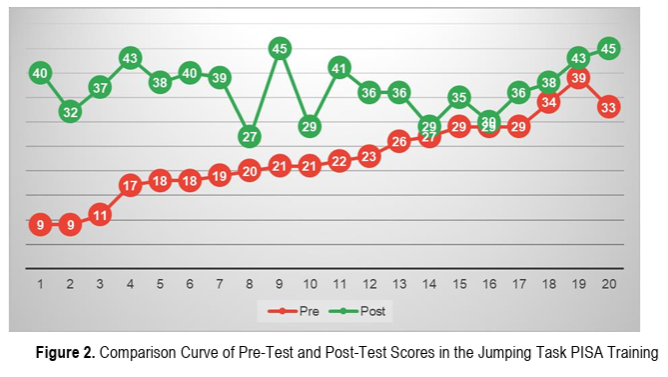
This community service program aimed to enhance teachers’ understanding of the conceptual framework of the Programme for International Student Assessment (PISA) and improve their skills in developing locally contextualized assessment items. This program was implemented using a community-based action research approach, involving systematic stages of planning, action, observation, and reflection carried out collaboratively with participating teachers. The activity responded to teachers’ limited ability to design questions requiring critical thinking and problem-solving, as well as their lack of experience in applying contextual tasks in classrooms. The program involved conceptual framework dissemination, training and mentoring on item development, classroom implementation, and evaluation through pre-tests, post-tests, response sheets, and classroom observations. Twenty-one participants, including teachers from Al-Arief Islamic schools and students from Jambi University, actively engaged in all stages. Results showed an increase in average scores from 2.62 to 4.04, with an N-Gain of 0.60 (moderate). Teachers’ knowledge, experience with assessment tasks, and problem-solving strategies all improved significantly. The novelty lies in integrating local contexts into item design, which strengthened teachers’ conceptual understanding and readiness for classroom implementation. The training proved effective in building teachers’ capacity and supporting more relevant and contextual teaching practices.
References
Darling-Hammond, L., Hyler, M. E., & Gardner, M. (2017). Effective teacher professional development. Learning Policy Institute. https://learningpolicyinstitute.org/product/effective-teacher-professional-development-report
Desimone, L. M., & Garet, M. S. (2015). Best practices in teachers’ professional development in the United States. Psychology, Society & Education, 7(3), 252–263. https://doi.org/10.25115/psye.v7i3.515
Gustiningsi, T., Putri, R. I. I., Zulkardi, Sari, D. K., Marlina, L., Rawani, D., & others. (2022). Designing student worksheet on relation and function material for mathematics learning: Jumping Task. Math Teach Res J, 14(4), 207–223. https://files.eric.ed.gov/fulltext/EJ1361679.pdf
Iswari, I., Pasaribu, F. T., Gustiningsi, T., & Nusantara, D. S. (2025). Pengembangan soal matematika tipe PISA level 6 menggunakan konteks benda bersejarah. Numeracy, 12(1), 19–36. https://doi.org/10.46244/numeracy.v12i1.3134
Kemendikbud. (2024). Rapor pendidikan Indonesia: Kota Jambi 2024. Pusat Data dan Teknologi Informasi. https://data.dikdasmen.go.id/publikasi/p/rapor-pendidikan-indonesia/rapor-pendidikan-indonesia-kota-jambi-2024
Kohar, A. W., Wardani, A. K., & Fachrudin, A. D. (2019). Profiling context-based mathematics tasks developed by novice PISA-like task designers. Journal of Physics: Conference Series, 1200(1), 012014. https://doi.org/10.1088/1742-6596/1200/1/012014
Lusinda, U., Pasaribu, F. T., Gustiningsi, T., & Nusantara, D. S. (2025). Pengembangan soal matematika tipe PISA konten uncertainty and data menggunakan konteks Museum Siginjai Jambi. Numeracy, 12(1), 99–117. https://doi.org/10.46244/numeracy.v12i1.3128
Meryansumayeka, M., Zulkardi, Z., Putri, R. I. I., & Hiltrimartin, C. (2021). Students’ strategies in solving PISA mathematical problems reviewed from problem-solving strategies. Jurnal Pendidikan Matematika, 15(1), 37–48. https://doi.org/10.22342/jpm.15.1.10405.37-48
Novita, R., Zulkardi, & Hartono, Y. (2012). Exploring primary student's problem-solving ability by doing tasks like PISA's question. Journal on Mathematics Education, 3(2), 133–150. https://doi.org/10.22342/jme.3.2.571.133-150
Nusantara, D. S., Florante P, I., Pasaribu, F. T., & Lusinda, U. (2025). Designing JUMPISA: A PISA-Based Jumping Task to Support Students’ Statistical Literacy using Jambi Context. Journal of Instructional Mathematics. https://doi.org/10.37640/jim.v6i2.2518
Nusantara, D. S., Herlambang, S. B., Pasaribu, F. T., & Maphutha, K. (2026). Developing PISA-like task using climate change contexts to enhance students’ statistical literacy. JRAMathEdu (Journal of Research and Advances in Mathematics Education), 11(2), 155–176. https://doi.org/10.23917/jramathedu.v11i2.15181
Nusantara, D. S., & Pradypta, J. A. (2026). Developing PISA-like jumping tasks on quantity content using Jambi tourism context to foster students’ numeracy skills. Journal on Mathematics Education, 17(3), 837–856. https://doi.org/10.22342/jme.v17i3.pp837-856
Nusantara, D. S., Zulkardi, Z., & Putri, R. I. I. (2025). Investigating Students’ Mathematical Argumentation Ability in Solving PISA-like Mathematics Tasks on Change and Relationships. Jurnal Pendidikan Matematika, 19(4), 807–826. https://doi.org/10.22342/mej.v19i4.pp807-826
Nusantara, D. S., Zulkardi, & Putri, R. I. I. (2021). Designing PISA-like mathematics task using a COVID-19 context (PISAComat). Jurnal Matematika dan Pendidikan Matematika, 12(2), 349–364. http://doi.org/10.22342/jme.12.2.13181.349-364
Nusantara, D. S., Zulkardi, & Putri, R. I. I. (2023). Designing PISA-like numeracy problem using a COVID-19 context. In AIP Conference Proceedings (Vol. 2811, p. 020039). http://aip.scitation.org/doi/abs/10.1063/5.0142282
OECD. (2018). PISA 2022 mathematics framework (Draft). OECD Publishing. https://pisa2022-maths.oecd.org/files/PISA%202022%20Mathematics%20Framework%20Draft.pdf
OECD. (2019). PISA 2018 assessment and analytical framework. OECD Publishing. https://www.oecd-ilibrary.org/education/pisa-2018-assessment-and-analytical-framework_b25efab8-en
OECD. (2023). PISA 2022 Assessment and Analytical Framework OECD Publishing. https://www.oecd.org/content/dam/oecd/en/publications/reports/2023/08/pisa-2022-assessment-and-analytical-framework_a124aec8/dfe0bf9c-en.pdf
Saito, E., Watanabe, M., Gillies, R., Someya, I., Nagashima, T., Sato, M., & others. (2015). School reform for positive behaviour support through collaborative learning: Utilising lesson study for a learning community. Cambridge Journal of Education, 45(4), 489–518. https://doi.org/10.1080/0305764X.2014.988684
Sato, M. (2018). Lesson study and schools as learning communities. Routledge. https://www.taylorfrancis.com/books/9781317426776
Sato, M. (2021). Learning to teach in professional community: Enhancing teacher knowledge in practice. In Envisioning teaching and learning of teachers for excellence and equity in education (pp. 189–200). Springer. https://link.springer.com/10.1007/978-981-16-2802-3_12
Sims, S., Fletcher-Wood, H., O'Mara-Eves, A., Cottingham, S., Stansfield, C., Van Herwegen, J., & Anders, J. (2021). What Are the Characteristics of Effective Teacher Professional Development? A Systematic Review and Meta-Analysis. Education Endowment Foundation. https://eric.ed.gov/?id=ED615914
Timperley, H., Wilson, A., Barrar, H., & Fung, I. (2007). Teacher professional learning and development: Best evidence synthesis iteration. Ministry of Education, New Zealand.
Wijaya, A., Van den Heuvel-Panhuizen, M., Doorman, M., & Robitzsch, A. (2014). Difficulties in solving context-based PISA mathematics tasks: An analysis of students’ error. The Mathematics Enthusiast, 11(3), 555–584.
Zulkardi, Z., & Putri, R. I. I. (2020). Supporting mathematics teachers to develop jumping task using PISA framework (JUMPISA). Jurnal Pendidikan Matematika, 14(2), 199–210. https://ejournal.unsri.ac.id/index.php/jpm/article/view/12115
Zulkardi, Z., Nusantara, D. S., & Putri, R. I. I. (2021). Designing PISA-like task on uncertainty and data using COVID-19 context. Journal of Physics: Conference Series, 1722(1), 012102. https://iopscience.iop.org/article/10.1088/1742-6596/1722/1/012102
Downloads
Published
Issue
Section
License
Copyright (c) 2026 Duano Sapta Nusantara, Tria Gustiningsi, Feri Tiona Pasaribu, syamsir sainuddin, Ranisa Junita, Yelli Ramalisa, Isnania Isnania

This work is licensed under a Creative Commons Attribution 4.0 International License.
Please find the rights and licenses in Jurnal Jurnal Karya Abdi Masyarakat (JKAM).
- License
The non-commercial use of the article will be governed by the Creative Commons Attribution license as currently displayed on Creative Commons Attribution 4.0 International License.
- Authors Warranties
The author warrants that the article is original, written by stated author(s), has not been published before, contains no unlawful statements, does not infringe the rights of others, is subject to copyright that is vested exclusively in the author and free of any third party rights, and that any necessary written permissions to quote from other sources have been obtained by the author(s).
- User Rights
JKAM's spirit is to disseminate articles published are as free as possible. Under the Creative Commons license, JKAM permits users to copy, distribute, display, and perform the work for non-commercial purposes only. Users will also need to attribute authors and JKAM on distributing works in the journal.
- Rights of Authors
Authors retain the following rights:
- Copyright, and other proprietary rights relating to the article, such as patent rights,
- The right to use the substance of the article in future own works, including lectures and books,
- The right to reproduce the article for own purposes, provided the copies are not offered for sale,
- The right to self-archive the article.
- Co-Authorship
If the article was jointly prepared by other authors, the signatory of this form warrants that he/she has been authorized by all co-authors to sign this agreement on their behalf, and agrees to inform his/her co-authors of the terms of this agreement.
- Termination
This agreement can be terminated by the author or JKAM upon two months notice where the other party has materially breached this agreement and failed to remedy such breach within a month of being given the terminating party notice requesting such breach to be remedied. No breach or violation of this agreement will cause this agreement or any license granted in it to terminate automatically or affect the definition of JKAM.
- Royalties
This agreement entitles the author to no royalties or other fees. To such extent as legally permissible, the author waives his or her right to collect royalties relative to the article in respect of any use of the article by JKAM or its sublicensee.
- Miscellaneous
JKAM will publish the article (or have it published) in the journal if the articles editorial process is successfully completed and JKAM or its sublicensee has become obligated to have the article published. JKAM may conform the article to a style of punctuation, spelling, capitalization, referencing and usage that it deems appropriate. The author acknowledges that the article may be published so that it will be publicly accessible and such access will be free of charge for the readers.