Optimizing Social Media and Photography as Weaving Promotion Media to Support Air Batu Tourism Village
DOI:
https://doi.org/10.22437/v6r5cx78Keywords:
Geopark, Product Photography, Social Media, Weaving GroupAbstract
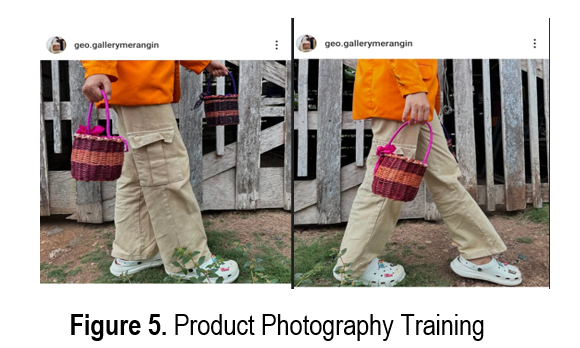
The Geopark Weaving Group is a business located in Air Batu Village. This weaving group supports the tourist village by continuously developing its products. The obstacles faced were that the group did not yet have a social media account and was not yet able to create attractive product photography. The purpose of this community service was to improve marketing by focusing on the implementation of social media applications and product photography. The application of this technology is expected to increase promotion and expand the market and support the tourist village. After the community service, the weaving group has a social media account and is able to create attractive product photography, although it is still in the learning stage. The group is very pleased with the assistance of KKNT students in supporting the Air Batu tourist village. In addition to activities from the community service program, the students also participated in activities carried out by the village community, teaching at schools, integrated health posts (posyandu), and art. The methods used in this community service are lectures, discussions, and training. It is hoped that partners will cooperate and be active during the community service implementation so that the predetermined goals are achieved.
References
Abidin, Z. (2024). Innovative community service programs with local participation to build independent villages. Zabags International Journal of Engagement, 2(1), 29–39. https://doi.org/10.61233/zijen.v2i1.17
Acharya, K. K., & Scott, J. (2022). A study of the capabilities and limitations of local governments in providing community services in Nepal. Public Administration and Policy, 25(1), 64–77. https://doi.org/10.1108/PAP-01-2022-0006
Adewunmi, Y. A., Nelson, M., Chigbu, U. E., Makashini-Masiba, L., Mwando, S., Mompati, L., & Kahireke, U. (2023). A scoping review of community-based facilities management for public services through social enterprises in developing communities. Facilities, 41(13/14), 868–889. https://doi.org/10.1108/F-07-2022-0100
Armutcu, B., Tan, A., Amponsah, M., Parida, S., & Ramkissoon, H. (2023). Tourist behaviour: The role of digital marketing and social media. Acta Psychologica, 240, 104025. https://doi.org/10.1016/j.actpsy.2023.104025
Daraio, C., & Vaccari, A. (2022). How should evaluation be? Is a good evaluation of research also just? Towards the implementation of good evaluation. Scientometrics, 127(12), 7127–7146. https://doi.org/10.1007/s11192-022-04329-2
de Amorim, L. A., Sousa, B. B., Dias, Á. L., & Santos, V. R. (2024). Exploring the outcomes of digital marketing on historic sites' visitor behaviour. Journal of Cultural Heritage Management and Sustainable Development, 14(6), 934–949. https://doi.org/10.1108/JCHMSD-11-2021-0202
Deb, S. K., Nafi, S. M., & Valeri, M. (2024). Promoting tourism business through digital marketing in the new normal era: a sustainable approach. European Journal of Innovation Management, 27(3), 775–799. https://doi.org/10.1108/EJIM-04-2022-0218
Felekoglu, B., Durmusoglu, S. S., Maier, A. M., & Moultrie, J. (2024). Walking the managerial tightrope: Top management involvement in product innovation projects. European Journal of Innovation Management, 27(3), 742–774. https://doi.org/10.1108/EJIM-08-2021-0408
Hapsara, O., & Ahmadi. (2022). Analysis of visit decisions via visit intention: Destination image and accessibility at Merangin Jambi Geopark [in Bahasa]. Jurnal Manajemen Terapan dan Keuangan (Mankeu), 11(1), 64–76. https://doi.org/10.22437/jmk.v11i01.14802
Imanova, G. E. (2023). Difference Between Digital Marketing and Traditional Marketing Models. In R. A. Aliev, J. Kacprzyk, W. Pedrycz, M. Jamshidi, M. B. Babanli, & F. Sadikoglu (Eds.), 15th International Conference on Applications of Fuzzy Systems, Soft Computing and Artificial Intelligence Tools – ICAFS-2022 (Vol. 610). https://doi.org/10.1007/978-3-031-25252-5_69
Jatobá, M. N., Franco, M., & Rodrigues, M. (2023). The role of communication between partners in the process of strategic alliances: a systematic literature review. Journal of Business & Industrial Marketing, 38(7), 1511–1531. https://doi.org/10.1108/JBIM-09-2021-0440
Jordaan, M., & Mennega, N. (2022). Community partners' experiences of higher education service-learning in a community engagement module. Journal of Applied Research in Higher Education, 14(1), 394–408. https://doi.org/10.1108/JARHE-09-2020-0327
Leal Filho, W., Dibbern, T., Dinis, M. A. P., Cristofoletti, E. C., Mbah, M. F., Mishra, A., Clarke, A., Samuel, N., Apraiz, J. C., Abubakar, I. R., & Aina, Y. A. (2024). The added value of partnerships in implementing the UN sustainable development goals. Journal of Cleaner Production, 438, 140794. https://doi.org/10.1016/j.jclepro.2024.140794
Mangai, M. S., Masiya, T., & Masemola, G. (2024). Engaging communities as partners: policing strategies in Johannesburg. Safer Communities, 23(1), 86–102. https://doi.org/10.1108/SC-04-2023-0012
Mariani, L., Trivellato, B., Martini, M., et al. (2022). Achieving sustainable development goals through collaborative innovation: evidence from four european initiatives. Journal of Business Ethics, 180, 1075–1095. https://doi.org/10.1007/s10551-022-05193-z
Perevozova, I., Daliak, N., Mokhnenko, A., Stetsyk, T., & Babenko, V. (2022). Partner Relationship Assessment Methodology. In M. Elhoseny, X. Yuan, & S. Krit (Eds.), Distributed Sensing and Intelligent Systems (Studies in Distributed Intelligence). Springer, Cham. https://doi.org/10.1007/978-3-030-64258-7_8
Rahman, A., Jeddawi, M., & Umar. (2025). Development strategy for the Merangin Jambi Geopark as a global geopark (UNESCO Global Geopark) [in Bahasa]. Jurnal Ilmiah Administrasi Pemerintahan Daerah (JIAPD), 17(2), 258–275. https://doi.org/10.33701/jiapd.v17i2.5687
Rodríguez-Zurita, D., Jaya-Montalvo, M., Moreira-Arboleda, J., Raya-Diez, E., & Carrión-Mero, P. (2025). Sustainable development through service learning and community engagement in higher education: a systematic literature review. International Journal of Sustainability in Higher Education, 26(1), 158–201. https://doi.org/10.1108/IJSHE-10-2023-0461
Sharma, A., & Sharma, S. (2024). Adoption of digital marketing in tourism SMEs: A review and research agenda. Management Research Review, 47(7), 1077–1095. https://doi.org/10.1108/MRR-08-2021-0597
Simarmata, E., Kusumastuti, R., & Wijaya, C. (2024). Achieving sustainable competitiveness of tourism dynamics with resource-based view. European Journal of Innovation Management, 27(3), 1001–1023. https://doi.org/10.1108/EJIM-07-2022-0365
Sondari, M. C., Hermanu, A. I., Nurlaeli, L., & Artisheila, D. S. (2025). Impact of community service on university performance and efficiency. Journal of Science and Technology Policy Management, 16(8), 1300–1321. https://doi.org/10.1108/JSTPM-03-2023-0048
Wan, Y. K. P., Li, X., Lau, V. M.-C., & Dioko, L. (2022). Destination governance in times of crisis and the role of public-private partnerships in tourism recovery from Covid-19: The case of Macao. Journal of Hospitality and Tourism Management, 51, 218–228. https://doi.org/10.1016/j.jhtm.2022.03.012
Wibowo, Y. G., Zahar, W., Syarifuddin, H., Asyifah, S., & Ananda, R. (2019). Development of eco-geotourism at Merangin Jambi Geopark [in Bahasa]. IJEEM - Indonesian Journal of Environmental Education and Management, 4(1), 23–43. https://doi.org/10.21009/jgg.041.03
Zheng, K., Kumar, J., Kunasekaran, P., & Valeri, M. (2024). Role of smart technology use behaviour in enhancing tourist revisit intention: the theory of planned behaviour perspective. European Journal of Innovation Management, 27(3), 872–893. https://doi.org/10.1108/EJIM-03-2022-0122
Downloads
Published
Issue
Section
License
Copyright (c) 2026 Nurhayani, Syamsurijal Tan, Selamet Rahmadi, Rosmeli, Novita Ekasari

This work is licensed under a Creative Commons Attribution 4.0 International License.
Please find the rights and licenses in Jurnal Jurnal Karya Abdi Masyarakat (JKAM).
- License
The non-commercial use of the article will be governed by the Creative Commons Attribution license as currently displayed on Creative Commons Attribution 4.0 International License.
- Authors Warranties
The author warrants that the article is original, written by stated author(s), has not been published before, contains no unlawful statements, does not infringe the rights of others, is subject to copyright that is vested exclusively in the author and free of any third party rights, and that any necessary written permissions to quote from other sources have been obtained by the author(s).
- User Rights
JKAM's spirit is to disseminate articles published are as free as possible. Under the Creative Commons license, JKAM permits users to copy, distribute, display, and perform the work for non-commercial purposes only. Users will also need to attribute authors and JKAM on distributing works in the journal.
- Rights of Authors
Authors retain the following rights:
- Copyright, and other proprietary rights relating to the article, such as patent rights,
- The right to use the substance of the article in future own works, including lectures and books,
- The right to reproduce the article for own purposes, provided the copies are not offered for sale,
- The right to self-archive the article.
- Co-Authorship
If the article was jointly prepared by other authors, the signatory of this form warrants that he/she has been authorized by all co-authors to sign this agreement on their behalf, and agrees to inform his/her co-authors of the terms of this agreement.
- Termination
This agreement can be terminated by the author or JKAM upon two months notice where the other party has materially breached this agreement and failed to remedy such breach within a month of being given the terminating party notice requesting such breach to be remedied. No breach or violation of this agreement will cause this agreement or any license granted in it to terminate automatically or affect the definition of JKAM.
- Royalties
This agreement entitles the author to no royalties or other fees. To such extent as legally permissible, the author waives his or her right to collect royalties relative to the article in respect of any use of the article by JKAM or its sublicensee.
- Miscellaneous
JKAM will publish the article (or have it published) in the journal if the articles editorial process is successfully completed and JKAM or its sublicensee has become obligated to have the article published. JKAM may conform the article to a style of punctuation, spelling, capitalization, referencing and usage that it deems appropriate. The author acknowledges that the article may be published so that it will be publicly accessible and such access will be free of charge for the readers.