
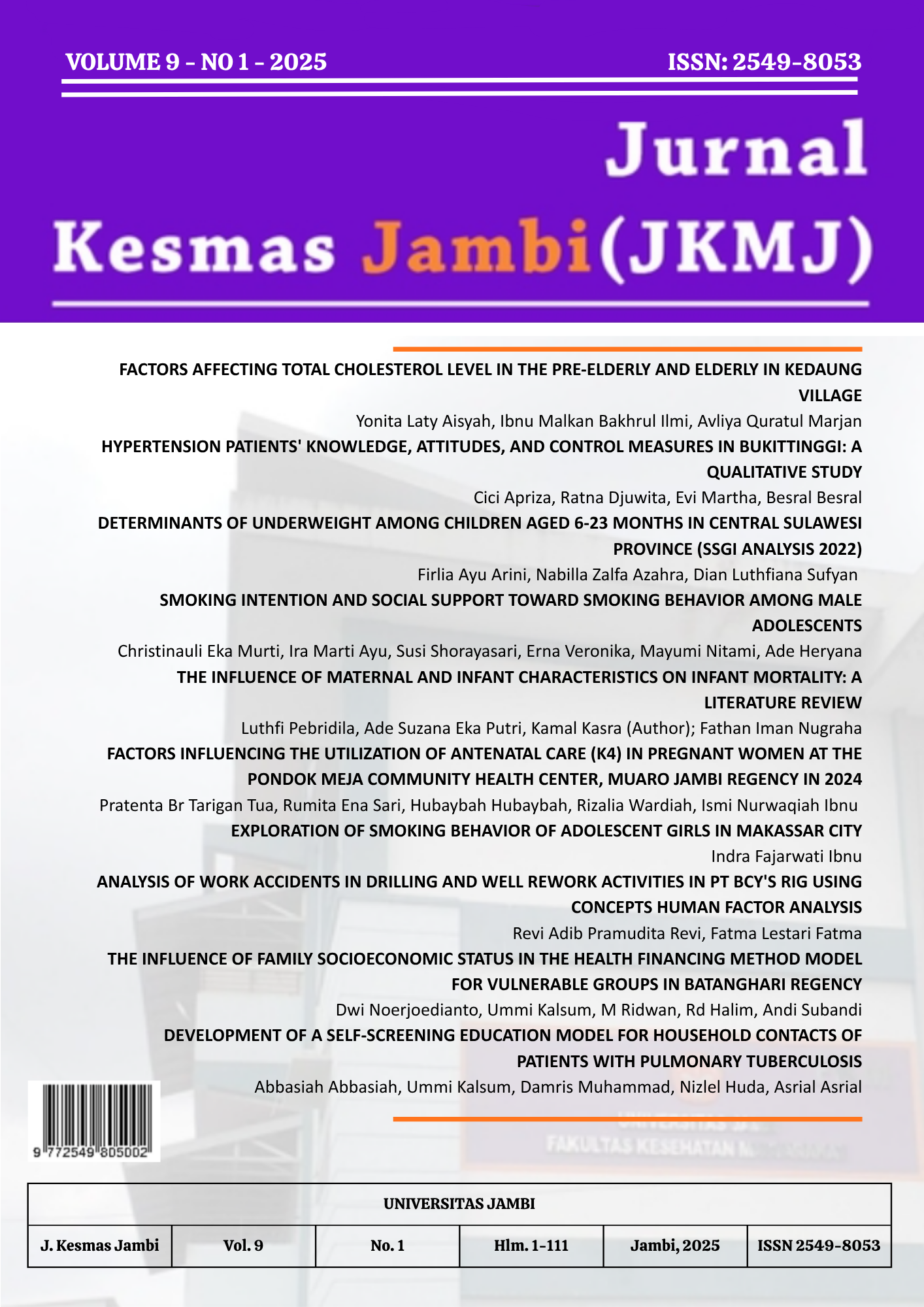
Development of a Self-Screening Education Model for Household Contacts of Patients with Pulmonary Tuberculosis
DOI:
https://doi.org/10.22437/jkmj.v9i1.47224Keywords:
educational media, tuberculosis, self-screening, self-detection, household contactsAbstract
The prevalence of tuberculosis (TB) in Indonesia continues to increase every year, placing Indonesia second in the world in terms of the number of TB cases. Efforts by the government to control TB are still hampered, one of which is the difficulty of detecting suspected TB cases due to negative stigma that makes patients reluctant to disclose their condition. This is due to a lack of knowledge. This study aims to develop a website-based educational model, “KECAPI,” enabling household contacts of TB patients to conduct self-assessments of transmission risk anytime and anywhere. The study was a development research (Research and Development) using a mixed-method approach within the ADDIE framework. The study subjects include 3 individuals in a one-on-one test, 15 persons in a small group test, and 35 persons for the field test and a control group of 35 persons. User satisfaction with the educational model was assessed using the System Usability Scale, and knowledge improvement was analyzed using the Mann-Whitney test. The “KECAPI” educational model (Recognize-Record-Check) was developed based on the Health Belief Model, Trans Theoretical Model, and Technological Acceptance Model, and was proven to be effective, easy to use, and improved household contacts' knowledge about TB. This model presents animated videos, text, and images and can be accessed via the link https://s.id/kecapitb. It is hoped that this model can be utilized by health institutions to detect suspected of TB cases in the community, thereby increasing the case detection rate and ensuring prompt and appropriate treatment.
References
1. Gilpin C, Korobitsyn A, Migliori GB, Raviglione MC, Weyer K. The World Health Organization standards for tuberculosis care and management. Eur Respir J [Internet]. 2018;51(3). Available from: http://dx.doi.org/10.1183/13993003.00098-2018
2. World Health Organization. Global Tuberculosis Report [Internet]. Vol. t/malaria/, January. 2023. Available from: https://www.who.int/teams/global-tuberculosis-programme/tb-reports/global-tuberculosis-report-2023
3. Indonesia T. Ayo Bersama Akhiri TBC, Indonesia Bisa! Semangat Eliminasi TBC di Hari TBC Sedunia 2023. 2023. p. https://www.tbindonesia.or.id/.
4. Kementerian kesehatan RI. Infodatin Tuberkulosis 2018. 2018.
5. Kristini T, Hamidah R. Potential for Pulmonary Tuberculosis Transmission to Patients Family. Indones J Public Heal. 2020;15(1):24.
6. Laghari M, Azhar S, Sulaiman S, Khan AH, Talpur BA, Bhatti Z. Contact screening and risk factors for TB among the household contact of children with active TB : a way to find source case and new TB cases. BMC Public Health [Internet]. 2019;19(1274):1–10. Available from: doi.org/10.1186/s12889-019-7597-0
7. Rosdiana R. Faktor Yang Berhubungan Dengan Kejadian Tuberkulosis Paru Di Rumah Sakit Umum Daerah Labuang Baji Makassar. Promot J Kesehat Masy. 2018;8(1):78.
8. Reichler MR, Khan A, Sterling TR, Zhao H, Moran J, McAuley J, et al. Risk and timing of tuberculosis among close contacts of persons with infectious tuberculosis. J Infect Dis. 2018;218(6):1000–8.
9. Nair D, Rajshekhar N, Klinton JS, Watson B, Velayutham B, Tripathy JP, et al. Household contact screening and yield of tuberculosis cases-a clinic based study in Chennai, South India. PLoS One. 2016;11(9):1–10.
10. Dinkes Provinsi Jambi. Profil Kesehatan Provinsi Jambi 2022. J Chem Inf Model. 2022;192.
11. Media Indonesia. Media Indonesia. 2021. Kemenkominfo: 89% Penduduk Indonesia Gunakan Smarthphone. Available from: https://mediaindonesia.com/humaniora/389057/kemenkominfo-89-penduduk-indonesia-gunakan-smartphone
12. Syahrul S, Saleh A, Syam Y, Latif AI, Amir H. Factor related to self care among Pulmonary Tuberculosis patients. Int J Health Sci (Qassim). 2022;(April):1218–29.
13. Pangestika R, Fadli RK, Alnur RD. Edukasi Pencegahan Penularan Penyakit Tb melalui Kontak Serumah. J SOLMA. 2019;8(2):229.
14. Malede A, Taye B, Legesse M, Debie A, Shibabaw A. Pulmonary tuberculosis preventive practices among Anibessa Bus users at Addis Ababa, Ethiopia: A cross-sectional study. BMC Res Notes [Internet]. 2019;12(1):1–6. Available from: https://doi.org/10.1186/s13104-019-4135-1
15. Yanti B, Heriansyah T, Riyan M. Penyuluhan Dengan Media Audio Visual Dan Metode Ceramah Dapat Meningkatkan Pencegahan Tuberkulosis. Ikesma. 2022;18(3):171.
16. Fitriani D, Rahmatulloh G, Yudiatma F, Hidayat AF. Implementasi aplikasi m-health model psikoedukasi dalam peningkatan pengetahuan dan kepatuhan minum obat pada pasien tuberkulosis paru. Holistik J Kesehat. 2025;18(10):1294–301.
17. Tumuhimbise W, Atwine D, Kaggwa F, Musiimenta A. Correction: Enhancing Tuberculosis Care in Southwestern Uganda: Facilitators and Barriers to Utilizing Mobile Health Technologies. Glob Implement Res Appl [Internet]. 2022;2(4):415–6. Available from: https://doi.org/10.1007/s43477-022-00061-4
18. Khamai N, Seangpraw K, Ong-Artborirak P. Using the Health Belief Model to Predict Tuberculosis Preventive Behaviors Among Tuberculosis Patients’ Household Contacts During the COVID-19 Pandemic in the Border Areas of Northern Thailand. J Prev Med Public Heal [Internet]. 2024;57(3):223–33. Available from: https://jpmph.org/journal/view.php?doi=10.3961/jpmph.23.453
19. Sarma M. Theoretical Foundations of Health Education and Health Promotion (4th ed.). Nursing (Lond). 1987;3(21):792–5.
20. Ade GVAK, Hidayah N, Eriyanti N. Gagasan Aplikasi Smart TB untuk Meningkatkan Manajemen Tuberkulosis Di Indonesia Demi Terwujudnya Universal Health Coverage. J Citra Keperawatan. 2022;10(1):8–19.
21. Widiastana IKA, Fanani L, Kharisma AP. Pengembangan Aplikasi Mobile Health Berbasis Android Untuk Mengetahui Pengaruh Self-Care Management Terhadap Pasien Tuberkulosis (TBC). J Pengemb Teknol Inf dan Ilmu Komput. 2024;1(1):1–10.
22. Astha Triyono E, Mahanani M, Anggraini SD, Maulana H, Pratiwi WD, Yochanan C, et al. Early Detection of Tuberculosis Application (E-Tibi): a New Paradigm To Detect New Case of Tuberculosis. J Berk Epidemiol. 2023;11(3):267–76.
Downloads
Published
Issue
Section
License
Copyright (c) 2025 Abbasiah Abbasiah, Ummi Kalsum, Damris Muhammad, Nizlel Huda, Asrial Asrial (Author)

This work is licensed under a Creative Commons Attribution 4.0 International License.
Proposed Creative Commons Copyright Notices
1. Proposed Policy for Journals That Offer Open Access
Authors who publish with this journal agree to the following terms:
- Authors retain copyright and grant the journal right of first publication with the work simultaneously licensed under a Creative Commons Attribution License that allows others to share the work with an acknowledgement of the work's authorship and initial publication in this journal.
- Authors are able to enter into separate, additional contractual arrangements for the non-exclusive distribution of the journal's published version of the work (e.g., post it to an institutional repository or publish it in a book), with an acknowledgement of its initial publication in this journal.
- Authors are permitted and encouraged to post their work online (e.g., in institutional repositories or on their website) prior to and during the submission process, as it can lead to productive exchanges, as well as earlier and greater citation of published work (See The Effect of Open Access).
Proposed Policy for Journals That Offer Delayed Open Access
Authors who publish with this journal agree to the following terms:
- Authors retain copyright and grant the journal right of first publication, with the work [SPECIFY PERIOD OF TIME] after publication simultaneously licensed under a Creative Commons Attribution License that allows others to share the work with an acknowledgement of the work's authorship and initial publication in this journal.
- Authors are able to enter into separate, additional contractual arrangements for the non-exclusive distribution of the journal's published version of the work (e.g., post it to an institutional repository or publish it in a book), with an acknowledgement of its initial publication in this journal.
- Authors are permitted and encouraged to post their work online (e.g., in institutional repositories or on their website) prior to and during the submission process, as it can lead to productive exchanges, as well as earlier and greater citation of published work (See The Effect of Open Access).


 p-ISSN :
  e-ISSN :