
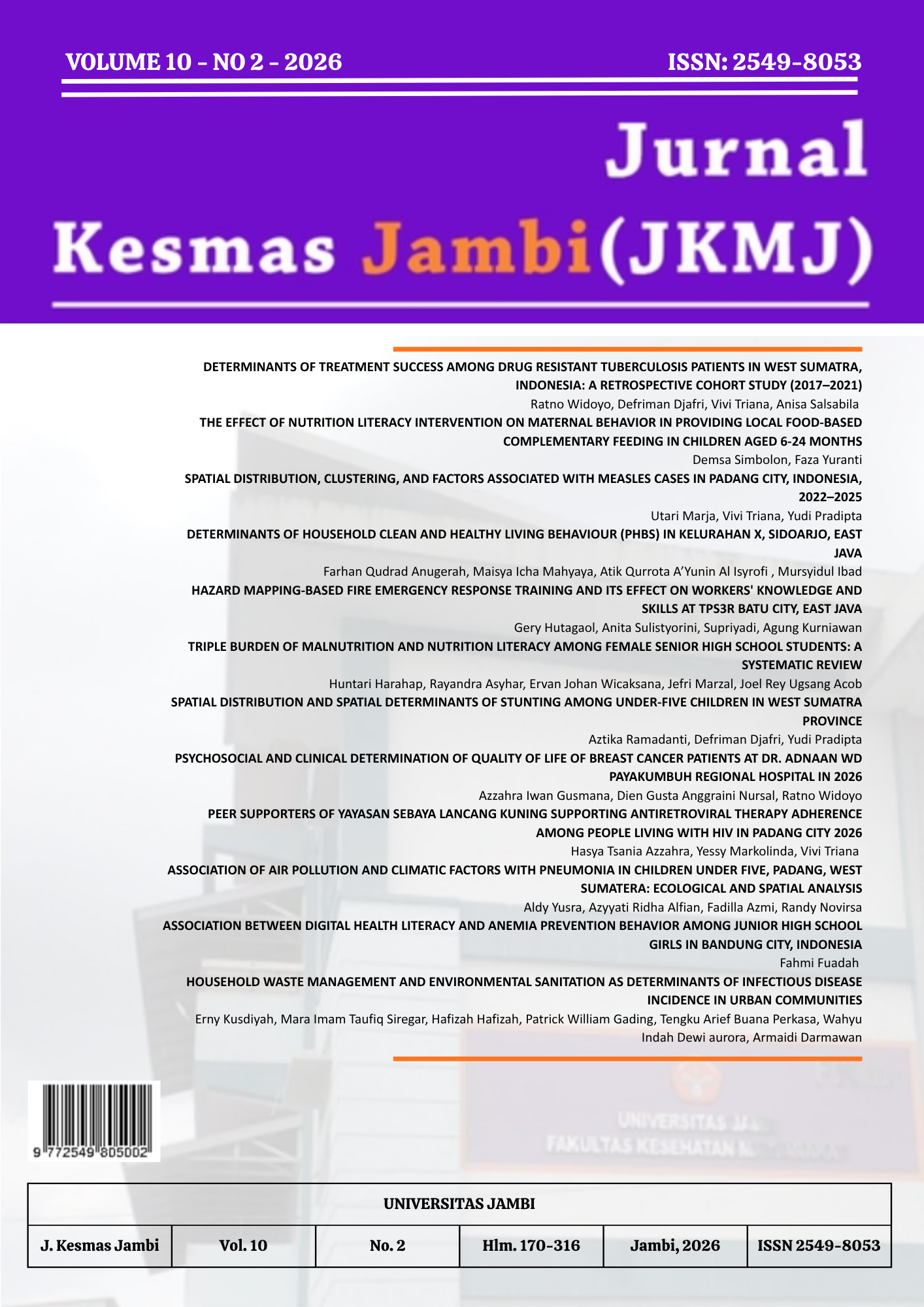
Peer Supporters of Yayasan Sebaya Lancang Kuning Supporting Antiretroviral Therapy Adherence Among People Living With HIV In Padang City 2026
DOI:
https://doi.org/10.22437/jkmj.v10i2.57499Keywords:
ART Adherence, Peer Support, People Living with HIV, Social SupportAbstract
Antiretroviral therapy (ART) adherence remains a critical gap in HIV care, with Indonesia falling short of the 95-95-95 targets and a 26% loss-to-follow-up rate. Community-based peer support is recommended to improve adherence, yet most studies emphasize quantifiable outcomes rather than the subjective experiences involved. This study explored the role of Peer Supporters from Yayasan Sebaya Lancang Kuning in supporting ART adherence among people living with HIV (PLHIV) in Padang City in 2026, across four social support dimensions: emotional, appraisal, instrumental, and informational. A qualitative phenomenological design was employed. Data were collected through in-depth interviews with nine purposively selected informants (four peer supporters, one program coordinator, and four PLHIV clients), supplemented by non-participatory observation and document review, and analyzed using the Miles and Huberman interactive model with source and method triangulation. Emotional support — built through confidentiality assurance, non-judgmental attitudes, and supporters' self-disclosure as fellow PLHIV — served as the foundation enabling other forms of support. Appraisal support was delivered through motivation, recognition of achievements, and supporters acting as role models. Instrumental support encompassed healthcare navigation, administrative assistance, medication delivery, and advocacy against discrimination, despite persisting stigma and client dependency. Informational support was provided progressively, from service access guidance to correcting health misinformation using concrete evidence. Peer supporters also reported substantial emotional burden. Peer support plays a multidimensional role in sustaining ART adherence, though sustainability requires attention to supporters' psychological wellbeing, clearer assistance guidelines, and stronger capacity to counter misinformation.
References
1. Maulana MA, Avrillina JP. Health as a Human Right: A Philosophical Perspective on Health Law (Kesehatan sebagai Hak Asasi: Perspektif Filosofis tentang Hukum Kesehatan). J Contemp Law Stud. 2024;2(1):42–54. https://doi.org/10.47134/lawstudies.v2i1.2075
2. UNAIDS. Global HIV & AIDS statistics 2023 — Fact sheet. 2024.
3. Kementerian Kesehatan RI. Indonesia Health Profile. Jakarta; 2025.
4. Yanti, F., Lestari, Y., & Yetti, H. Analysis of the Implementation of the HIV/AIDS Control Program at Bungus Health Center, Padang City, 2020 (Analisis Implementasi Program Penanggulangan HIV/AIDS di Puskesmas Bungus Kota Padang Tahun 2020). 2020. Jurnal Kesehatan Medika Saintika, 11(2), 112–122. https://jurnal.syedzasaintika.ac.id/index.php/medika/article/view/847
5. Gutiérrez,G., Lucas,AH., Pineda,B. Quality of life and psychological variables affecting adherence to antiretroviral treatment in Mexican patients with HIV/AIDS infection. Rev Chil Infectol. 2019;36(3):331–9. https://doi.org/10.4067/S0716-10182019000300331
6. Hanifah L, Kriswibowo A. HIV/AIDS Control Policy from the Perspective of Health Policy Triangle Analysis in Surabaya City. AL-MANHAJ J Huk dan Pranata Sos Islam. 2023;5(1):961–70. https://doi.org/10.37680/almanhaj.v5i1.2827
7. Kemenkes RI. Technical Guidelines for HIV Sentinel Surveillance. Jakarta: Kemenkes RI; 2015.
8. Artati LPN. Survey Study: Loss to Follow-Up Among People with HIV/AIDS. Journal Nurse Media. 2022;1(1):35–41. https://doi.org/10.55887/nrpm.v1i1.5
9. Badan Pusat Statistik Provinsi Sumatera Barat. Kasus Penyakit Menurut Kabupaten/Kota dan Jenis Penyakit di Provinsi Sumatera Barat, 2023.
10. Dinas Kesehatan Kota Padang. New ARV Case and Treatment Data for PLHIV, 2017–2024 (October).
11. Putri, A. S., & Erawati, K. (2022). The Relationship Between ARV Medication Adherence and Quality of Life Among PLHIV at Padang City Health Centers (Hubungan kepatuhan minum ARV dengan kualitas hidup ODHA di Puskesmas Kota Padang). Jurnal Ilmu Kesehatan Masyarakat Andalas, 16(2), 112–120. https://doi.org/10.24893/jikma.v16i2.1022
12. Jahro UU, Mulyana DS. Analysis of Factors Affecting the Quality of Life of (PLHIV) at Serang City Health Center (Analisis Faktor Yang Mempengaruhi Kualitas Hidup Orang Dengan HIV/AIDS (ODHA) Di Puskesmas Serang Kota). Jurnal Ilmu Keperawatan. 2023;9(3):137–48. https://doi.org/10.33023/jikep.v9i3.1600
13. Rejeki TS. The Effect of ARV Medication Adherence on Hospitalization Rates of HIV/AIDS Patients in the Internal Medicine Ward of Sultan Imanuddin Regional Hospital, Pangkalan Bun (Pengaruh Kepatuhan Minum Obat ARV Terhadap Angka Kejadian Hospitalisasi Pasien HIV AIDS Di Ruang Penyakit Dalam RSUD Sultan Imanuddin Pangkalan Bun) [thesis]. Pangkalan Bun: Sekolah Tinggi Ilmu Kesehatan Borneo Cendekia Medika; 2021.
14. Kementerian Kesehatan RI. Peraturan Menteri Kesehatan Republik Indonesia Nomor 23 Tahun 2022 Tentang Penanggulangan Human Immunodeficiency Virus, Acquired Immuno-Deficiency Syndrome, Dan Infeksi Menular Seksual. Indonesia; 2022.
15. Budhiana, J., Ratiningsih, R., & Purnairawan, Y. (2025). The Relationship Between Peer Support Group Companionship and ARV Medication Adherence Among HIV Patients (Hubungan pendampingan kelompok dukungan sebaya dengan kepatuhan minum obat ARV pada pasien orang dengan HIV). Jurnal Ilmu Kesehatan Bhakti Husada: Health Sciences Journal, 16(1), 190–196. https://doi.org/10.34305/jikbh.v16i01.1578
16. Zhou B, Li D, Huang L, Han S, Zhang L, Wu X, et al. Perspectives and Needs of Social Support for People With HIV: A Qualitative Study According to Three Aspects of Stakeholders. 2025. https://doi.org/10.1155/nrp/8847734
17. Silubun, T. A., & Abdillah, R. (2022). The Dynamics of Social Support Among HIV/AIDS-Positive Women (Dinamika Dukungan Sosial Pada Perempuan Positif HIV/AIDS). Jurnal Psikologi Karakter, 6(1), 366–380. https://doi.org/10.31004/prepotif.v6i1.3126
18. Septiyansah, C., & Mesra, R. (2024). The Role of Yayasan Pesona Jakarta in Implementing HIV/AIDS Prevention and Control Programs in the MSM Community in DKI Jakarta (Peran Yayasan Pesona Jakarta dalam Melaksanakan Program Pencegahan Dan Penanggulangan HIV dan AIDS pada Komunitas LSL di DKI Jakarta). Jurnal Mahasiswa Kreatif, 1(3), 129–137. https://doi.org/10.64924/d5ehwb23
19. Mujugira A, Karungi B, Mugisha J, Nakyanzi A, Bagaya M, Kamusiime B, et al. "I felt special!": a qualitative study of peer-delivered HIV self-tests, STI self-sampling kits and PrEP for transgender women in Uganda. 2023;1–9. https://doi.org/10.1002/jia2.26201
20. Thomas DR, Hodges ID. A new taxonomy of social support: Clarifying supportive behaviours and measures. 2026. J Health Psychol. 2026 Jan 25. https://doi.org/10.1177/13591053251412946.
21. Daramatasia, W., Zunaedi, R., & Yuliyanik, Y.. The Relationship Between Peer Support and Status Disclosure Among People with HIV/AIDS (Hubungan Dukungan Pendamping Sebaya Dengan Keterbukaan Status Pada Orang Dengan HIV/AIDS). 2025. MAHESA: Malahayati Health Student Journal, 5(8), 3824–3837. https://doi.org/10.33024/mahesa.v5i8.19883
22. Wogrin C, Willis N, Mutsinze A, Chinoda S, Verhey R. It helps to talk: A guiding framework (TRUST) for peer support in delivering mental health care for adolescents living with HIV. PLoS One. 2021;1–13. https://doi.org/10.1371/journal.pone.0248018
23. Repål AØ, Berg RC, Skogen V, Fossum M. Peer support in an outpatient clinic for people living with human immunodeficiency virus: a qualitative study of service users' experiences. BMC Health Service. 2022;22. https://doi.org/10.1186/s12913-022-07958-8
24. Berg RC, Page S, Repål AØ. The effectiveness of peer-support for people living with HIV: A systematic review and meta-analysis. PLoS One. 2021;1–24. https://doi.org/10.1371/journal.pone.0252623
25. Chang K, Wu Y, Shan S, Han S. Exploring the experiences of peer support participation for HIV peer volunteers. Int J Nurs Stud. 2024;153. https://doi.org/10.1016/j.ijnurstu.2024.104715
26. Anwar, A. A., Murdiana, S., & Nur, H. (2023). The Dynamics of Self-Acceptance Among Wives of PLHIV Infected with HIV at Yayasan Peduli Peer Support Group, Makassar (Dinamika Penerimaan Diri pada Istri Odha yang Tertular HIV di Yayasan Peduli Kelompok Dukungan Sebaya Makassar). Sultra Education Journal, 3(2), 52–60. https://doi.org/10.54297/seduj.v3i2.500
27. Berg RC. Peer Support for People Living With HIV: A Scoping Review. Health Promot Pract. 2023;24(1):172–90. https://doi.org/10.1177/15248399211049824
28. Theresia, T. T., Lestari, S., Febriyanti, A., & Wibowo, A. R. (2025). Incidence of PLHIV Cases and Their Management at Taman Sari Health Center, 2021–2023 (Kejadian Kasus ODHIV (Orang dengan HIV) dan Penatalaksanaan di Puskesmas Taman Sari Tahun 2021–2023). Jurnal Dunia Kesmas, 14(1). https://doi.org/10.33024/jdk.v14i1.17795
29. Wells N, Philpot SP, Murphy D, Ellard J, Howard C, Rule J, et al. Belonging, social connection and non-clinical care: Experiences of HIV peer support among recently diagnosed people living with HIV in Australia. Heal Soc Care Community. 2022;4793–801. https://doi.org/10.1111/hsc.13886
30. Martiana, I., Waluyo, A., Yona, S., & Edianto, E. (2021). A secondary analysis of peer support and family acceptance among homosexual living with HIV and antiretroviral therapy: Quality of life perspectives. Jurnal Keperawatan Indonesia, 24(1), 1–8. https://doi.org/10.7454/jki.v24i1.1095
31. Steenekamp, B. L., & Barker, S. L. (2024). Exploring the experiences of compassion fatigue amongst peer support workers in homelessness services. Community Mental Health Journal, 60(4), 772–783. https://doi.org/10.1007/s10597-024-01234-1
32. Rocha-Jiménez T, Pitpitan EV, Cazares R, Smith LR. "He is the Same as Me": Key Populations' Acceptability and Experience of a Community-Based Peer Navigator Intervention to Support Engagement in HIV Care in Tijuana, Mexico. 2021;35(11). https://doi.org/10.1089/apc.2021.0069
33. Iryawan AR, Stoicescu C, Sjahrial F, Nio K, Dominich A. The impact of peer support on testing, linkage to and engagement in HIV care for people who inject drugs in Indonesia: qualitative perspectives from a community-led study. Harm Reduct J. 2022;19(16):1–13. https://doi.org/10.1186/s12954-022-00595-8
34. Rosmalina, A., & Kurnaedi, D. (2020). Companionship for People with HIV/AIDS by the Pakungwati Peer Support Group, Cirebon City (Pendampingan terhadap orang dengan HIV/AIDS oleh kelompok dukungan sebaya Pakungwati Kota Cirebon). Dimasejati: Jurnal Pengabdian Kepada Masyarakat, 2(1), 35–49. Available from: https://www.syekhnurjati.ac.id/Jurnal/index.php/dimasejati/article/view/6650/3023
35. Meng X, Yin H, Ma W, Gu J, Lu Z, Fitzpatrick T. Peer-Led Community-Based Support Services and HIV Treatment Outcomes Among People Living With HIV in Wuxi, China: Propensity Score–Matched Analysis of Surveillance Data. JMIR Public Health Surveill. 2023;9:1–15. https://doi.org/10.2196/43635
36. Putri FA, Sitanggang HD, Wisudariani E, Fitri A, Syukri M. Five-Year Survival Analysis of HIV/AIDS Patients Receiving Antiretroviral Therapy (ART) at Raden Mattaher Regional Hospital, Jambi Province (Analisis Survival 5 Tahun Pasien HIV/AIDS yang Mendapat Terapi Antiretroviral (ARV) di RSUD Raden Mattaher, Provinsi Jambi). J Kesmas Jambi. 2024;8(2):119–133. https://doi.org/10.22437/jkmj.v8i2.37000
37. Karver TS, Barrington C, Donastorg Y, Perez M, Gomez H, Page KR, et al. Exploring peer navigation and support in the quality of HIV care experiences of female sex workers in the Dominican Republic. BMC Health Serv Res. 2022;1–11. https://doi.org/10.1186/s12913-021-07439-4
38. Nufus, B. H., Susanti, E. W., & Pairan. (2018). The Role of Companions in Interventions for People with HIV/AIDS (Peran Pendamping Dalam Intervensi Pada Orang Dengan HIV/AIDS. Jurnal Ilmu Kesejahteraan Sosial, 19(2), 163–175. https://doi.org/10.7454/jurnalkessos.v19i2.1201
39. Syukaisih, S., Alhidayati, A., & Oktavia, W. (2022). Stigma analysis and community discrimination of people with HIV/AIDS (PLWHA) in Indragiri Hulu District. Menara Ilmu, 16(2), 86–97. https://doi.org/10.31869/mi.v16i2.3429
40. Hutahaean BSH, Stutterheim SE, Jonas KJ. Barriers and Facilitators to HIV Treatment Adherence in Indonesia: Perspectives of People Living with HIV and HIV Service Providers. Trop Med Infect Dis. 2023;8:1–23. https://doi.org/10.3390/tropicalmed8030138
41. Sianturi EI, Perwitasari DA, Soltief SN, et al. Health literacy of people living with HIV in a rural area in Indonesia: A cross-sectional study. 2021;127–34. https://doi.org/10.1111/hsc.13075
Downloads
Published
Issue
Section
License
Copyright (c) 2026 Hasya Tsania Azzahra, Yessy Markolinda, Vivi Triana (Author)

This work is licensed under a Creative Commons Attribution 4.0 International License.
Proposed Creative Commons Copyright Notices
1. Proposed Policy for Journals That Offer Open Access
Authors who publish with this journal agree to the following terms:
- Authors retain copyright and grant the journal right of first publication with the work simultaneously licensed under a Creative Commons Attribution License that allows others to share the work with an acknowledgement of the work's authorship and initial publication in this journal.
- Authors are able to enter into separate, additional contractual arrangements for the non-exclusive distribution of the journal's published version of the work (e.g., post it to an institutional repository or publish it in a book), with an acknowledgement of its initial publication in this journal.
- Authors are permitted and encouraged to post their work online (e.g., in institutional repositories or on their website) prior to and during the submission process, as it can lead to productive exchanges, as well as earlier and greater citation of published work (See The Effect of Open Access).
Proposed Policy for Journals That Offer Delayed Open Access
Authors who publish with this journal agree to the following terms:
- Authors retain copyright and grant the journal right of first publication, with the work [SPECIFY PERIOD OF TIME] after publication simultaneously licensed under a Creative Commons Attribution License that allows others to share the work with an acknowledgement of the work's authorship and initial publication in this journal.
- Authors are able to enter into separate, additional contractual arrangements for the non-exclusive distribution of the journal's published version of the work (e.g., post it to an institutional repository or publish it in a book), with an acknowledgement of its initial publication in this journal.
- Authors are permitted and encouraged to post their work online (e.g., in institutional repositories or on their website) prior to and during the submission process, as it can lead to productive exchanges, as well as earlier and greater citation of published work (See The Effect of Open Access).


 p-ISSN :
  e-ISSN :