The Role of Boundary Management in the Relationship between Self-Leadership and Work-Study Balance among Working Students at the Faculty of Economics and Business, Universitas Pamulang
DOI:
https://doi.org/10.22437/element.v4i2.59536Keywords:
Self-Leadership, Boundary Managemen, Work-Study Balance, Working Students, PLS-SEMAbstract
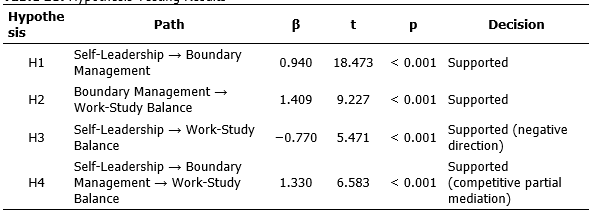
Working students must balance academic and work demands, yet evidence on how personal self-regulation translates into work-study balance is limited, particularly in Indonesia. This study aimed to examine the effect of self-leadership on work-study balance, with boundary management as a mediator, among working students at the Faculty of Economics and Business, Universitas Pamulang. A cross-sectional survey of 290 working students (cohorts 2022–2025, purposive sampling) was analyzed with PLS-SEM (SmartPLS 4). Self-leadership had a positive effect on boundary management (β = 0.940; p < 0.001), and boundary management had a positive effect on work-study balance (β = 1.409; p < 0.001). The direct effect of self-leadership on work-study balance was negative (β = −0.770; p < 0.001), whereas the indirect effect was positive (β = 1.330; p < 0.001), indicating competitive partial mediation. However, self-leadership and boundary management were not empirically distinct (HTMT = 0.986) and two coefficients exceeded 1.0, so the results should be regarded as preliminary. The findings point to boundary-management support as a practical focus for university student services. Limitations include the cross-sectional, self-reported data from a single faculty.