Institutional Conditions Under Which Earnings Management Affects Firm Value: A Structured Narrative Review
DOI:
https://doi.org/10.22437/element.v4i2.58218Keywords:
earnings management, financial governance, firm value, institutional quality, investor protectionAbstract
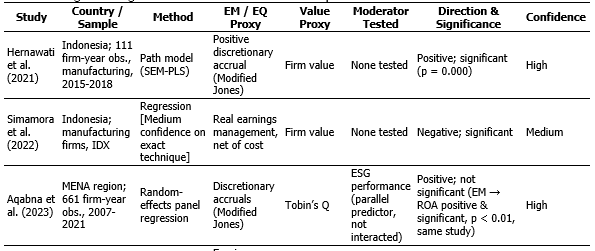
Earnings management’s consequences for firm value remain contested because prior findings diverge sharply across institutional settings. This study conducts a structured narrative review, strengthened by a vote-counting synthesis of six primary studies with independently verifiable results, to examine how earnings management relates to firm value, whether this relationship differs between accrual-based and real earnings management, and how institutional quality, investor protection, and financial reporting environments moderate it. Evidence was drawn from a targeted, verified body of accounting, finance, and management literature and integrated across agency theory, institutional theory, information asymmetry, signaling theory, the efficient market hypothesis, and stakeholder theory. Rather than a uniformly negative relationship, the review finds that direction depends systematically on measurement choice and institutional context: real earnings management measured net of its operational cost is associated with lower firm value, accrual-based measures show weaker or even positive associations, and one cross-country study shows the relationship reversing sign between strong- and weak-institution environments, with board oversight, ownership structure, and regulatory quality emerging as the governance mechanisms that explain this heterogeneity. This boundary-condition synthesis, integrating six theoretical perspectives into a single framework, is the review’s principal theoretical contribution; because it is a narrative rather than a PRISMA-compliant systematic review, its scope and access limitations are stated explicitly in the Methods. The findings offer managerial guidance for monitoring real activities manipulation and policy guidance for sequencing accounting-standard and enforcement reforms, together with a concrete agenda for the quantitative meta-analysis this literature still requires.