Empowering Youth to Enhance the Productivity of Hydroponic Horticultural Crops in Sungai Duren Village Jambi Luar Kota District
DOI:
https://doi.org/10.22437/gdymxn52Keywords:
Community Development, Holticultural Crops, Hydroponics, Product Diversification, Youth EmpowermentAbstract
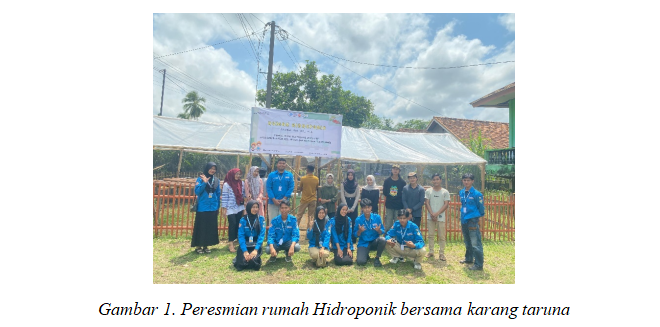
Young people have a strategic role in agricultural development through the adoption of modern technologies and innovative practices. In Sungai Duren Village, agricultural activities are predominantly carried out by farmers aged 45–60 years, highlighting the need to strengthen youth participation in agriculture. This community empowerment program aimed to improve youth skills in hydroponic horticulture while developing entrepreneurial opportunities through product diversification and digital marketing. The program involved practical training, construction of a hydroponic house, NFT-based cultivation of chili and long bean, horticultural product processing, digital marketing training, and continuous mentoring. Participants were directly involved in seedling preparation, nutrient management, plant maintenance, and harvesting. The harvested commodities were processed into value-added products, namely Kacapa (Kacang Panjang Pangsit) and Chiliku (Cabai Bubukku). The program demonstrated that integrating hydroponic cultivation, product diversification, and digital marketing can strengthen youth technical skills, entrepreneurial capacity, and awareness of environmentally responsible agricultural practices. The program also established a foundation for developing Kacapa and Chiliku as potential innovative village products and supporting the sustainability of youth-based agricultural activities in Sungai Duren Village.
References
Al Mamun, A., Naznen, F., Jingzu, G., & Yang, Q. (2023). Predicting the intention and adoption of hydroponic farming among Chinese urbanites. Heliyon, 9(3). https://doi.org/10.1016/j.heliyon.2023.e14420
Al-Shammary, A. A. G., Al-Shihmani, L. S. S., Fernández-Gálvez, J., & Caballero-Calvo, A. (2024). Optimizing sustainable agriculture: A comprehensive review of agronomic practices and their impacts on soil attributes. Journal of environmental management, 364, 121487. https://doi.org/10.1016/j.jenvman.2024.121487
Bathaei, A., & Štreimikienė, D. (2023). Renewable energy and sustainable agriculture: Review of indicators. Sustainability, 15(19), 14307.
Cabacungan, P. M., Cao, R. P., Manabat, B. K. A., Delos Reyes, I. D. L., Orocay, J. A. G., Osiones, K. A. H., ... & Tangonan, G. L. (2024, July). Cultivating futures: Integrating hydroponic gardens into educational curricula for community resilience and inter-generational learning. In International conference on WorldS4 (pp. 165-176). Singapore: Springer Nature Singapore. https://doi.org/10.1007/978-981-97-9327-3_14
Chowdhury, M., Samarakoon, U. C., & Altland, J. E. (2024). Evaluation of hydroponic systems for organic lettuce production in controlled environment. Frontiers in Plant Science, 15, 1401089. https://doi.org/10.3389/fpls.2024.1401089
Eprilianto, D. F., Kartika Sari, Y. E., Ma’ruf, M. F., Pradana, G. W., Lasmijan, & Febrianti, E. (2023, November). Village community empowerment through sustainable food program in realizing sustainable agriculture. In IOP Conference Series: Earth and Environmental Science (Vol. 1275, No. 1, p. 012022). IOP Publishing. https://doi.org/10.1088/1755-1315/1275/1/012022
Fathidarehnijeh, E., Nadeem, M., Cheema, M., Thomas, R., Krishnapillai, M., & Galagedara, L. (2023). Current perspective on nutrient solution management strategies to improve the nutrient and water use efficiency in hydroponic systems. Canadian Journal of Plant Science, 104(2), 88-102. https://doi.org/10.1139/cjps-2023-0034
Geza, W., Ngidi, M. S. C., Slotow, R., & Mabhaudhi, T. (2022). The dynamics of youth employment and empowerment in agriculture and rural development in South Africa: A scoping review. Sustainability, 14(9), 5041. https://doi.org/10.3390/su14095041
Girdziute, L., Besuspariene, E., Nausediene, A., Novikova, A., Leppala, J., & Jakob, M. (2022). Youth's (Un) willingness to work in agriculture sector. Frontiers in Public Health, 10, 937657. https://doi.org/10.3389/fpubh.2022.937657
Gong, M., Zhong, Y., Zhang, Y., Elahi, E., & Yang, Y. (2023). Have the new round of agricultural land system reform improved farmers' agricultural inputs in China?. Land Use Policy, 132, 106825. https://doi.org/10.1016/j.landusepol.2023.106825
Hidayah, U., Amo, F. M., & Klau, A. D. (2024). Social and economic development of rural border area in Malaka and Belu regencies (Border of Indonesia-Timor Leste). Jurnal Perencanaan Pembangunan: The Indonesian Journal of Development Planning, 8(2), 191-216. https://doi.org/10.36574/jpp.v8i2.588
Hilmawan, R., Aprianti, Y., Vo, D. T. H., Yudaruddin, R., Bintoro, R. F. A., Fitrianto, Y., & Wahyuningsih, N. (2023). Rural development from village funds, village-owned enterprises, and village original income. Journal of Open Innovation: Technology, Market, and Complexity, 9(4), 100159.
Karim, M. H., Diantoro, M., Nasikhudin, N., & Lestari, S. R. (2023). Implementation of agricultural technology urban farming agrivoltaic based system to increase productivity and empowerment of farmer women’s community. Journal of Community Service and Empowerment, 4(1), 184-195.
Kovshov, V., Lukyanova, M., Zalilova, Z., Frolova, O., & Galin, Z. (2024). International regional competitiveness of rural territories as a factor of their socio-economic development: Methodological aspects. Heliyon, 10(1). https://doi.org/10.1016/j.heliyon.2023.e23795
Kusuma, Y. A., Khoiri, H. A., Hariani, D. I., Bukhori, D., Talitha, T., Lutfianto, S., & Yuniahastuti, I. T. (2026). Community empowerment for family welfare program members in hydroponic vegetable cultivation within household surroundings. GANDRUNG: Jurnal Pengabdian Kepada Masyarakat, 7(2), 2932-2941. https://doi.org/10.36526/gandrung.v7i2.7965
Maswadi, M., Kusrini, N., Oktoriana, S., & Suharyani, A. (2025). Community economic empowerment using urban farming in Pontianak. PRIMA: Journal of Community Empowering and Services, 9(2), 108-113. https://doi.org/10.20961/prima.v9i2.99069
Ngadi, N., Zaelany, A. A., Latifa, A., Harfina, D., Asiati, D., Setiawan, B., ... & Rajagukguk, Z. (2023). Challenge of agriculture development in Indonesia: Rural youth mobility and aging workers in agriculture sector. Sustainability, 15(2), 922. https://doi.org/10.3390/su15020922
Nurmahmudah, E., Nuryuniarti, R., Herdiani, I., Apipudin, W., Gojali, R. F., & Suhartini, S. (2024). Community empowerment through hydroponic farming education to improve economy and public health. Community Empowerment, 9(11), 1591-1600. https://doi.org/10.31603/ce.11855
Pagano, G., Kiwior, M., Gross, J., Reyes, A., Ramos, E., Cumberbatch, I., ... & Tuininga, A. R. (2025, June). Greens do good: A hydroponic vertical farm augmented and virtual reality training prototype for autistic trainees. In International Conference on Immersive Learning (pp. 287-303). Cham: Springer Nature Switzerland. https://doi.org/10.1007/978-3-031-98080-0_18
Pandey, S. C., Modi, P., Pereira, V., & Fosso Wamba, S. (2025). Empowering small farmers for sustainable agriculture: A human resource approach to SDG-driven training and innovation. International Journal of Manpower, 46(4), 652-675. https://doi.org/10.1108/ijm-11-2023-0655
Rahman, M. A., Chakraborty, N. R., Sufiun, A., Banshal, S. K., & Tajnin, F. R. (2024). An AIoT-based hydroponic system for crop recommendation and nutrient parameter monitorization. Smart Agricultural Technology, 8, 100472. https://doi.org/10.1016/j.atech.2024.100472
Rahmania, N., Sureni, S., Hendratama, H., Tatsar, M. Z., & Zuhri, Z. (2024). Application of hydroponic technology to enhance the economic independence of rural communities. Bisma: Bimbingan Swadaya Masyarakat, 6(5), 353-366. https://doi.org/10.59689/bisma.v6i5.1180
Saikanth, D. K., Singh, B. V., Rai, A. K., Bana, S. R., Sachan, D. S., & Singh, B. (2023). Advancing sustainable agriculture: a comprehensive review for optimizing food production and environmental conservation. International Journal of Plant & Soil Science, 35(16), 417-425. https://doi.org/10.9734/ijpss/2023/v35i163169
Sanyaolu, M., & Sadowski, A. (2024). The role of precision agriculture technologies in enhancing sustainable agriculture. Sustainability, 16(15), 6668. https://doi.org/10.20944/preprints202407.0428.v1
Gunawan, E., Darwis, V., Ashari & Marhendro. (2022). Farmers’ perception, awareness, and constraints of organic rice farming in Indonesia. Open Agriculture, 7(1), 284-299. https://doi.org/10.1515/opag-2022-0090
Wahyuni, H. (2026). Empowering rural communities to support the development of educational tourism through organic hydroponic farming training in Sido Mulio Village, Langkat. Journal of Saintech Transfer, 9(1), 1-6. https://doi.org/10.32734/jst.v9i1.22868
Wang, A., Duncan, B., Duncan, E., Johnson, E., Wang, K., & Meade, B. (2026, June). Implementation of hydroponic teaching and research platforms at primarily undergraduate institutions. In Frontiers in education (Vol. 11, p. 1808562). Frontiers Media SA. https://doi.org/10.3389/feduc.2026.1808562
Wati, S. S., & Alisalman, M. (2025). Community empowerment in the probebaya program through hydroponic cultivation in RT 02, Gunung Lingai Village, Samarinda City. Empowerment: Jurnal Ilmiah Program Studi Pendidikan Luar Sekolah, 14(2), 292-298.
Wulandari, R., Fifintari, F. R., & Buddhisatyarini, T. (2022). Empowerment of urban communities in utilizing small courtyards with hydroponic technology. Community Empowerment, 7(8), 1294-1303. https://doi.org/10.31603/ce.6243
Yang, C., Ji, X., Cheng, C., Liao, S., Obuobi, B., & Zhang, Y. (2024). Digital economy empowers sustainable agriculture: Implications for farmers’ adoption of ecological agricultural technologies. Ecological Indicators, 159, 111723. https://doi.org/10.1016/j.ecolind.2024.111723
Downloads
Published
Issue
Section
License
Copyright (c) 2026 Eko Satria, Qonita Lutfiah, Sylka Azzahra, Jamaluddin, Sri Novita

This work is licensed under a Creative Commons Attribution 4.0 International License.
Please find the rights and licenses in Jurnal Jurnal Karya Abdi Masyarakat (JKAM).
- License
The non-commercial use of the article will be governed by the Creative Commons Attribution license as currently displayed on Creative Commons Attribution 4.0 International License.
- Authors Warranties
The author warrants that the article is original, written by stated author(s), has not been published before, contains no unlawful statements, does not infringe the rights of others, is subject to copyright that is vested exclusively in the author and free of any third party rights, and that any necessary written permissions to quote from other sources have been obtained by the author(s).
- User Rights
JKAM's spirit is to disseminate articles published are as free as possible. Under the Creative Commons license, JKAM permits users to copy, distribute, display, and perform the work for non-commercial purposes only. Users will also need to attribute authors and JKAM on distributing works in the journal.
- Rights of Authors
Authors retain the following rights:
- Copyright, and other proprietary rights relating to the article, such as patent rights,
- The right to use the substance of the article in future own works, including lectures and books,
- The right to reproduce the article for own purposes, provided the copies are not offered for sale,
- The right to self-archive the article.
- Co-Authorship
If the article was jointly prepared by other authors, the signatory of this form warrants that he/she has been authorized by all co-authors to sign this agreement on their behalf, and agrees to inform his/her co-authors of the terms of this agreement.
- Termination
This agreement can be terminated by the author or JKAM upon two months notice where the other party has materially breached this agreement and failed to remedy such breach within a month of being given the terminating party notice requesting such breach to be remedied. No breach or violation of this agreement will cause this agreement or any license granted in it to terminate automatically or affect the definition of JKAM.
- Royalties
This agreement entitles the author to no royalties or other fees. To such extent as legally permissible, the author waives his or her right to collect royalties relative to the article in respect of any use of the article by JKAM or its sublicensee.
- Miscellaneous
JKAM will publish the article (or have it published) in the journal if the articles editorial process is successfully completed and JKAM or its sublicensee has become obligated to have the article published. JKAM may conform the article to a style of punctuation, spelling, capitalization, referencing and usage that it deems appropriate. The author acknowledges that the article may be published so that it will be publicly accessible and such access will be free of charge for the readers.