The Role of the Oversight Mechanism in Fostering Ethical Work Climates in Municipal Local Governments
DOI:
https://doi.org/10.22437/cbt9fw43Keywords:
Accountability, Ethical Work Climate, Municipal Local Governments, Oversight Mechanism, Public SectorAbstract
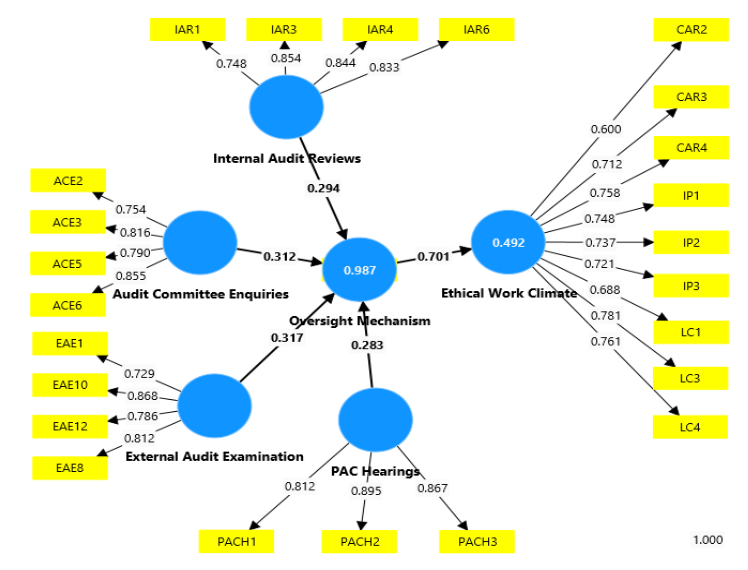
This study investigated the relationship between oversight mechanisms and ethical work climate in municipal local governments. The study is particularly relevant to developing-country contexts, where concerns regarding the misapplication of public resources and public accountability remain significant. A quantitative research approach was employed using a pre-coded structured questionnaire to collect data from respondents. Data were analyzed using SPSS and partial least squares structural equation modeling (PLS-SEM) to examine the relationships between the study variables. The findings confirmed a significant positive relationship between oversight mechanisms and ethical work climate, indicating that stronger oversight is associated with a more ethical work environment. The findings support previous research highlighting the importance of independent oversight in shaping ethical behavior within public organizations. The study provides evidence that strengthening oversight mechanisms can enhance compliance with laws and policies, promote ethical work environments, and support public accountability in municipal local governments. The study contributes to the literature by examining the combined role of four oversight mechanism functions—internal audit, audit committees, external audit, and Public Accounts Committees of Parliament—in fostering ethical work climate in municipal local governments within a developing-country context.
References
Acheampong, J. O., Dzordzoemenyoh, M. K., Bawole, J. N., Ahenkan, A., & Sakyi, E. K. (2023). Vertical accountability among ministries of state in an emerging economy: A case study of Ghana. Cogent Business & Management, 10(2), Article 2199488. https://doi.org/10.1080/23311975.2023.2199488
Al-Shboul, M. A. (2024). On the nexus between code of business ethics, human resource supply chain management and corporate culture: Evidence from MENA countries. Journal of Information, Communication and Ethics in Society, 22(1), 174–203.
Amoah, C., & Steyn, D. (2023). Barriers to unethical and corrupt practices avoidance in the construction industry. International Journal of Building Pathology and Adaptation, 41(6), 85–101.
Amoako, G. K., Bawuah, J., Asafo-Adjei, E., & Ayimbire, C. (2023). Internal audit functions and sustainability audits: Insights from manufacturing firms. Cogent Business & Management, 10(1), Article 2192313. https://doi.org/10.1080/23311975.2023.2192313
Anin, E. K., Essuman, D., Asare-Baffour, F., Manu, D., & Asamany, P. A. (2024). Enhancing procurement quality performance in a developing country: The roles of procurement audit and top management commitment. International Journal of Public Administration, 47(4), 283–294. https://doi.org/10.1080/01900692.2022.2116046
Auditor General. (2022). Payroll management in local governments for the financial year 2021/2022. Office of the Auditor General. https://www.oag.go.ug/
Ayepare, P., & Orueze, O. (2015). Functional impact of Public Accounts Committee on public accountability over financial crimes in Nigeria. Journal of Poverty, Investment and Development, 8, 53–82.
Azizkhani, M., Hossain, S., & Nguyen, M. (2023). Effects of audit committee chair characteristics on auditor choice, audit fee and audit quality. Accounting & Finance, 63, 3675–3707.
Badara, M. S., & Saidin, S. Z. (2014). Empirical evidence of the moderating effect of effective audit committee on audit experience in the public sector: Perception of internal auditors. Mediterranean Journal of Social Sciences, 5(10), 176–184.
Bananuka, J., Nkundabanyanga, S. K., Nalukenge, I., & Kawaase, T. (2018). Internal audit function, audit committee effectiveness and accountability in the Ugandan statutory corporations. Journal of Financial Reporting and Accounting, 16(1), 138–157.
Batista, D. A. (2024). Enhancing transparency and accountability in public procurement: Exploring blockchain technology to mitigate fraud. Records Management Journal. https://doi.org/10.1108/RMJ-10-2023-0054
Bisogno, M., Cuadrado-Ballesteros, B., Rossi, F. M., & Peña-Miguel, N. (2023). Sustainable development goals in public administrations: Enabling conditions in local governments. International Review of Administrative Sciences. https://doi.org/10.1177/00208523221146458
Bonsu, A. B., Appiah, K. O., Gyimah, P., & Afriyie, R. O. (2022). Public sector accountability: Do leadership practices, integrity and internal control systems matter? IIM Ranchi Journal of Management Studies, 2(1), 4–15.
Bovens, M., & Wille, A. (2021). Indexing watchdog accountability powers: A framework for assessing the accountability capacity of independent oversight institutions. Regulation & Governance, 15, 856–876.
Bradley, L., Favotto, A., & McKernan, J. (2023). Local authority audit in England, playing the field? Financial Accountability & Management, 39, 286–303. https://doi.org/10.1111/faam.12350
Castro, C., & Lopes, I. C. (2022). E-government as a tool in controlling corruption. International Journal of Public Administration. https://doi.org/10.1080/01900692.2022.2076695
Creswell, J. W., & Creswell, J. D. (2023). Research design: Qualitative, quantitative, and mixed methods approaches (6th ed.). SAGE Publications.
Cullen, J. B., Victor, B., & Bronson, J. W. (1993). The ethical climate questionnaire: An assessment of its development and validity. Psychological Reports, 73, 667–674.
Czukor, G., Ciinar, C., & Isik, I. (2021). Conceptualizations of societal development: An under-investigated construct and its potential implications for employee-organization fit. Journal of Social Sciences, 2(3), 527–539.
Dang, V. C., & Nguyen, O. K. (2022). Audit committee characteristics and tax avoidance: Evidence from an emerging economy. Cogent Economics & Finance, 10(1), Article 2023263. https://doi.org/10.1080/23322039.2021.2023263
Denzin, N. K., & Lincoln, Y. S. (2008). Strategies of qualitative inquiry (3rd ed.). SAGE Publications.
Ebaid, I. E. (2022). The courage of whistleblowing of prospective accountants: Evidence from Saudi Arabia. Journal of Applied Research in Higher Education, 15(3), 713–730.
Eisenhardt, K. M. (1989). Agency theory: An assessment and review. Academy of Management Review, 14(1), 57–74.
El-Deeb, M. S., Ismail, T. H., & El Banna, A. A. (2023). Does audit quality moderate the impact of environmental, social and governance disclosure on firm value? Further evidence from Egypt. Journal of Humanities and Applied Social Sciences, 5(4), 293–322. https://doi.org/10.1108/JHASS-11-2022-0155
Erich, C. F., Aharon, T., & Cristinel, V. (2023). Perceptions of ethical climate and organizational justice as antecedents to employee performance: The mediating role of employees' attributions of leader effectiveness. European Management Journal, 41, 114–124. https://doi.org/10.1016/j.emj.2021.11.003
Essien, E. E., & Anyadighibe, J. A. (2022). Public university workers’ perception of instrumental ethical work climate: An exploratory study based on demographic variables. International Journal of Educational Management, 36(7), 1394–1411.
Eriksen, A. (2021). Accountability and the multidimensional mandate. Political Research Quarterly, 74(2), 364–376. https://doi.org/10.1177/1065912920906880
Ferry, L., Midgley, H., & Ruggiero, P. (2023). Regulatory space in local government audit: An international comparative study of 20 countries. Public Money & Management, 43(3), 233–241. https://doi.org/10.1080/09540962.2022.2129559
Haldorai, K., Kim, W. G., Chang, H., & Li, J. (2020). Workplace spirituality as a mediator between ethical climate and workplace deviant behavior. International Journal of Hospitality Management, 86, Article 102372. https://doi.org/10.1016/j.ijhm.2019.102372
Hair, J. F., Hult, G. T. M., Ringle, C. M., Sarstedt, M., Danks, N. P., & Ray, S. (2021). Partial least squares structural equation modeling (PLS-SEM) using R: A workbook. Springer. https://doi.org/10.1007/978-3-030-80519-7
Hegazy, M., El-Deeb, M. S., Hamdy, H. I., & Halim, Y. T. (2023). Effects of organizational climate, role clarity, turnover intention, and workplace burnout on audit quality and performance. Journal of Accounting & Organizational Change, 19(5), 765–789.
Henseler, J., Ringle, C. M., & Sarstedt, M. (2015). A New Criterion for Assessing Discriminant Validity in Variance-Based Structural Equation Modeling. Journal of the Academy of Marketing Science, 43, 115-135.
https://doi.org/10.1007/s11747-014-0403-8
Hill, D. A., Johnson, S. G., Greco, L. M., Boyle, E. H., & Walter, S. L. (2021). Endogeneity: A review and agenda for the methodology-practice divide affecting micro and macro research. Journal of Management, 47(1), 105–147.
Hooi, T. K., Abu, B. H. N., & Rahim, A. I. K. M. (2018). Relationship of big data analytics capability and product innovation performance using SmartPLS 3.2.6: Hierarchical component modelling in PLS-SEM. International Journal of Supply Chain Management, 7(1), 51–64.
Ibietan, J. (2013). Corruption and public accountability in the Nigerian public sector: Interrogating the omission. European Journal of Business and Management, 5(15), 41–49.
Inspectorate of Government. (2020). Strengthening collaboration with Inspectorate Units in local governments to prevent corruption in ministries, departments, agencies and local governments. Inspectorate of Government of the Republic of Uganda. https://www.igg.go.ug/
Jakobsen, M., & Jensen, R. (2015). Common method bias in public management studies. International Public Management Journal, 18(1). https://doi.org/10.1080/10967494.2014.997906
Jensen, M. C., & Meckling, W. H. (1976). Theory of the firm: Managerial behavior, agency costs and ownership structure. Journal of Financial Economics, 3(4), 305–360.
Kemp, D., Kochan, K., & Burton, J. (2023). Critical reflections on the Juukan Gorge parliamentary inquiry and prospects for industry change. Journal of Energy & Natural Resources Law, 41(4), 379–402. https://doi.org/10.1080/02646811.2022.2156202
Knill, C., Steinebach, Y., & Zink, D. (2024). How policy growth affects policy implementation: Bureaucratic overload and policy triage. Journal of European Public Policy, 31(2), 324–351. https://doi.org/10.1080/13501763.2022.2158208
Krejcie, R. V., & Morgan, D. W. (1970). Determining sample size for research activities. Educational and Psychological Measurement, 30(3), 607–610.
Kumar, P. (2022). Human resource practices and job satisfaction in the hotel sector in India: An organizational perspective with SmartPLS analysis. SRUSTI Management Review, 15(2), 40–51. https://doi.org/10.13140/RG.2.2.30918.55366
Kuye, O. L., & Akinwale, O. E. (2021). Conundrum of bureaucratic processes and health service delivery in government hospitals in Nigeria. Journal of Humanities and Applied Social Sciences, 3(1), 25–48. https://doi.org/10.1108/JHASS-12-2019-0081
Kwon, J. (2023). Jurisdictional overlap: The juxtaposition of institutional independence and collaboration in police wrongdoing investigations. Regulation & Governance. https://doi.org/10.1111/rego.12532
Loke, C. H., Ismail, S., & Fatima, A. H. (2022). Ethical work climate and its influence on work-related ethical behavior among the Malaysian public sector auditors. International Journal of Ethics and Systems, 38(4), 720–741.
Mazzucato, M. (2024). Governing the economics of the common good: From correcting market failures to shaping collective goals. Journal of Economic Policy Reform. https://doi.org/10.1080/17487870.2023.2280969
Mbali, M., & Rucell, J. (2022). African voices in global health: Knowledge, creativity, accountability. Global Public Health, 17(12), 3993–4001.
Mwesigwa, D., & Oladapo, I. A. (2021). Accountability: A necessity to pro-poor service delivery in municipal councils in Uganda. Journal of Governance and Accountability Studies, 1(1), 43–54. https://doi.org/10.35912/jgas.v1i1.337
Nalukenge, I., Kaawaase, T. K., Bananuka, J., & Ogwal, P. F. (2021). Internal audit quality, punitive measures and accountability in Ugandan statutory corporations. Journal of Economic and Administrative Sciences. https://doi.org/10.1108/JEAS-05-2020-0084
Newton, P. M., Da-Silva, A., & Berry, S. (2020). The case for pragmatic evidence-based higher education: A useful way forward? Conceptual analysis. Frontiers in Education, 5, Article 583157. https://doi.org/10.3389/feduc.2020.583157
Ng’eni, F. B. (2016). Theoretical aspects underpinning public sector audit and financial accountability in Tanzanian local government authorities (LGAs). International Journal of Finance and Accounting. https://doi.org/10.5923/j.ijfa.20160501.06
Nxumalo, N., Gilson, L., Goudge, J., Tsofa, B., Susan, C., Barasa, E., & Molyneux, S. (2018). Accountability mechanisms and the value of relationships: Experiences of front-line managers at sub-national level in Kenya and South Africa. BMJ Global Health, 3, Article e000842. https://doi.org/10.1136/bmjgh-2018-000842
Oboh, C. S., Ajibolade, S. O., & Otusanya, O. J. (2020). Ethical decision-making among professional accountants in Nigeria: The influence of ethical ideology, work sector, and types of professional membership. Journal of Financial Reporting and Accounting, 18(2), 389–422.
Odongo, K. O., & Kazungu, I. (2023). Predictors of strategic procurement performance metrics adoption in county governments: Empirical evidence from Kakamega County Government, Kenya. LBS Journal of Management & Research, 21(1), 30–52. https://doi.org/10.1108/LBSJMR-05-2022-0010
Ong, M. H. A., & Puteh, F. (2017). Quantitative data analysis: Choosing between SPSS, PLS and AMOS in social science research. International Interdisciplinary Journal of Scientific Research, 3(1), 14–25.
Österberg, E. E., & Licht, J. D. F. (2023). Beyond auditor and audit: Exploring the governance of performance in eldercare. Public Management Review. https://doi.org/10.1080/14719037.2021.1937686
Podsakoff, P. M., MacKenzie, S. B., Lee, J. Y., & Podsakoff, N. P. (2012). Sources of method bias in social science research and recommendations on how to control it. Annual Review of Psychology, 63, 539–565.
Ramaano, A. I. (2024). Towards tourism-oriented community-based natural resource management for sustainability and climate change mitigation leadership in rural municipalities. Journal of Humanities and Applied Social Sciences. https://doi.org/10.1108/JHASS-07-2024-0099
Republic of Uganda. (1995). Constitution of the Republic of Uganda, 1995 (as amended). Uganda Printing and Publishing Corporation.
Republic of Uganda. (2008a). National Audit Act, 2008. Uganda Printing and Publishing Corporation.
Republic of Uganda. (2008b). The Local Governments (Financial and Accounting) Regulations, 2008. Uganda Printing and Publishing Corporation.
Republic of Uganda. (2016). Public Finance Management Regulations, 2016. Uganda Printing and Publishing Corporation.
Republic of Uganda. (2017). Treasury instructions, 2017. Uganda Printing and Publishing Corporation.
Rugeiyamu, R., & Nguyahambi, A. M. (2024). Advocacy non-governmental organizations (NGOs) resiliency to shrinking civic space in Tanzania. Journal of Humanities and Applied Social Sciences, 6(3), 258–279. https://doi.org/10.1108/JHASS-08-2023-0096
Sardana, N., Shekooh, S., Cornett, E., & Kaye, A. D. (2023). Qualitative and quantitative research methods. In A. D. Kaye, R. D. Urman, E. M. Cornett, & A. N. Edinoff (Eds.), Substance use and addiction research (pp. 65–69). Academic Press. https://doi.org/10.1016/B978-0-323-98814-8.00008-1
Sajari, A., Haorn, H., Ganesan, Y., & Khalid, A. A. (2022). Factors influencing the level of ethics and integrity in the Malaysian public sector. Journal of Islamic Accounting and Business Research. https://doi.org/10.1108/JIABR-09-2021-0256
Sibanda, M. M., Zindi, B., & Maramura, T. C. (2020). Control and accountability in supply chain management: Evidence from a South African metropolitan municipality. Cogent Business & Management, 7, Article 1785105. https://doi.org/10.1080/23311975.2020.1785105
Tasan-Kok, T., Van Der Hurk, M., Ozogul, S., & Bittencourt, S. (2019). Public accountability mechanisms in the governance of Dutch urban regeneration. European Planning Studies, 27(6), 1107–1128. https://doi.org/10.1080/09654313.2019.1598017
Triveni, G. R. V., & Danish, F. (2024). Exploring the dependability of combined ratio estimators in stratified ranked set sampling: Insights from COVID-19 data. Alexandria Engineering Journal, 92, 267–272.
Victor, B., & Cullen, J. B. (1987). A theory and measure of ethical climates in organizations. Research in Corporate Social Performance and Policy, 9, 51–71.
Victor, B., & Cullen, J. B. (1988). The organizational bases of ethical work climates. Administrative Science Quarterly, 33, 101–125.
Yapa, P. (2014). The oversight committees in developing countries: Public financial control and the expectations gap—Some empirical evidence from Sri Lanka. Asian Journal of Finance & Accounting, 6(1), 50–69.
Zhou, G., & Tawanda, Z. (2012). Auditing government institutions in Zimbabwe: Frameworks, processes and practices. International Journal of Accounting and Financial Reporting, 2(2), 218–237.
Downloads
Published
Issue
Section
License
Copyright (c) 2026 Christopher Neil Makanga

This work is licensed under a Creative Commons Attribution 4.0 International License.
Please find the rights and licenses in Jurnal Jurnal Karya Abdi Masyarakat (JKAM).
- License
The non-commercial use of the article will be governed by the Creative Commons Attribution license as currently displayed on Creative Commons Attribution 4.0 International License.
- Authors Warranties
The author warrants that the article is original, written by stated author(s), has not been published before, contains no unlawful statements, does not infringe the rights of others, is subject to copyright that is vested exclusively in the author and free of any third party rights, and that any necessary written permissions to quote from other sources have been obtained by the author(s).
- User Rights
JKAM's spirit is to disseminate articles published are as free as possible. Under the Creative Commons license, JKAM permits users to copy, distribute, display, and perform the work for non-commercial purposes only. Users will also need to attribute authors and JKAM on distributing works in the journal.
- Rights of Authors
Authors retain the following rights:
- Copyright, and other proprietary rights relating to the article, such as patent rights,
- The right to use the substance of the article in future own works, including lectures and books,
- The right to reproduce the article for own purposes, provided the copies are not offered for sale,
- The right to self-archive the article.
- Co-Authorship
If the article was jointly prepared by other authors, the signatory of this form warrants that he/she has been authorized by all co-authors to sign this agreement on their behalf, and agrees to inform his/her co-authors of the terms of this agreement.
- Termination
This agreement can be terminated by the author or JKAM upon two months notice where the other party has materially breached this agreement and failed to remedy such breach within a month of being given the terminating party notice requesting such breach to be remedied. No breach or violation of this agreement will cause this agreement or any license granted in it to terminate automatically or affect the definition of JKAM.
- Royalties
This agreement entitles the author to no royalties or other fees. To such extent as legally permissible, the author waives his or her right to collect royalties relative to the article in respect of any use of the article by JKAM or its sublicensee.
- Miscellaneous
JKAM will publish the article (or have it published) in the journal if the articles editorial process is successfully completed and JKAM or its sublicensee has become obligated to have the article published. JKAM may conform the article to a style of punctuation, spelling, capitalization, referencing and usage that it deems appropriate. The author acknowledges that the article may be published so that it will be publicly accessible and such access will be free of charge for the readers.