Student Achievement Rewards in Relation to Key Performance Indicator 3: A Qualitative Policy Evaluation at an Indonesian Public University
DOI:
https://doi.org/10.22437/1s61yf92Abstract
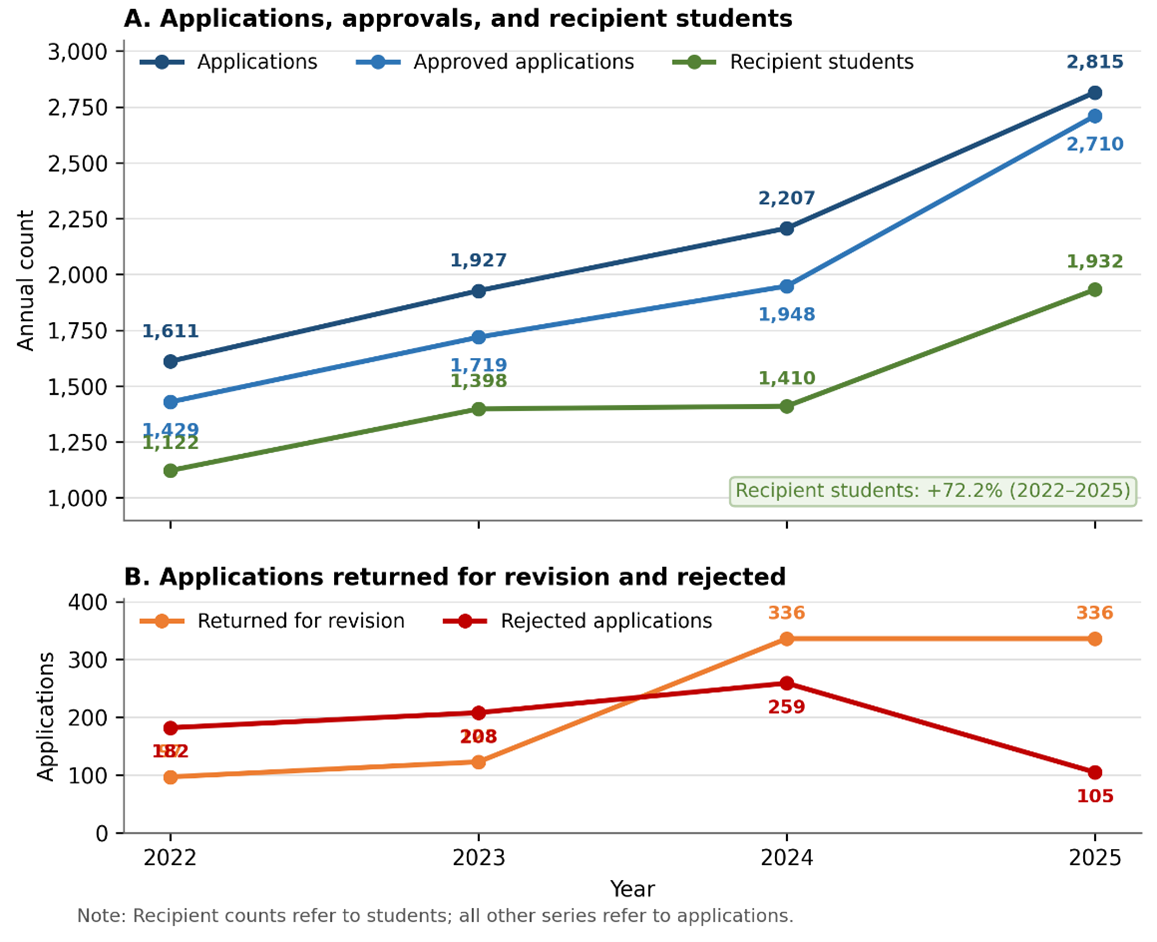
This study evaluates a student achievement reward policy at an Indonesian public university and examines its relevance to the student-achievement dimension of Key Performance Indicator 3 (IKU 3). Using a qualitative evaluative single-case design structured by Dunn’s six criteria, the study drew on 31 interviews—20 students, six faculty supervisors, four student-affairs officials and technical implementers, and one senior leader-alongside observation, document review, and institutional records from 2022–2025. Data were structurally coded and interpreted through cross-source triangulation and negative-case comparison. Rewards functioned primarily as institutional recognition and supplementary motivation rather than the main reason for entering competitions. SIMPELMAWA centralized submission and verification, but document deficiencies, peak-period workloads, limited status information, uneven dissemination, and partial financial coverage constrained administrative experience and equitable access. Because detailed expenditure data, formal service standards, faculty- and campus-disaggregated administrative denominators, and case-level reconciliation with official IKU 3 records were unavailable, the study does not claim formal cost-efficiency, statistically measured inter-unit equity, or measured IKU 3 conversion. Instead, it proposes a recognition-access-conversion model as an audit framework and recommends proactive communication, document pre-validation, service standards, system integration, equity monitoring, and periodic conversion audits.
Downloads
Published
Issue
Section
License
Copyright (c) 2026 Megha Nilasari Khoiro, Mufarrihul Hazin, Nuphanudin Nuphanudin, Amrozi Khamidi, Muhamad Sholeh, Mohammad Syahidul Haq, Budi Purwoko

This work is licensed under a Creative Commons Attribution 4.0 International License.