Governance Strategies for Meeting School Principal Needs in Indonesia's Education Transformation
DOI:
https://doi.org/10.22437/ideal.q9hck328Abstract
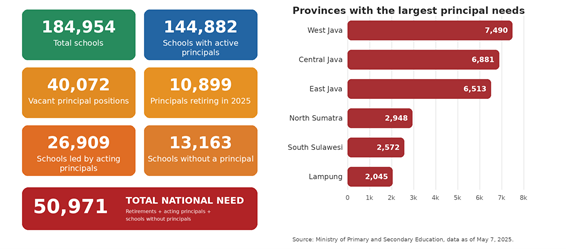
Indonesia's national education transformation depends on stable and professional school leadership, yet the appointment system continues to face large vacancies, reliance on acting principals, and uneven regional distribution. This study analyzes governance strategies for meeting school principal needs and examines the gap between the merit-based policy framework and implementation. A qualitative educational policy analysis was conducted through document review of national regulations, 2024-2025 education reports, official principal-need statistics, and 27 Scopus-indexed journal articles. The findings show a national need for 50,971 principals, comprising 10,899 impending retirements, 26,909 schools led by acting principals, and 13,163 schools without a principal. The problem reflects weak succession planning, candidate pipelines marked by inequitable access to preparation across regions, limited data integration, and context-insensitive distribution. The study proposes six mutually reinforcing strategies-fast-track appointment, cross-school redistribution, a ready-to-serve pipeline, conversion of acting principals, integrated digital governance, and affirmative support for priority regions—each mapped to implementing actors, classified by legal feasibility, and paired with post-appointment evaluation indicators. Its contribution lies in translating principal supply, selection, preparation, distribution, and digital governance into a legally grounded, actor-specific, and evaluable governance sequence rather than a purely conceptual framework, offering practical guidance for central and local governments.
Downloads
Published
Issue
Section
License
Copyright (c) 2026 Kasmir Kasmir, Arismunandar Arismunandar, Aswi Aswi

This work is licensed under a Creative Commons Attribution 4.0 International License.