Integrating UTAUT3 and UGT to Predict Artificial Intelligence Adoption in Elementary Schools
DOI:
https://doi.org/10.22437/dv8kmy78Abstract
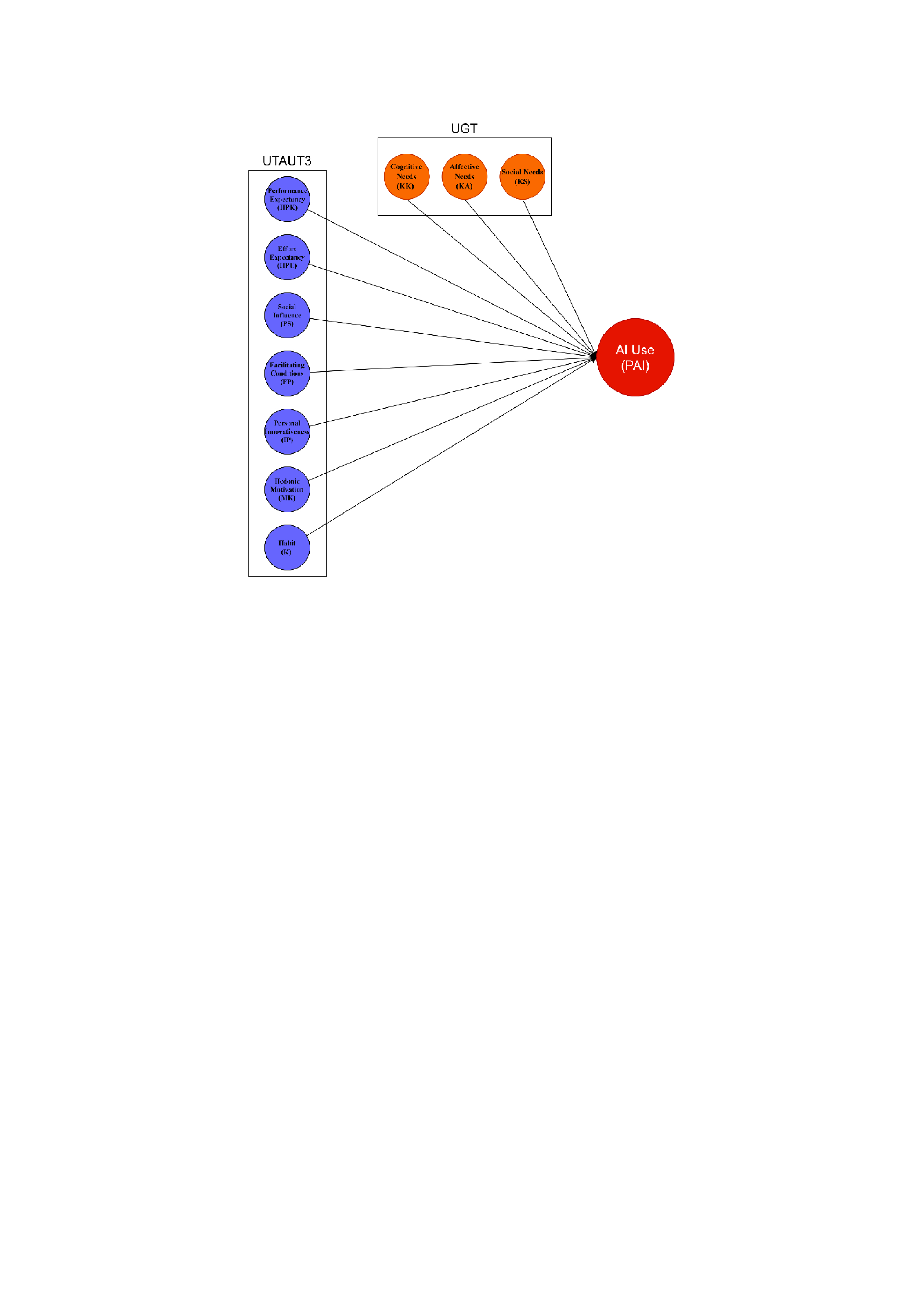
This study tests an integrated UTAUT3 and Uses and Gratifications Theory (UGT) model to predict Artificial Intelligence (AI) use among 1,050 elementary school teachers in Jambi Province, Indonesia. Using a quantitative survey design, the study analyzed the data with Partial Least Squares Structural Equation Modeling (PLS-SEM). Habit was the strongest predictor of AI use (β = 0.408, p < .001), followed by Social Needs (β = 0.172, p < .001), Hedonic Motivation (β = 0.112, p = 0.003), Cognitive Needs (β = 0.089, p = 0.016), Social Influence (β = 0.069, p = 0.018), and Personal Innovativeness (β = 0.065, p = 0.013). Affective Needs (β = 0.066, p = 0.116), Performance Expectancy (β = 0.048, p = 0.095), Effort Expectancy (β = -0.020, p = 0.514), and Facilitating Conditions (β = 0.030, p = 0.308) were not statistically significant. These results indicate that AI use in this setting is more strongly associated with habitual and psychosocial motivations than with conventional utility expectations. The findings suggest that educational policy should complement infrastructure and technical training with professional collaboration, AI literacy, and supportive school ecosystems. The integrated UTAUT3–UGT framework provides a useful basis for examining AI use among elementary school teachers in a developing-region context.
Downloads
Published
Issue
Section
License
Copyright (c) 2026 Alirmansyah Alirmansyah, Asrial Asrial, Muhammad Sofwan, Destrinelli Destrinelli, Akhmad Habibi

This work is licensed under a Creative Commons Attribution 4.0 International License.