Mapping Academic Expertise and Its Impact on Lecturer Career Development in Indonesian Islamic Universities: A Case Study of STAIN Mandailing Natal
DOI:
https://doi.org/10.22437/ideal.v8i1.55114Abstract
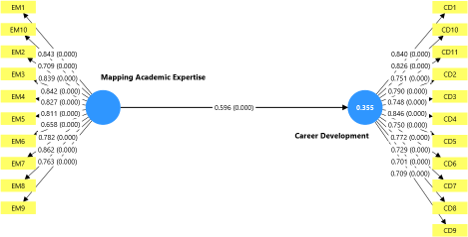
Amidst the demands of Education 5.0, higher education institutions are faced with the challenge of data-based academic resource management. This study discusses the influence of expertise mapping on the career development of lecturers at Islamic universities in Indonesia, focusing on the case study at the Mandailing Natal State Islamic College. Using an explanatory sequential mix method design. Quantitative data were analyzed using Structural Equation Modeling–Partial Least Squares (SEM-PLS) v4.1.1.2, while qualitative data were analyzed using NVivo. The findings reveal that expertise mapping significantly influences lecturer career development, with a path coefficient β = 0.596, p < 0.001, R² = 0.355, indicating a moderate explanatory effect. In addition, expertise mapping contributes positively to teaching quality improvement and lecturer productivity in scientific publications. These findings highlight expertise mapping as a strategic data-driven academic resource management model that supports lecturer career advancement, strengthens institutional policy development, and aligns higher education governance with the objectives of Education 5.0 and the Sustainable Development Goals (SDGs).
Downloads
Published
Issue
Section
License
Copyright (c) 2026 Novebri Novebri, Deden Deni Koswara, Aan Komariah, Dedy Achmad Kurniady, Asep Suryana, Hadiyanto Hadiyanto

This work is licensed under a Creative Commons Attribution 4.0 International License.