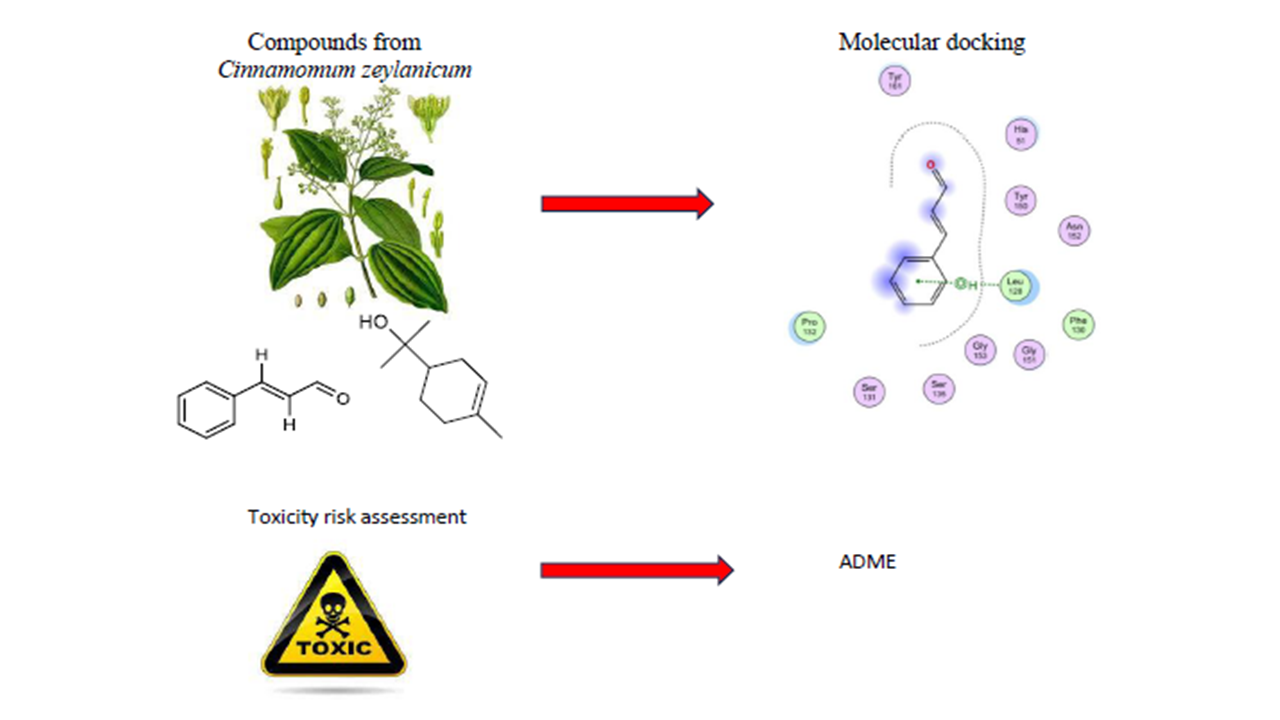
Molecular docking, prediction of drug-likeness properties, and toxicity risk assessment of compounds from Cinnamomum zeylanicum as inhibitors of Dengue DEN2 NS2B/NS3.
DOI:
https://doi.org/10.22437/chp.v9i2.43598Kata Kunci:
Cinnamomum zeylanicum, Dengue DEN2 NS2B/NS3, Docking, Drug-likeness, ToxicityAbstrak
Dengue hemorrhagic fever (DHF) is a serious mosquito-borne disease caused by the dengue virus, most often transmitted by the bite of female Aedes aegypti mosquitoes. In Indonesia, the number of DHF cases has steadily increased since the disease was first reported, underscoring the urgent need for effective treatments. This study used in silico methods to explore the potential of three bioactive compounds from Cinnamomum zeylanicum i.e. cinnamaldehyde, α-terpineol, and chavicol as inhibitors of the dengue virus NS2B/NS3 protease and evaluated their drug-likeness and potential toxicity. The compounds sourced from the NADI database were compared with panduratin A as a positive control. Molecular docking was performed using the Molecular Operating Environment (MOE) 2023.0901 software, and drug-likeness and toxicity predictions were performed using SwissADME and Protox-II. Among the tested compounds, α-terpineol exhibited the strongest potential to inhibit NS2B/NS3, while all three met the standard drug-likeness criteria. Notably, α-terpineol demonstrated the most favorable safety profile compared to cinnamaldehyde, chavicol, and panduratin A.
Unduhan
Referensi
[1]. Sutriyawan, A.; Aba, M.; and Habibi, J. Determinan Epidemiologi Demam Berdarah Dengue (DBD) Di Daerah Perkotaan: Studi Retrospektif’. Journal of Nursing and Public Health 2020; 8(2): 1–9. https://doi.org/10.37676/jnph.v8i2.1173
[2]. Frimayanti, N.; IKhtarudin, I.; Septama, A. W.; Susanty, A.; Isroq, N.D. Synthesis, In Silico and Structural Insight of Flavonol Derivative Compounds as New Competitive Dengue NS2B/NS3 Protease Inhibitor. Journal Research in Pharmacy 2023; 27(3): 1157-1169. http://dx.doi.org/10.29228/jrp.406
[3]. Guo, J.; Yan, S.; Jiang, X.; Su, Z.; Zhang, F.; Xie, J.; Hao, E.; Yao, C. Advances in pharmacological effects and mechanism of action of cinnamaldehyde. Frontier in Pharmacology. 2024; 15:1365949. https://doi.org/10.3389/fphar.2024.1365949
[4]. Loaiza-Cano, V.; Monsalve-Escudero L.M; Filho, C.D.S.M.B.;.Martinez-Gutierrez, M.; de Sousa, DP. Antiviral Role of Phenolic Compounds against Dengue Virus: A Review. Biomolecules. 2020; 11(1):11. https://doi.org/10.3390/biom11010011
[5]. Komarudin, AG.; Adharis, A.; Sasmono, R.T. Natural Compounds and Their Analogs as Antivirals Against Dengue Virus: A Review”. Phytotherapy Research. 2025; 39(2):888-921. https://doi.org/10.1002/ptr.8408
[6]. Vasconcelos, NG.; Croda, J.; Simionatto, S. Antibacterial mechanisms of cinnamon and its constituents: A review. Microbial Pathogenesis. 2018;120:198-203. https://doi.org/10.1016/j.micpath.2018.04.036
[7]. Rasool, N.; Ashraf, A.A.; Waseem, M.; Hussain, W.; & Mahmood, S. Computational exploration of antiviral activity of phytochemicals against NS2B/NS3 proteases from dengue virus. Turkish Journal of Biochemistry 2018; 44: 261 - 277.
https://doi.org/10.1515/TJB-2018-0002
[8]. Bari, M.A.; Ahmed, S.; Perveen, F.F.; Akter, M.; Ahmed, N.; Hossain, J.; Nasrulla, M.; Akter, K.; & Islam, M.N. Novel Antiviral Phytochemicals Against Dengue Virus 2 NS2B‐NS3 Protease: An In Silico Drug Development Approach. ChemistrySelect 2024. https://doi.org/10.1002/slct.202404053
[9]. Purohit, P.; Sahoo, S.; Panda, M.; Sahoo, P.S.; Meher, B.R. Targeting the DENV NS2B-NS3 protease with active antiviral phytocompounds: structure-based virtual screening, molecular docking and molecular dynamics simulation studies. Journal of Molecular Modeling. 2022. 28(365). https://doi.org/10.1007/s00894-022-05355-w
[10]. Frimayanti, N.; Lukman, A.; and Nathania, L. Studi molecular docking senyawa 1, 5-benzothiazepine sebagai inhibitor dengue DEN-2 NS2B/NS3 serine protease. Chempublish Journal 2021; 6(1): 54-62.
https://doi.org/10.22437/chp.v6i1.12980
[11]. Adawara, S. N.; Shallangwa, G. A.; Mamza, P. A.; and Ibrahim, A. Molecular docking and QSAR theoretical model for prediction of phthalazinone derivatives as new class of potent dengue virus inhibitors.” Beni-Suef University Journal of Basic and Applied Sciences 2020; 9(1): 1-17. https://doi.org/10.1186/s43088-020-00073-9
[12]. Wani, A.R., Yadav, K., Khursheed, A., & Rather, M.A. An updated and comprehensive review of the antiviral potential of essential oils and their chemical constituents with special focus on their mechanism of action against various influenza and coronaviruses. Microbial Pathogenesis 2020; 152: 104620. https://doi.org/10.1016/j.micpath.2020.104620
[13]. Ghosh, S.; Jana, K.; Parua, P.; Seth, A.; Bishal, A.; Debnath, B., Kumar Rout, S.; Halder, J.; Rai, V.K.; Dash, P.; Das, C.; Kar, B.; Ghosh, G.; & Rath, G. Antiviral Bioactive Compounds: Their Activities and Underlying Mechanisms Against Human Viral Infections. Recent advances in anti-infective drug discovery 2025. https://doi.org/10.2174/0127724344376918250328054623
[14]. Orosco FL, Quimque MTJ. “Antiviral potential of terpenoids against major viral infections: Recent advances, challenges, and opportunities. Journal of Advanced Biotechnology and Experimental Therapeutics. 2024; 7(1): 221-238. https://doi.org/10.5455/jabet.2024.d19
[15]. Frimayanti, N.; Septama, AW.; Teruna, HY.; Rahmi, E.P. In silico investigation of artocarpin, cycloarotcarpin, artocarpanone, and cyanomaclurin for Dengue virus inhibitor DEN2 NS2B/NS3 serine protease. Journal of Pharmacy & Pharmacognosy Research. 2025; 13 (1), 193-202. https://doi.org/10.56499/jppres24.2052_13.1.193
[16]. Frimayanti, N.; Yaeghoobi, M.; Ikhtiarudin, I.; Rizki, D.; and Putri, W. Insight on the In silico Study and Biological Activity Assay Molecular Docking”. Chiang Mai University. Chiang Mai Journal of Natural Sciences 2021; 20(1): 1–11. https://doi.org/10.12982/CMUJNS.2021.019
[17]. Lipinski, C. A.; Lombardo, F.; Dominy, B. W.; and Feeney, P. J. Experimental and computational approaches to estimate solubility and permeability in drug discovery and development settings. Advanced Drug Delivery Reviews. 2001; 46(1): 3-26.
https://doi.org/10.1016/S0169-409X(00)00129-0
[18]. Erbel, P.; Schiering, N.; D’Arcy, A.; Renatus, M.; Kroemer, M.; Lim, S. P.; Yin, Z.; Keller, T.H.; Vasudevan, S.G.; and Hommel,U. Structural Basic For The Activation of Flaviviral NS3 Proteases From Dengue and West Nile Virus. Nature Structural and Molecular Biology. 2006; 13(4): 372-373. https://doi.org/10.1038/nsmb1073
[19]. Daina, A.; Michielin, O.; and Zoete, V. SwissADME: a free web tool to evaluate pharmacokinetics, drug-likeness and medicinal chemistry friendliness of small molecules. Scientific reports. 2017; 7(1): 1-13. https://doi.org/10.1038/srep42717
[20]. Lipinski, C.A. Lead- and Drug-Like Compounds: The Rule-Of-Five Revolution. Drug Discovery Today: Technologies 2004; 1(4): 337–341. https://doi.org/10.1016/j.ddtec.2004.11.007
[21]. Veber, D. F., Johnson, S. R., Cheng, H. Y., Smith, B. R., Ward, K. W., and Kopple, K. D. Molecular properties that influence the oral bioavailability of drug candidates. Journal of medicinal chemistry. 2002. 45(12): 2615-2623. https://doi.org/10.1021/jm020017n
[22]. Ertl, P.; Rohde, B.; and Selzer, P. Fast Calculation of Molecular Polar Surface Area as a Sum of Fragment Based Contributions and its Application to the Prediction of Drug Transport Properties. Journal of Medicinal Chemistry. 2000; 43(20): 3714-3717. https://doi.org/10.1021/jm000942e
[23]. Banerjee, P.; Kemmler, E.; Dunkel, M.; Preissner, R. ProTox 3.0: a webserver for the prediction of toxicity of chemicals. Nucleic Acids Research. 2024. 52:513-520. https://doi.org/10.1093/nar/gkae303 .
[24]. Yang, H.; Sun, L.; Li, W.; Liu, G.; and Tang, Y. In silico prediction of chemical toxicity for drug design using machine learning methods and structural alerts. Frontiers in chemistry. 2018; 6(30): 1-12. https://doi.org/10.3389/fchem.2018.00030
[25]. Siramshetty, V.B.; Nickel, J.; Omieczynski, C.; Gohlke, B.O.; Drwal, M.N.; and Preissner, R. WITHDRAWN - A Resource for Withdrawn and Discontinued Drugs. Nucleic Acids Research 2016; 44(D1): 1080–1086. https://doi.org/10.1093/nar/gkv1192
[26]. Regev, A. Drug-induced liver injury and drug development: industry perspective. In Seminars in liver disease. Thieme Medical Publishers 2014; 34(2): 227-239. https://doi.org.10.1055/s-0034-1375962