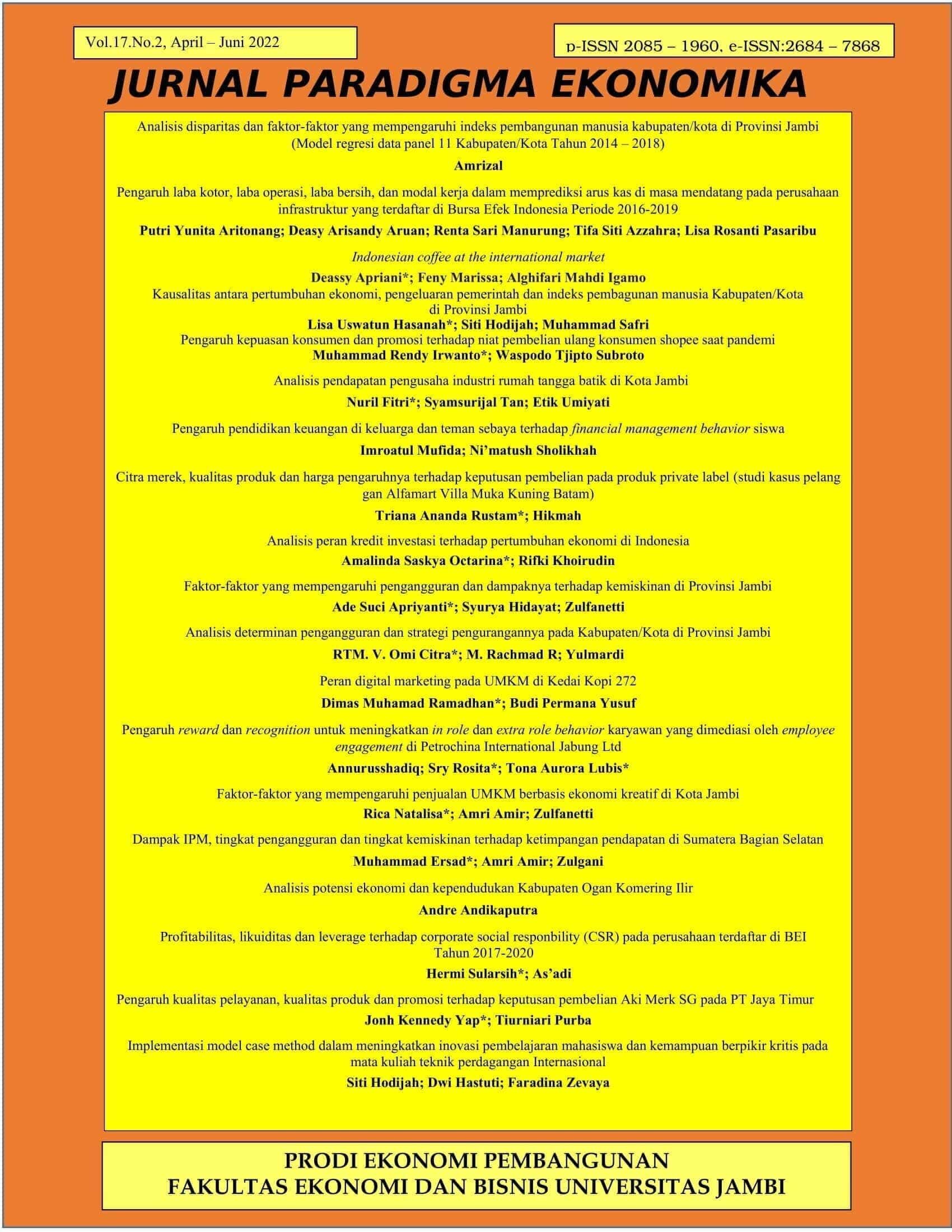
Pengaruh reward dan recognition untuk meningkatkan in role dan extra role behavior karyawan yang dimediasi oleh employee engagement di Petrochina International Jabung Ltd
DOI:
https://doi.org/10.22437/jpe.v17i2.18926Keywords:
reward, recognition, employee engagementAbstract
The pupose of this study was to examine and determine the effect of reward and recognition to increase in-role and extra-role behavior of employees mediated by employee engagement at Petrochina International Jabung Ltd. – Jambi. The sample used in as many as 81 respondents. Data collection and the method used is a method with a questionnaire that has been tested for validity and reliability then measured using a likert scale and the hypothesis is then analyzed by Structural Equation Modeling (SEM) based on Partial Least Squares Path Modeling (PLS-SEM) components. The results of statistical analysis prove that direct rewards have an insignificant effect on in-role and extra-role behavior and have no significant effect on employee engagement. Recognition directly has an insignificant effect on in-role and extra-role behavior and has a positive and significant effect on employee engagement. The results of statistical analysis also prove that employee engagement has a positive and significant effect on in-role and extra-role behavior. For the mediating effect of the employee engagement variable, it is proven that employee engagement can mediate the indirect influence relationship between recognition on in-role and extra-role behavior.
References
Allya Roosallyn Assyofa., A Fadhillah, D Abdurrahman, AR Assyofa. (2022).4th Social and humanities research symposium (SoRes 2021), 238-242.
Baqir, M., Campus, M., Hussain, S., Waseem, R., & Islam, K. M. A. (2020). Impact of reward and recognition, supervisor support on employee engagement. american international. Journal of Business and Management Studies, 2(3), 8–21. https://doi.org/10.46545/aijbms.v2i3.256
Bratton, John & Gold, Jeffrey. (2017). Human resources management theory and practice. Macmillan Press: London.
Brun, J. P., & Dugas, N. (2008). An analysis of employee recognition: perspective on human resource practice. The International Journal of Human Resource Management , 19 (4), 716-730
Byars, Lloyd L., Rue. (2010). Human resource management. Ninth Edition. New York : McGraw Hill. (Hal 25)
Christensen Hughes, J. dan Rog, E. (2008). Talent management: A strategy for improving employee recruitment, retention and engagement within hospitality organizations. International Journal of Contemporary Hospitality Management, 20(7), 743-757.
Gibson, James L, John M.Ivancevich, James H. Donnelly and Robert Konopaske. (2014). Organizatons behavior, structure, processes:fourteenth edition. Mc-Graw Hill Education: New York.
Güngör, Pinar. (2011). The relationship between reward management system and employee performance with the mediating role of motivation: a quantitative study on global banks. procedia - social and behavioral sciences. pp 1510–1520.https://doi.org/10.106j.sbspro.2011 .09.029
Ghozali, Imam, Hengky Latan. (2015). Konsep, teknik, aplikasi menggunakan smart PLS 3.0 untuk penelitian empiris. BP UNDIP: Semarang
Ng, P. K., & Tung, B. (2018). The importance of reward and recognition system in the leadership of virtual project teams: a qualitative research for the financial services sector. Journal of Transnational Management, 23(4), 198–214. https://doi.org/10.1080/15475778.2018.1512827
Nurofia, Fifie. (2005). Mengenal employee engagement. repository. maranatha.edu/2598/1/mengenal employee engagement. artikel employee engagement (diunduh 23 Maret 2014).
Organ, D.W., Podsakof, M.P., MacKenzie, B.S. (2006). Organizational citizenship behavior. Sage Publications, Inc: USA.
Podsakoff, MacKenzie., Moorman., & Fetter’s. (1990). Transformational leader behaviour and their effect on follower trust satisfaction and org anizational citizenship behavior. Leadership Quarterly , 1, 107-142.
Rai, A., Ghosh, P., Chauhan, R., & Singh, R. (2018). Improving in-role and extra-role performances with rewards and recognition: Does engagement mediate the process? Management Research Review, 41(8), 902–919. https://doi.org/10.1108/MRR-12-2016-0280
Rotundo, M. and Sackett, P.R. (2002) The relative importance of task, citizenship, and counterproductive performance to global aspects of job performance.
Schaufeli, Wilmar & Arnold Bakker. (2004). UWES, utrecht work engagement scale preliminary manual version 1.1. Netherland: Occupational Health Psychology Unit Utrecht University
Sanderson, C.A. (2004). Health psychology. USA: John Wiley and Sons, Inc.
Wiscombe Janet. (2001). Can pay for performance really work, work force, 80(8), 28-34
Zhu, Y. (2013). Individual behavior: in-role and extra-role. International Journal of Business Administration, 4, 23-27
Downloads
Published
Issue
Section
License
Copyright (c) 2022 Annurusshadiq Shadiq, Sry Rosita, Tona Aurora Lubis

This work is licensed under a Creative Commons Attribution-ShareAlike 4.0 International License.