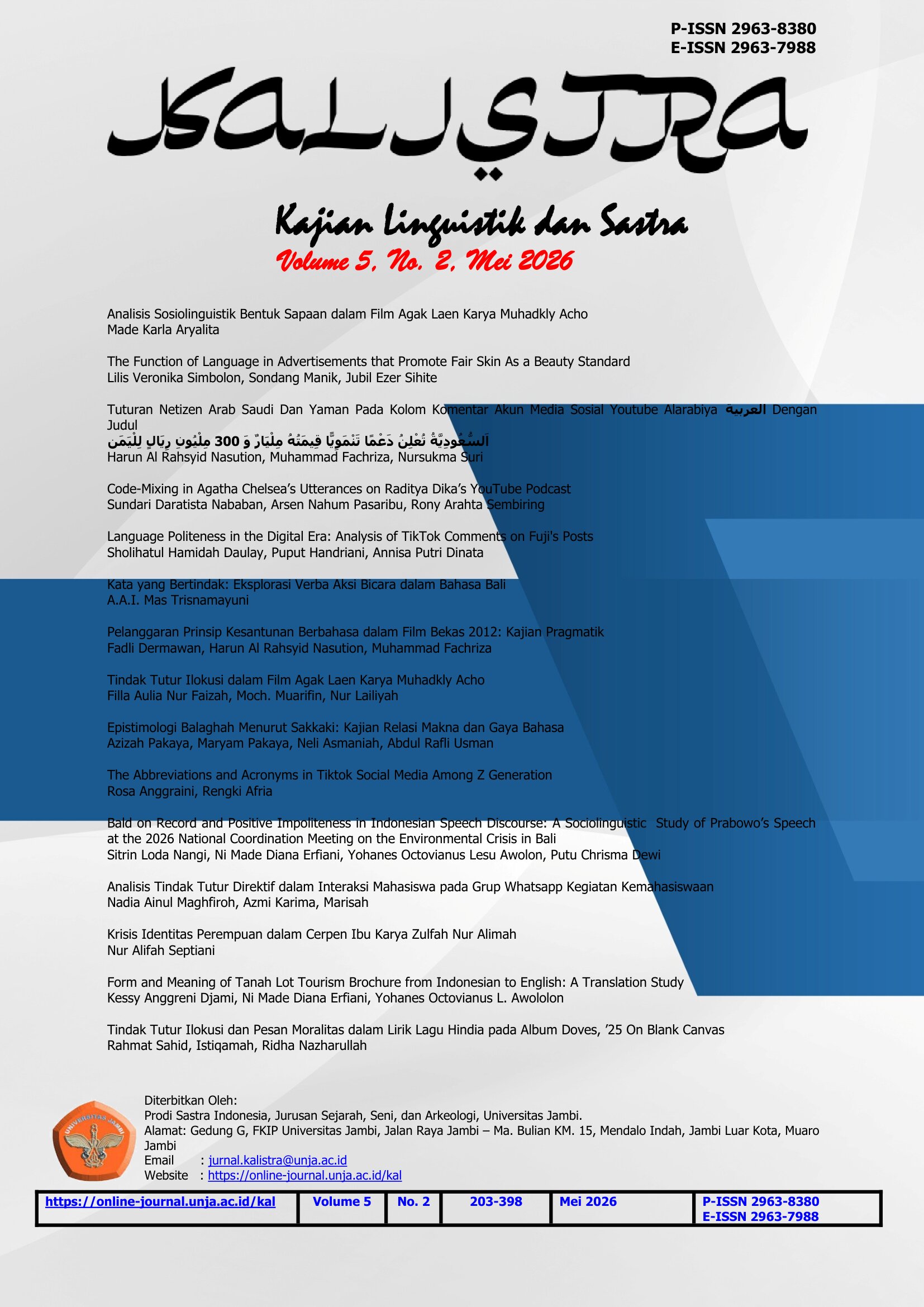
Form and Meaning of Tanah Lot Tourism Brochure from Indonesian to English : A Translation Study
DOI:
https://doi.org/10.22437/kalistra.v5i2.58403Kata Kunci:
translation, type, meaning, tourismAbstrak
This study aims to analyze the forms and meanings found in the translation of the Tanah Lot tourism brochure from Indonesian into English by applying Larson’s (1988) theory of form-based and meaning-based translation and Leech’s (1981) theory of the seven types of meaning. This study employed a descriptive qualitative method, using the bilingual Tanah Lot tourism brochure as the primary data source. The data were collected through document analysis and classified according to translation forms and meaning types. The findings reveal two translation forms in the brochure: form-based translation and meaning-based translation. Four data were identified as form-based translation, while seven data were categorized as meaning-based translation. Form-based translation was mainly used for proper names, locational descriptions, operational information, and institutional labels, whereas meaning-based translation was applied to culturally and spiritually significant expressions. The analysis also shows that conceptual meaning is the most dominant type of meaning, followed by connotative, social, affective, reflected, and collocative meanings. The study concludes that meaning-based translation is more effective in conveying cultural concepts and maintaining naturalness, while form-based translation is suitable for preserving factual information in tourism texts.
Abstrak
Penelitian ini bertujuan untuk menganalisis bentuk dan makna yang terdapat dalam terjemahan brosur wisata Tanah Lot dari bahasa Indonesia ke bahasa Inggris dengan menggunakan teori penerjemahan berbasis bentuk dan berbasis makna dari Larson (1988) serta teori tujuh jenis makna dari Leech (1981). Penelitian ini menggunakan metode deskriptif kualitatif dengan brosur wisata bilingual Tanah Lot sebagai sumber data utama. Data dikumpulkan melalui analisis dokumen dan diklasifikasikan berdasarkan bentuk penerjemahan serta jenis makna. Hasil penelitian menunjukkan adanya dua bentuk penerjemahan dalam brosur, yaitu penerjemahan berbasis bentuk dan penerjemahan berbasis makna. Sebanyak empat data termasuk dalam penerjemahan berbasis bentuk dan tujuh data termasuk dalam penerjemahan berbasis makna. Penerjemahan berbasis bentuk digunakan pada nama diri, deskripsi lokasi, informasi operasional, dan label institusional, sedangkan penerjemahan berbasis makna digunakan pada ungkapan yang mengandung unsur budaya dan spiritual. Analisis juga menunjukkan bahwa makna konseptual merupakan jenis makna yang paling dominan, diikuti oleh makna konotatif, sosial, afektif, reflektif, dan kolokatif. Penelitian ini menyimpulkan bahwa penerjemahan berbasis makna lebih efektif dalam menyampaikan konsep budaya dan menjaga kealamiahan bahasa sasaran, sedangkan penerjemahan berbasis bentuk lebih sesuai untuk mempertahankan informasi faktual dalam teks pariwisata.
Referensi
Alit Indonesia. (2021). Makna tirta bagi Hindu Bali. Retrieved from https://alitindonesia.or.id/makna-tirta-bagi-hindu-bali
Amanda, R., Hilman, A., & Agustina, D. (2022). Translation strategy and linguistic approach reference in The Little Prince novel. PROJECT (Professional Journal of English Education), 5(1), 1-8. https://doi.org/10.22460/project.v5i1.p124-132
Arbain, A. (2023). Translation techniques used and its shift in Stranger Things movie. Journal of English Educators Society, 8(2), 1-9. https://doi.org/10.21070/jees.v8i2.1758
Ardianto, F., et al. (2013). Pengaruh brosur melalui model pembelajaran STAD terhadap aktivitas dan penguasaan materi. Jurnal Bahasa dan Teknologi, 1(2), 1-9.
Asia Today. (2023, November 7). Tirta (holy water), Bali’s local wisdom concept in water conservation. Retrieved from https://asiatoday.id/read/tirta-holy-water-balis-local-wisdom-concept-in-water-conservation
Aulia, A., Fajri, D. R., & Hendra, H. (2023). An analysis of translation of idiomatic expression in The Perfect Date movie. Journal of English Language Teaching and Literature (JELTL), 6(2), 190-201. https://doi.org/10.30743/ll.v1i1.12098
Bhandesa, A. M., Sudiana, I. M., & Suamba, I. B. (2022). The concept of traditional medicine in Lontar Usada Yeh. Journal of Hindu Religious Research. https://doi.org/10.1007/irsr-2019-0008
Cambridge University Press. (n.d.). Souvenir. In Cambridge Dictionary. Retrieved June 19, 2025, from https://dictionary.cambridge.org/dictionary/english/souvenir
Creswell, J. W. (2014). Research Design: Qualitative, Quantitative, and Mixed Methods Approaches (4th ed.). California: SAGE Publications.
Hermawan, B., Salim, U., Rohman, F., & Rahayu, M. (2019). Spiritual journey to places considered sacred (Dharma Yatra). International Review for Spiritual Renewal, 9(1). https://doi.org/10.1007/irsr-2019-0008
Hinzler, H. I. R. (1993). Balinese Palm-Leaf Manuscripts. Leiden: KITLV Press.
Larson, M. L. (1988). Meaning-Based Translation: A Guide to Cross-Language Equivalence (2nd ed.). New York: University Press of America.
Leech, G. (1981). Semantics: The study of meaning (2nd ed.). Harmondsworth, England: Penguin Books.
Myers, J. E., Sweeney, T. J., & Witmer, J. M. (2000). The wheel of wellness counseling for wellness: A holistic model for treatment planning. Journal of Counseling & Development, 78(3), 251-266.
Nasution, S., & Kharisma, M. (2024). Translation analysis of tourism brochure “Borobudur: Inspiring Historical Heritage”. Journal of Language and Literature Studies, 8(1), 15-27. https://doi.org/10.37249/assalam.v8i1.680
Newmark, P. (1988). A Textbook of Translation. UK: Prentice Hall International.
Oxford University Press. (n.d.). Gift. In Oxford Learner’s Dictionaries. Retrieved June 19, 2025, from https://www.oxfordlearnersdictionaries.com/definition/english/gift
Paramita, A. A. G. K. (2021). Filosofi tirta sebagai air suci dalam implementasi upacara Dewa Yadnya. Widya Katambung: Jurnal Filsafat Agama Hindu, 12(2), 32-40. https://doi.org/10.33363/wk.v12i2.719
Putra, I. K. Y. D. (2023). A translation analysis on idiomatic in Boat Song by Ed Sheeran based on Larson’s theory. Prosiding SINTESA, 6, 605-612.
Riska, I. W. (2024). Pengembangan brosur kesehatan masyarakat berbasis pengobatan herbal. Educatoria Jurnal Ilmiah Ilmu Pendidikan, 4(1), 9-16. https://doi.org/10.36312/educatoria.v4i1.241
Riyono, A., Kurniati, D., Mutohhar, M., & Ma’mun, N. (2024). Cross-culture bridges in tourism: A study on translation strategies in Indonesian promotional materials. English Review: Journal of English Education, 12(2), 703-714. https://doi.org/10.25134/erjee.v12i2.9364
Soemarno, T. (1997). Sedikit Catatan Mengenai Teori Penerjemahan. Surakarta: UNS.
Soemarno, T. (1999). Makna dalam Penerjemahan. Surakarta: UNS.
Sutarya, I. G. (2020). The potentials and prospects of yoga pilgrimage exploration in Bali tourism. International Journal of Religious Tourism and Pilgrimage, 8(8). https://doi.org/10.21427/05cm-qk98
Zoetmulder, P. J. (1995). Kamus Jawa Kuno-Indonesia. Jakarta: Gramedia.
Unduhan
Diterbitkan
Terbitan
Bagian
Lisensi
Hak Cipta (c) 2026 Kessy Anggreni Djami, Ni Made Diana Erfiani, Yohanes Octovianus Lesu Awololon

Artikel ini berlisensiCreative Commons Attribution-ShareAlike 4.0 International License.
Kalistra: Kajian Linguistik dan Sastra is licensed under Creative Commons Attribution-ShareAlike 4.0 International License.

Authors who publish their manuscripts in Kajian Linguistik dan Sastra agree to the following terms:
1. The copyright in each article belongs to the author.
2. The author acknowledges that Kajian Linguistik dan Sastra reserves the right to be the first to publish under a Creative Commons Attribution-ShareAlike 4.0 International License (Attribution 4.0 International CC BY-SA 4.0).
3. Authors may submit articles separately, arranging for non-exclusive distribution of manuscripts that have been published in this journal to other versions (e.g., delivery to the author's institutional repository, publication into a book, etc.), acknowledging that the manuscript has been first published in Kajian Linguistik dan Sastra.