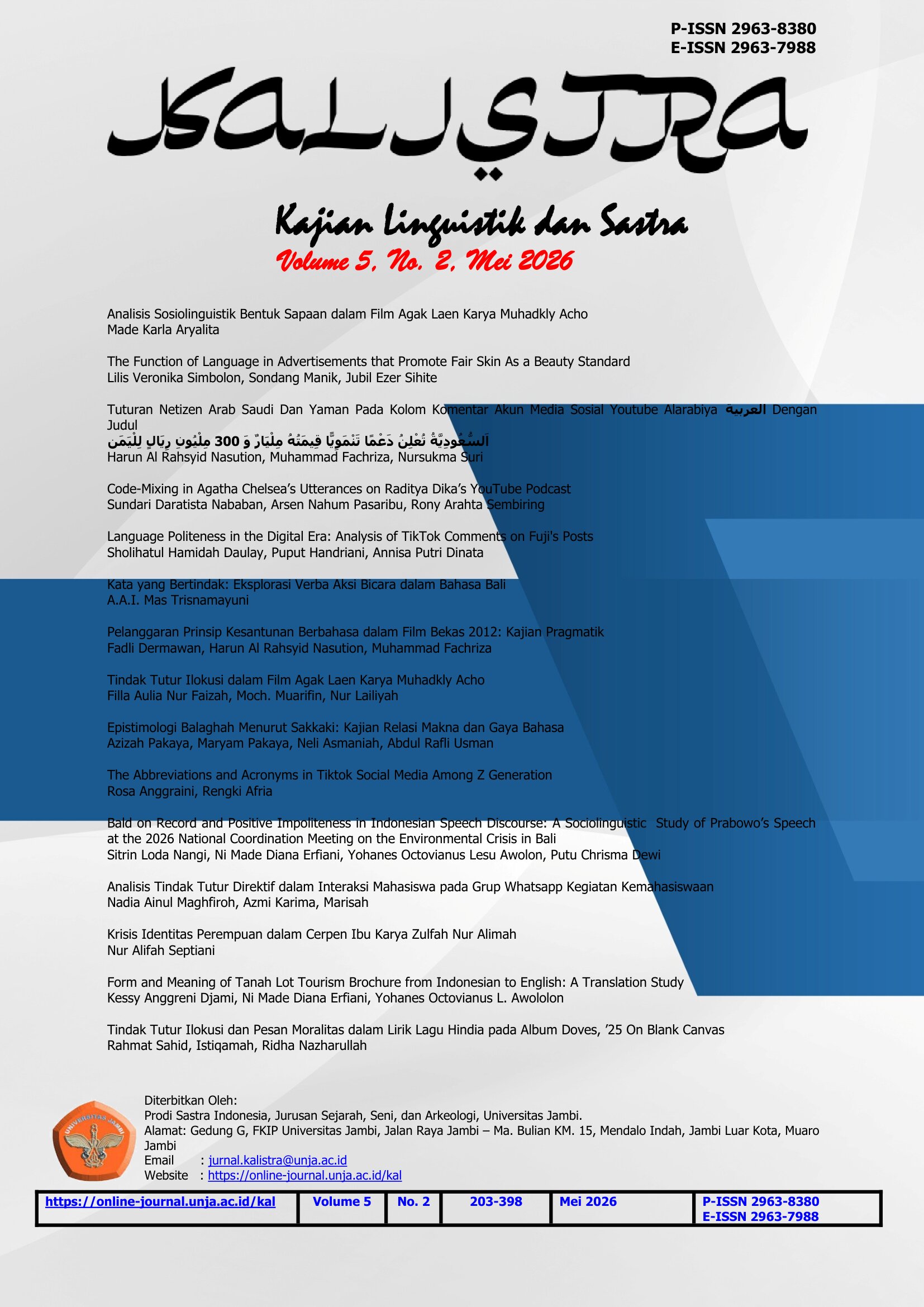
Bald on Record and Positive Impoliteness in Indonesian Speech Discourse: A Sociolinguistic Study of Prabowo’s Speech at the 2026 National Coordination Meeting on the Environmental Crisis in Bali
DOI:
https://doi.org/10.22437/kalistra.v5i2.56333Keywords:
strategies, impoliteness, presidential discourse, bald on recordAbstract
This study examines the use of bald on record and positive impoliteness strategies in President Prabowo Subianto's speech at the National Coordination Meeting (Rakornas) of the Central and Regional Governments held on February 2, 2026. In that forum, the President openly reprimanded the governors and regents of Bali in front of thousands of regional heads from all over Indonesia for their failure to handle the waste crisis, which was deemed to tarnish the national tourism image. This research uses a descriptive qualitative approach by applying Culpeper's (1996; 2011) impoliteness theory framework as the analytical instrument. The data are sourced from official transcripts and video recordings of the speech published by CNN Indonesia (2026) and cross referenced with the official transcript from the Cabinet Secretariat of the Republic of Indonesia. The analysis results show that the bald on record impoliteness strategy dominates through direct criticism without mitigation and explicit commands, while positive impoliteness is present through utterances that publicly belittle the competence of regional officials.
Abstrak
Studi ini meneliti penggunaan strategi bald on record dan positive impoliteness dalam pidato Presiden Prabowo Subianto pada Rapat Koordinasi Nasional (Rakornas) Pemerintah Pusat dan Daerah yang diadakan pada 2 Februari 2026. Dalam forum tersebut, Presiden secara terbuka menegur para gubernur dan bupati Bali di depan ribuan kepala daerah dari seluruh Indonesia atas kegagalan mereka menangani krisis sampah, yang dianggap mencemari citra pariwisata nasional. Penelitian ini menggunakan pendekatan kualitatif deskriptif dengan menerapkan kerangka teori ketidaksopanan Culpeper (1996; 2011) sebagai instrumen analisis. Data diambil dari transkrip resmi dan rekaman video pidato yang diterbitkan oleh CNN Indonesia (2026) dan dicross-referensikan dengan transkrip resmi dari Sekretariat Kabinet Republik Indonesia. Hasil analisis menunjukkan bahwa strategi ketidaksopanan bald on record mendominasi melalui kritik langsung tanpa mitigasi dan perintah eksplisit, sementara ketidaksopanan positif hadir melalui ucapan yang secara publik merendahkan kompetensi pejabat daerah.
References
Anwar, M., Amir, F. R., Zuhriyah, S. A., Purbasari, R., & Rosa, H. T. (2024). Language impoliteness in memes contesting the 2024 presidential elec-tion in Indonesia. JOLLT Journal of Languages and Language Teaching, 12(4), 1899–1912. https://doi.org/10.33394/jollt.v12i4.12801
Aprokoah, J. O. (2023). Impoliteness strategies in political discourse: A study of Nigeria's president's campaign speech. Awka Journal of English Lan-guage and Literary Studies, 11(1). https://doi.org/10.59284/ajells.2024.110
Balci, A., Yetim, H. T., & Dinler, M. (2025). The power of disrespect: Overt im-politeness and hierarchy in leader-level diplomacy. European Journal of International Relations. https://doi.org/10.1177/13691481251407495
Britos, J. C., Miras, E. L., Villaraiz, A. V. S., & Syting, C. J. O. (2025). Impolite-ness in the Office of the Vice President confidential fund congressional hearing: A socio-pragmatic analysis. European Journal of Literature, Language and Linguistics Studies, 9(3), 118–133. https://doi.org/10.46827/ejlll.v9i3.659
Brown, P., & Levinson, S. C. (1987). Politeness: Some universals in language usage. Cambridge University Press.
Chankova, M. (2023). Evaluations of appropriateness through impoliteness in political discourse reframed for entertainment purposes. Lodz Papers in Pragmatics, 19(2), 279–299. https://doi.org/10.1515/lpp-2023-0015
Culpeper, J. (1996). Towards an anatomy of impoliteness. Journal of Pragmat-ics, 25(3), 349–367. https://doi.org/10.1016/0378-2166(95)00014-3
Culpeper, J. (2011). Impoliteness: Using language to cause offence. Cambridge University Press. https://doi.org/10.1017/CBO9780511975752
Culpeper, J., & Hardaker, C. (2017). Impoliteness. In J. Culpeper, M. Haugh, & D. Z. Kádár (Eds.), The Palgrave handbook of linguistic (im)politeness (pp. 199–225). Palgrave Macmillan. https://doi.org/10.1057/978-1-137-37508-7_8
Culpeper, J., Bousfield, D., & Wichmann, A. (2003). Impoliteness revisited: With special reference to dynamic and prosodic aspects. Journal of Pragmatics, 35(10–11), 1545–1579. https://doi.org/10.1016/j.pragma.2003.06.001
Hasanah, R., Murni, S. M., & Lubis, F. K. (2024). Impoliteness strategies used by haters and supporters of presidential candidates in cyber-conflicts. Proceedings of English Linguistic and Literature, 4, 16–19.
Ikechukwu-ibe , C. J (2025). An analysis of impoliteness as the oppositional discourse in the Nigerian EndSARS protest. African Identities, 23(1), 128–144. https://doi.org/10.1080/14725843.2023.2227355
Kaulika, A., Salim Mansyur, A., & Wardoyo, C. (2024). Impoliteness strategies in hate comments on Noah Schnapp's Instagram post. Celtic: A Journal of Culture, English Language Teaching, Literature and Linguistics, 11(2), 449–464. https://doi.org/10.22219/celtic.v11i2.33866
Lubis, D. N., Tantira, N., Sibarani, L. P. S., Siagian, T. L., & Rangkuti, R. (2025). Impoliteness strategies in online political discourse: A study of hate comments on Ahmad Sahroni's Instagram account. Linguistics and ELT Journal, 13(2). https://doi.org/10.31764/leltj.v13i2.36958
Mbaka, N., & Atieno, C. (2025). Impoliteness strategies in political discourse during the impeachment of the deputy president of Kenya: A case study of Hansard parliamentary discourse. Open Access Library Journal, 12, e14214. https://doi.org/10.4236/oalib.1114214
Murti, R. W., Pratama, H., & Yulianto, H. J. (2024). Impoliteness strategies in online political discourse: A case study of Indonesian netizens' com-ments on TikTok. English Education Journal, 14(3), 428–439. https://doi.org/10.15294/eej.v14i3.15973
Nurfitria, R., & Wijana, I. D. P. (2025). Impoliteness strategies in the comment section of Donald Trump's Instagram account. Anglophile Journal, 5(1), 41–54. https://doi.org/10.51278/anglophile.v5i1.1482
Pasaribu, S., Marchella, Y., Dywanti, R. D., & Ardiansyah, R. (2025). Analysis of impoliteness strategies in YouTube comment sections. Jurnal Sadewa: Publikasi Ilmu Pendidikan, Pembelajaran dan Ilmu Sosial, 3(3). https://doi.org/10.61132/sadewa.v3i3.2028
Rabab’ah, G. (2025). Political rhetorical force: Analyzing the dynamics of threat in President Biden's speeches. Cogent Social Sciences, 11(1). https://doi.org/10.1080/23311886.2025.2582839
Saragi, C. N. (2026). Digital impoliteness strategies in response to Finance Min-ister Purbaya's assertions on the high-speed Whoosh project. JOLLT Journal of Languages and Language Teaching. https://doi.org/10.33394/jollt.v14i1.18410
Setiawati, E., & Salamah. (2024). Navigating impoliteness in political discourse on social media: A cyber pragmatics analysis of the 2024 Indonesian presidential election. Journal of Pragmatics and Discourse Research, 5(2), 222–231.
Simanjuntak, H. M., (2024). Impoliteness strategies in the third Indonesia presidential debate 2024: Pragmatics research. Jurnal Onoma: Pendidi-kan, Bahasa, dan Sastra, 10(3), 2635–2646. https://doi.org/10.30605/onoma.v10i3.4080
Situmorang, Y. F., Lestari, F. D., & Sinaga, N. T. (2024). Impoliteness strate-gies of the hate comments on Twitter. ALACRITY: Journal of Education, 4(3), 220–228. https://doi.org/10.52121/alacrity.v4i3.437
Tsoumou, J. M. (2023). “What is wrong with you people that you are happy someone has Covid”: Impoliteness in the coronavirus pandemic era. SAGE Open, 13(1). https://doi.org/10.1177/21582440231161040
Downloads
Published
Issue
Section
License
Copyright (c) 2026 Sitrin Loda Nangi, Ni Made Diana Erfiani, Yohanes Octovianus Lesu Awolon, Putu Chrisma Dewi

This work is licensed under a Creative Commons Attribution-ShareAlike 4.0 International License.
Kalistra: Kajian Linguistik dan Sastra is licensed under Creative Commons Attribution-ShareAlike 4.0 International License.

Authors who publish their manuscripts in Kajian Linguistik dan Sastra agree to the following terms:
1. The copyright in each article belongs to the author.
2. The author acknowledges that Kajian Linguistik dan Sastra reserves the right to be the first to publish under a Creative Commons Attribution-ShareAlike 4.0 International License (Attribution 4.0 International CC BY-SA 4.0).
3. Authors may submit articles separately, arranging for non-exclusive distribution of manuscripts that have been published in this journal to other versions (e.g., delivery to the author's institutional repository, publication into a book, etc.), acknowledging that the manuscript has been first published in Kajian Linguistik dan Sastra.