Artikel Uji toksisitas akut oral xilooligosakarida dari hidrolisis xilan jerami menggunakan enzim rekombinan Endo-β-1,4-D-Xylanase
Studi Toksisitas Xilooligosakarida
DOI:
https://doi.org/10.22437/chp.v10i1.49759Kata Kunci:
analisis biokimia klinis, analisis hematologi, enzim xilanase rekombinan, pemeriksaan histologis, toksisitas oral akutAbstrak
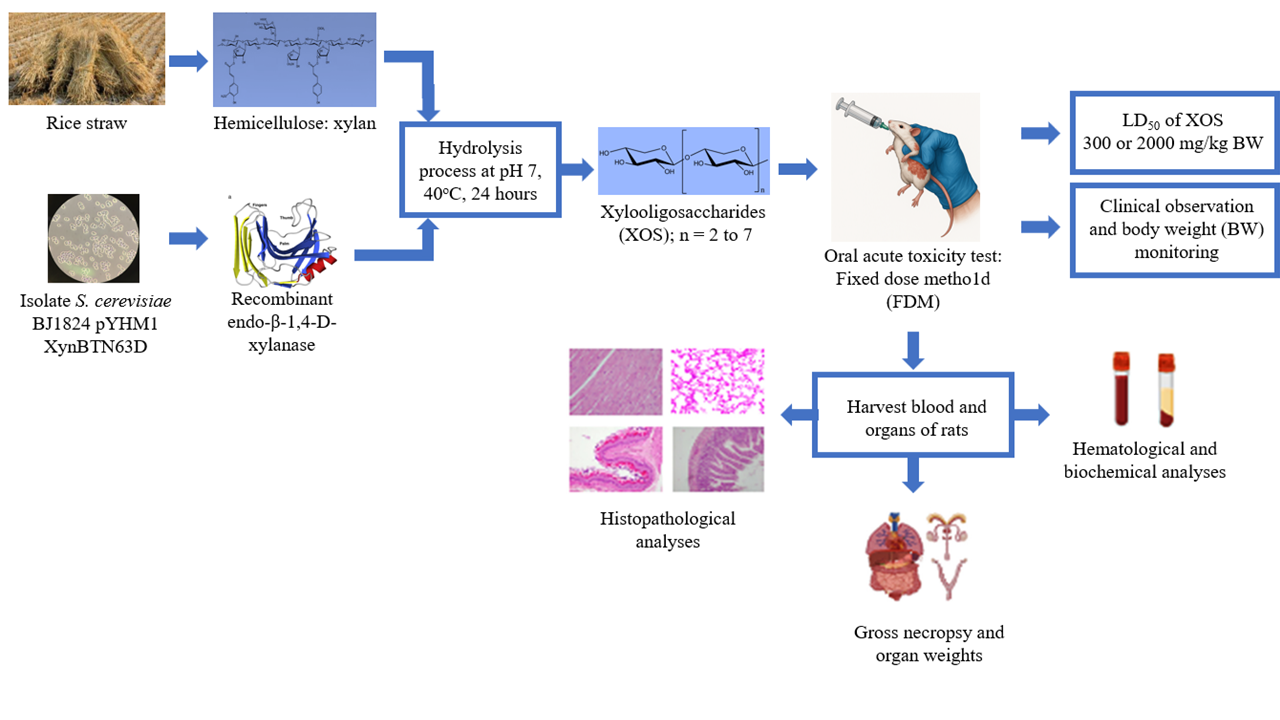
Xylooligosakarida (XOS) dikenal sebagai prebiotik yang merangsang perkembangbiakan bakteri probiotik dan meningkatkan produksi asam lemak rantai pendek (SCFA). Dibandingkan dengan prebiotik lainnya, XOS menawarkan keunggulan penting, termasuk stabilitas termal dan toleransi terhadap rentang pH yang luas. Berdasarkan atribut-atribut ini, penelitian ini bertujuan untuk mengevaluasi potensi toksisitas XOS yang berasal dari xilan jerami padi yang dihidrolisis menggunakan endo-β-1,4-D-xilanase rekombinan yang diekspresikan dalam Saccharomyces cerevisiae. Toksisitas oral akut dinilai pada tikus Wistar jantan dengan dosis tunggal 2000 mg/kg berat badan, dengan observasi dilakukan selama periode 14 hari. Parameter yang dievaluasi meliputi berat badan, gejala klinis, indeks hematologi dan biokimia, serta perubahan makroskopis dan histopatologis. Tanda-tanda toksisitas teramati sebagai perubahan konsistensi tinja dalam 4 hingga 24 jam pertama, sedangkan kematian terjadi pada tiga tikus jantan. Meskipun berat badan menunjukkan kecenderungan meningkat, terutama pada laki-laki, perkiraan nilai LD₅₀ berkisar antara >500 dan 2000 mg/kg berat badan, sehingga XOS tergolong cukup toksik. Selain itu, pemeriksaan histopatologi menunjukkan adanya perubahan patologis pada ginjal dan hati, sedangkan analisis biokimia serum menunjukkan perubahan metabolik yang masih dalam batas normal. Secara keseluruhan, temuan ini menunjukkan bahwa XOS memiliki potensi prebiotik yang menjanjikan; namun, penelitian lebih lanjut diperlukan untuk memastikan keamanan jangka panjangnya untuk diterapkan pada produk makanan.
Referensi
[1] Turck D, Bresson JL, Burlingame B, Dean T, Fairweather-Tait S, Heinonen M, Hirsch-Ernst KI, Mangelsdorf I, McArdle HJ, Naska A, Neuhauser-Berthold M, Nowicka G, Pentieva K, Sanz Y, Siani A, Sjodin A, Stern M, Tome D, Vinceti M, Willatts P, Engel KH, Marchelli R, Pöting A, Poulsen M, Schlatter JR, Turla E, and van Loveren H., “Safety of xylo-oligosaccharides (XOS) as a novel food pursuant to Regulation (EU) 2015/2283,” EFSA Journal, vol. 16, no. 7, 2018, https://doi.org/10.2903/j.efsa.2018.5361
[2] Arome D and Chinedu E. The importance of toxicity testing. Journal of Pharmaceutical and BioScience, 2014. 4(2013): 146-148.
[3] Boonchuay P, Wongpoomchai R, Jaturasitha S, Mahatheeranont S, Watanabe M, and Chaiyaso T. Prebiotic properties, antioxidant activity, and acute oral toxicity of xylooligosaccharides derived enzymatically from corncob. Food Bioscience, 2021. 40, https://doi.org/10.1016/j.fbio.2021.100895
[4] Ali K, Nadia N., Muhammad W., Waqas A., Mudassar H, Muhammad UK, Assam BT, Ali R, and Imran MK. Xylooligosaccharides: A comprehensive review of production, purification, characterization, and quantification. Food Research International. 2025.https://doi.org/10.1016/j.foodres.2024.115631
[5] Corim Marim AV, and Gabardo S. Xylooligosaccharides: prebiotic potential from agro-industrial residue, production strategies and prospects. Biocatalysis and Agricultural Biotechnology. 2021. https://doi.org/10.1016/j.bcab.2021.102190
[6] Samanta AK. Jayapal N, Jayaram C, Roy S, Kolte AP, Senani S, and Sridhar M. Xylooligosaccharides as prebiotics from agricultural by-products: Production and applications. Bioactive Carbohydrates and Dietary Fibre. 2015, https://doi.org/10.1016/j.bcdf.2014.12.003
[7] Santibáñez L, Henríquez C, Corro-Tejeda R, Bernal S, Armijo B, and Salazar O. Xylooligosaccharides from lignocellulosic biomass: A comprehensive review,” Carbohydrate Polymers. 2021. https://doi.org/10.1016/j.carbpol.2020.117118
[8] Singh RD, Nadar CG, Muir J, and Arora A. Green and clean process to obtain low degree of polymerisation xylooligosaccharides from almond shell. Journal Cleaner Production. 2019. 241. https://doi.org/10.1016/j.jclepro.2019.118237
[9] Ratnadewi AAI, Suwardiyanto H, Masruroh, and Santoso AB. Application of Coffee Peel Waste as Raw Material for Xylooligosaccharide Production. Coffee Science, 2019. 14:446–454. https://doi.org/10.25186/cs.v14i4.1610
[10] Ratnadewi AAI, Santoso AB, Sulistyaningsih E, and Handayani W. Application of Cassava Peel and Waste as Raw Materials for Xylooligosaccharide Production Using Endoxylanase from Bacillus subtilis of Soil Termite Abdomen. Procedia Chemistry. 2016. 18:31–38, https://doi.org/10.1016/j.proche.2016.01.007
[11] Ratnadewi AAI. Production of Xylooligosaccharide from Cassava Pulp’s Waste by Endo-β-1,4-D-Xylanase and Characterization of Its Prebiotic Effect by Fermentation of Lactobacillus acidophilus. Fermentation. 2022. 8(10), https://doi.org/10.3390/fermentation8100488
[12] Ratnadewi AAI, Handayani W, Oktavianawati I, Santoso AB, and Puspaningsih NNT. Isolation and Hydrolysis Xylan from Soybean Waste with Endo-β-1,4-D-Xilanase of Bacillus sp. From Soil Termite Abdomen. Agriculture and Agricultural Science Procedia, 2016.9:371–377.https://doi.org/10.1016/j.aaspro.2016.02.152
[13] Ali S, Hamayun M, Siraj M, Khan SA, Kim HY, and Lee B. Recent advances in prebiotics: Classification, mechanisms, and health applications. Future Foods. 2025. https://doi.org/10.1016/j.fufo.2025.100680
[14] Gao Y, Zhang S, Li C, Xiao L, Shen J, and Yin J. Acute and subchronic toxicity of xylo-oligosaccharide in mice and rats,” Toxicology Mechnisms Methods. 2012. 22(8): 605–610. https://doi.org/10.3109/15376516.2012.706837
[15] Jain M, Gote M, Dubey A, Narayanan S, Krishnappa H, Kumar D, Ravi G, Vijayasarathi S, and Shankar S. Safety evaluation of fructooligosaccharide (FOSSENCE TM): Acute, 14-day, and subchronic oral toxicity study in Wistar rats. Toxicology Research and Application. 2018. 2, https://doi.org/10.1177/2397847318787750
[16] Kpemissi M, Metowogo K, Melila M, Veerapur V, Negru M, Taulescu M, Potârniche A, Suhas D, Puneeth T, Vijayakumar S, Eklu-Gadegbeku K, Aklikokou K. Acute and subchronic oral toxicity assessments of Combretum micranthum (Combretaceae) in Wistar rats. Toxicology Reports. 2020. 7:162–168. https://doi.org/10.1016/j.toxrep.2020.01.007
[17] Connell E. Tietz Textbook of Clinical Chemistry and Molecular Diagnostics (5th edn). Annals of Clinical Biochemistry: International Journal of Laboratory Medicine, 2021. 49(6). https://doi.org/10.1258/acb.2012.201217
[18] Kumar M, Dandapat S, Prasad Sinha M, Kumar A, and Raipat BS. Different blood collection methods from rats: A review,” Balneo Research Journal. 2017. 8(2). https://doi.org/10.12680/balneo.2017.141
[19] Chitlange (Kasat) SN, Jungare SA, and Ghangale SG. Six Sigma Metrics: Indicator of Quality Assurance for Clinical Biochemistry. International Journal Advanced Research (Indore). 2024. 12(01). https://doi.org/10.21474/ijar01/18105
[20] de Freitas C, Carmona E, and Brienzo M. Xylooligosaccharides production process from lignocellulosic biomass and bioactive effects. Bioactive Carbohydrates and Dietary Fibre. 2019. 18. https://doi.org/10.1016/j.bcdf.2019.100184
[21] Widiadnyani NKE, and Sudimartini LM. The Akut Toxicity Testing Lethal Dose Oral Green Meniran Leaf Extract by Using Mice. Buletin Veteriner Udayana. 2024, https://doi.org/10.24843/bvu.v16i1.71
[22] Sabilla GA and Widiyanto S. Effect of SNEDDS (self-nanoemulsifying drug delivery system) kawista leaf aqueous extract (Limonia acidissima L.) on body and organ weight of Rats. Bioscience. 2021. 5(2). https://doi.org/10.24036/0202152113065-0-00
[23] Wijayanti HN, Fadhilah YN, Yuniarti WM, Lukiswanto BS, Arimbi A, Suprihati E, Kurnijasanti R. Protective effect of Moringa oleifera leaves extract against gentamicin induced hepatic and nephrotoxicity in rats. Iraqi Journal of Veterinary Sciences. 2023. 37(1).https://doi.org/10.33899/ijvs.2022.133276.2197
[24] Noor Z, Kusindarta DL, Sadewa AH, Heriyanto DS, Hadiati DR, and Mustofa. Acute toxicity of the galactagogue phytomedicine containing Sauropus androgynous, Trigonella foenum-graecum, and Moringa oleifera. Pharmaceutical Sciences Asia. 2022. 49(4). https://doi.org/10.29090/psa.2022.04.21.217
[25] Marjawan H, Pratiwi WR, Nugrahaningsih DAA, Sholikhah EN, and Satriyo PB. Acute Oral Toxicity Test of Antihypertensive Polyherbal Preparations Containing Allium sativum Curcuma aeruginosa & Amomi fructus. Majalah Farmaseutik. 2022. 18(4). https://doi.org/10.22146/farmaseutik.v18i4.79299
[26] Tandi J, Mariani NMI, and Setiawati NP. Potensi Ekstrak Etanol Daun Afrika (Gymnanthemum amygdalinum (Delile) Sch. Bip, Ex walp) Terhadap Penurunan Kadar Glukosa Darah dan Histopatologi Pankreas Tikus Putih Jantan (Rattus norvegicus) yang Diinduksi Streptocotocin dan Pakan Tinggi Lemak. Majalah Farmasetika. 2020. 4. https://doi.org/10.24198/mfarmasetika.v4i0.25861
[27] Himawan S. Patologi, 1st ed. Jakarta: Fakultas Kedokteran Universitas Indonesia, 1994.
[28] Oktora MZ, Setiamurti SM, and Khomeini K. Perubahan Gambaran Histologik Paru Mencit (Mus musculus) yang Terpapar Asap Rokok. Health and Medical Journal. 2023. 5(2).https://doi.org/10.33854/heme.v5i2.1286