Integrative Network Pharmacology and Molecular Docking Analysis of Tinospora crispa L. for Breast Cancer Therapy
Keywords:
breast cancer, molecular docking, network pharmacology, Tinospora crispaAbstract
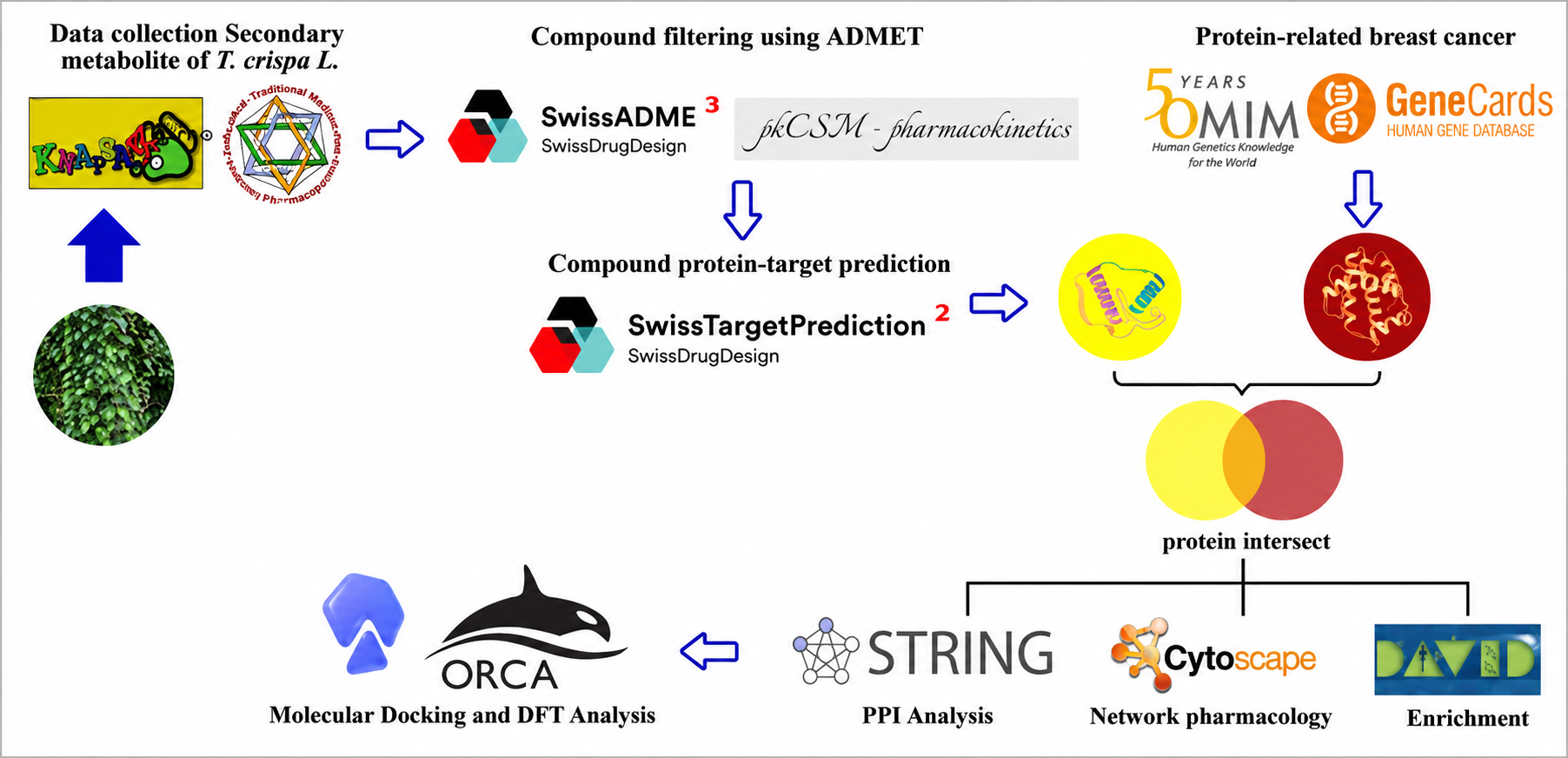
Breast cancer remains one of the leading mortality causes of disease related to cancer. Therefore, it is necessary to explore novel alternative therapeutic, particularly through the utilization of plant-derived natural product. Tinospora crispa L. contains diverse bioactive compounds with reported antioxidant and anticancer activities. This study integrates network pharmacology and molecular docking approaches to elucidate the molecular mechanisms of T. crispa against breast cancer. A total of 72 overlapping targets were identified between T. crispa compounds and breast cancer-related proteins, forming a highly interconnected PPI network consisting of 72 nodes and 340 edges. Clustering and enrichment analyses revealed that second cluster was significantly associated with cancer-related pathways, including AKT1, MAPK, and EGFR. The compound–protein–pathway network demonstrated two compound from T. crispa, apigenin and cycloeucalenone, possessed the highest degrees, suggesting their central regulatory roles. Molecular docking further confirmed these findings, showing that cycloeucalenone exhibited the strongest binding affinity toward EGFR and AKT1 through extensive hydrophobic interactions, whereas apigenin bound more stably to MAPK3 via multiple hydrogen bonds and hydrophobic interactions. These findings indicate that T. crispa compounds may exert anticancer effects by modulating multiple oncogenic pathways, supporting their potential development as multi-target agents in breast cancer therapy.
References
[1]. Andi Herawati, Syamsu Rijal, Arsal ASF, Reeny Purnamasari, Abdi DA, Syarifuddin Wahid. Karakteristik Kanker Payudara. Fakumi Medical Journal: Jurnal Mahasiswa Kedokteran. 2021 Oct 31;1(1):44–53. DOI: 10.33096/fmj.v1i1.76
[2]. Ozmen V. Breast cancer in the world and Turkey. Journal of Breast Health. 2008;4(2):6–12.
[3]. Yun D, Yoon SY, Park SJ, Park YJ. The Anticancer Effect of Natural Plant Alkaloid Isoquinolines. International Journal of Molecular Sciences. 2021 Feb 6;22(4):1653. DOI: 10.3390/ijms22041653
[4]. Kopustinskiene DM, Jakstas V, Savickas A, Bernatoniene J. Flavonoids as Anticancer Agents. Nutrients. 2020;12(2):457. DOI:10.3390/nu12020457
[5]. Othman A, Mukhtar NJ, Ismail NS, Chang SK, Alam S., Phenolics, flavonoids content and antioxidant activities of 4 Malaysian herbal plants. International Food Research Journal. 2014.21(2):759-766.
[6]. Warsinah W, Baroroh HN, Harwoko H. Phytochemical Analysis and Antioxidant Activity of Brotowali (Tinospora crispa L. Mier) Stem. Molekul. 2020. 27;15(2):73. DOI:10.20884/1.jm.2020.15.2.533
[7]. Yusoff M, Hamid H, Houghton P. Anticholinesterase Inhibitory Activity of Quaternary Alkaloids from Tinospora crispa. Molecules. 2014 Jan 20;19(1):1201–11. DOI:10.3390/molecules19011201
[8]. Martani NS, Fatmaria F. Pemanfaatan Penawar Sampai (Tinospora crispa L.) sebagai Tanaman Obat Tradisional oleh Suku Dayak Ngaju. Jurnal Pharmascience. 2020. 31;7(2):156. DOI: 10.20527/jps.v7i2.8799
[9]. Hopkins AL. Network pharmacology. Nature Biotechnology. 2007 Oct;25(10):1110–1. DOI: 10.1038/nbt1007-1110
[10]. Noor F, Tahir ul Qamar M, Ashfaq UA, Albutti A, Alwashmi ASS, Aljasir MA. Network Pharmacology Approach for Medicinal Plants: Review and Assessment. Pharmaceuticals. 2022;15(5):572. DOI:10.3390/ph15050572
[11]. Jiao X, Jin X, Ma Y, Yang Y, Li J, Liang L, et al. A comprehensive application: Molecular docking and network pharmacology for the prediction of bioactive constituents and elucidation of mechanisms of action in component-based Chinese medicine. Computational Biology and Chemistry. 2021. 90:107402. DOI:10.1016/j.compbiolchem.2020.107402
[12]. Pagadala NS, Syed K, Tuszynski J. Software for molecular docking: a review. Biophysical Review. 2017; 91–102. DOI: 10.1007/s12551-016-0247-1
[13]. Pinzi L, Rastelli G. Molecular Docking: Shifting Paradigms in Drug Discovery. International Journal of Molecular Sciences. 2019, 4;20(18):4331. DOI:10.3390/ijms20184331
[14]. Puthanveedu V, Muraleedharan K. Phytochemicals as potential inhibitors for COVID-19 revealed by molecular docking, molecular dynamic simulation, and DFT studies. Structural Chemistry. 2022. 13;33(5):1423–43. DOI:10.1007/s11224-022-01982-4
[15]. Eberhardt J, Santos-Martins D, Tillack AF, Forli S. AutoDock Vina 1.2.0: New Docking Methods, Expanded Force Field, and Python Bindings. Journal of Chemical Information and Modeling. 2021. 23;61(8):3891–8. DOI: 10.1021/acs.jcim.1c00203
[16]. Trott O, Olson AJ. AutoDock Vina: Improving the speed and accuracy of docking with a new scoring function, efficient optimization, and multithreading. Journal of Computational Chemistry. 2009;31(2):455-461.DOI:10.1002/jcc.21334
[17]. Lipinski CA. Lead- and drug-like compounds: the rule-of-five revolution. Drug Discovery Today: Technology. 2004,1(4):337–41. DOI:10.1016/j.ddtec.2004.11.007
[18]. Pratas A, Malhão B, Palma R, Mendonça P, Cervantes R, Marques-Ramos A. Effects of apigenin on gastric cancer cells. Biomedicine & Pharmacotherapy. 2024.172:116251. DOI:10.1016/j.biopha.2024.116251
[19]. Pham TH, Page Y Le, Percevault F, Ferrière F, Flouriot G, Pakdel F. Apigenin, a Partial Antagonist of the Estrogen Receptor (ER), Inhibits ER-Positive Breast Cancer Cell Proliferation through Akt/FOXM1 Signaling. International Journal of Molecular Sciences. 2021,22(1):470. DOI:10.3390/ijms22010470
[20]. Zhang Y, Yang C, Guo J, Yan L, Li Y, Zhang Y. Anticancer Potential of β-Sitosterol: A Comprehensive Exploration of Mechanisms and Therapeutic Prospects. The American Journal of Chinese Medicine. 2025;53(04):1241–63. DOI: 10.1142/S0192415X2550048X
[21]. Farshori NN, Al-Oqail MM, Al-Sheddi ES, Al-Massarani SM, Alam P, Siddiqui MA, et al. HPTLC estimation and anticancer potential of Aloe perryi petroleum ether extract (APPeE): A mechanistic study on human breast cancer cells (MDA-MB-231). Journal of King Saud University-Science. 2022. 34(4):101968. DOI: 10.1016/j.jksus.2022.101968
[22]. Cairns J, Fridley BL, Jenkins GD, Zhuang Y, Yu J, Wang L. Differential roles of ERRFI1 in EGFR and AKT pathway regulation affect cancer proliferation. EMBO Reports. 2018. 15;19(3). DOI:10.15252/embr.201744767
[23]. Yang S, Manna C, Manna PR. Harnessing the Role of ESR1 in Breast Cancer: Correlation with microRNA, lncRNA, and Methylation. International Journal of Molecular Sciences. 2025. 27;26(7):3101. DOI:10.3390/ijms26073101
[24]. Kaboli PJ, Imani S, Jomhori M, Ling KH. Chemoresistance in breast cancer: PI3K/Akt pathway inhibitors vs the current chemotherapy. American Journal of Cancer Research. 2021;11(10):5155–83.
[25]. Smith B, Williams J, Schulze-Kremer S. The ontology of the gene ontology. AMIA Annual Symposium Proceedings. 2003;2003:609–13. PMID: 14728245.
[26]. Ashburner M, Ball CA, Blake JA, Botstein D, Butler H, Cherry JM, et al. Gene Ontology: tool for the unification of biology. Nature Genetics. 2000, 25(1):25–9. DOI: 10.1038/75556
[27]. Ali IJ, Olofinsan KA, Ikeh GO, Okorie NH, Adonu CC, Omeh RC, et al. Anti‐Inflammatory, Antioxidant, Molecular Docking and Pharmacokinetics Properties of Cycloeucalenone Isolated from Musa paradisiaca L. Fruit Peels. Chemistry Biodiversity. 2025. 23(1). DOI:10.1002/cbdv.202502342
[28]. Dong R, Wang J, Guan R, Sun J, Jin P, Shen J. Role of Oxidative Stress in the Occurrence, Development, and Treatment of Breast Cancer. Antioxidants. 2025, 17;14(1):104. DOI:10.3390/antiox14010104
[29]. Shiau JP, Chuang YT, Tang JY, Yang KH, Chang FR, Hou MF, et al. The Impact of Oxidative Stress and AKT Pathway on Cancer Cell Functions and Its Application to Natural Products. Antioxidants. 2022. 19;11(9):1845. DOI: 10.3390/antiox11091845