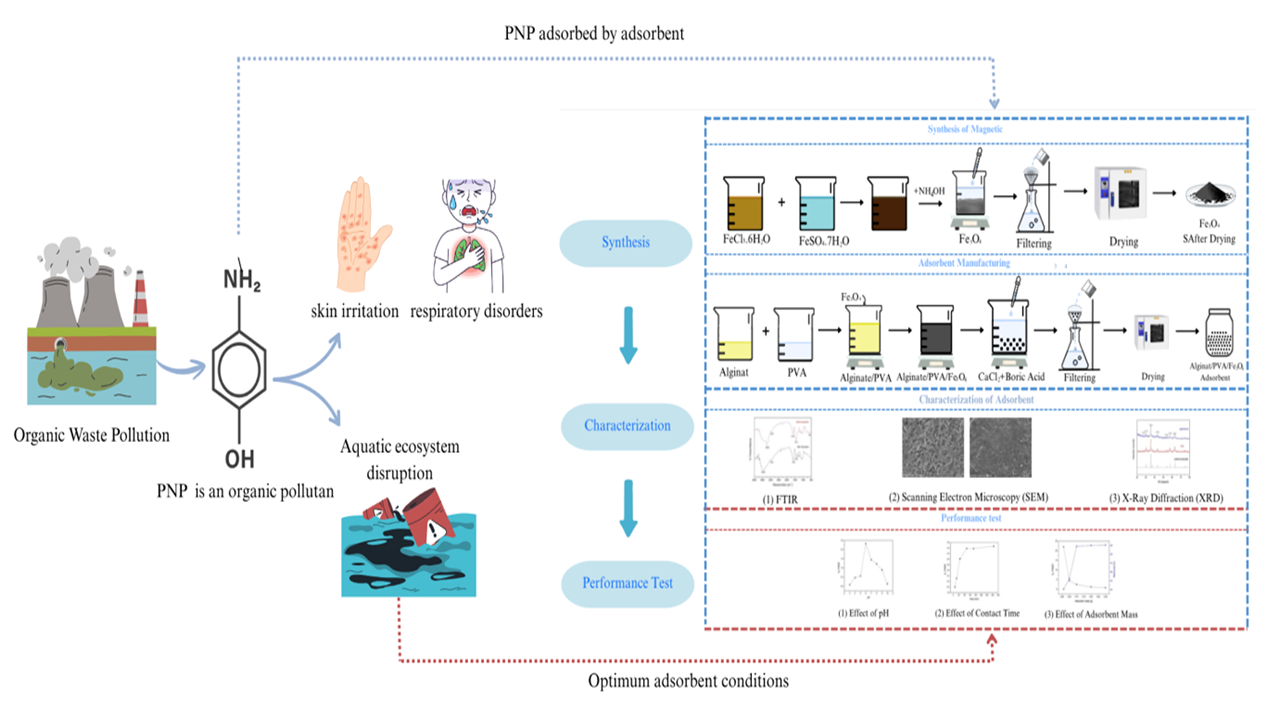
Synthesis and Characterization of Alginate/PVA/Fe3O4 as an Adsorbent for p-Nitrophenol Adsorption
DOI:
https://doi.org/10.22437/chp.v10i1.50987Keywords:
Adsorption, alginate, Fe3O4, p-nitrophenol, PVAAbstract
p-nitrophenol (PNP) is one of the priority pollutants in the environment because PNP has toxic properties and is a persistent organic pollutant (POPs), so it requires more attention in waste treatment to maintain human health and aquatic ecosystems. Adsorption is one of the pollutant removal method that has the advantage of being simple and low-cost. The adsorption process involves an adsorbent that attracts and retains certain molecules, ions, and particles on its surface. Alginate is one of the biosorbents that can be used to adsorb liquid waste, but alginate has weak mechanical properties, so it can be modified with polyvinyl alcohol (PVA) to form a beads adsorbent. The addition of magnetic Fe3O4 to the adsorbent aims to provide magnetic properties to facilitate the separation of the adsorbent from the analyte. The adsorbent has been characterized using Fourier Transform Infra Red Spectroscopy (FTIR), Scanning Electron Microscopy (SEM), X-Ray Diffraction (XRD), and Delsa™ Nano C Particle Analyzer. The adsorption of PNP using 0.1 gram of adsorbent using the batch method reached optimum conditions at pH 6 and a contact time of 120 minutes. The PNP adsorption process followed a pseudo-second-order adsorption kinetics model with a maximum adsorption capacity of 3.598 mg/g
References
[1] Racles, C., Zaltariov M. F., Damoc M., Macsim A. M., Iacob, M., Sacarescu, L Three Reactions, One Catalyst: A multi-Purpose platinum(IV) complex and its silica-supported homologue for environmentally friendly processes. Applied Organometallic Chemistry. 2020, 34(3). DOI: 10.1002/aoc.5422
[2] Pourkhanali, K., Saleh, M., Khayati, G. Performance evaluation of bulk liquid membrane technique on p-nitrophenol removal from aqueous solution. Chemical and Biochemical Engineering Quarterly. 2018, 32 (1), 83–90. DOI:10.15255/CABEQ.2016.1033.
[3] Velusamy, S., Roy, A., Mariam, E., Krishnamurthy, S., Sundaram, S., Mallick, T. K. Effectual visible light photocatalytic reduction of para-nitro phenol using reduced graphene oxide and ZnO composite. Scientific Report. 2023, 13, 2260-2269. DOI: 10.1038/s41598-023-36574-7
[4] Lin, X. Q., Kong, W. M., Lin, X. Degradation of high-concentration p-nitrophenol by Fenton oxidation. Water Science and Technology. 2020, 81, 2260–2269. DOI: 10.2166/wst.2020.284
[5] Kassem, A. A., Abdelhamid, H. N., Fouad, D. M., Ibrahim, S. A. Catalytic reduction of 4-nitrophenol using copper terephthalate frameworks and CuO@C composite. Journal of Environmental Chemical Engineer. 2021, 9(1), 2213-3437. DOI: 10.1016/j.jece.2020.104401
[6] Modirshahla, N., Behnajady, M. A., Mohammadi, A. S. Investigation of the effect of different electrodes and their connections on the removal efficiency of 4-nitrophenol from aqueous solution by electrocoagulation. Journal of Hazardous Materials. 2008, 154(1), 778–786. DOI: 10.1016/j.jhazmat.2007.10.120.
[7] Zhang, B., Li, F., Wu, T., Sun, D., Li, Y. Adsorption of p-nitrophenol from aqueous solutions using nanographite oxide. Colloids and Surfaces A: Physicochemical and Engineering Aspects. 2015, 464, 78–88. DOI: 10.1016/j.colsurfa.2014.10.020.
[8] Cheng, M., Jiang, J., Wang, J., Fan, J., Highly Salt Resistant Polymer Supported Ionic Liquid Adsorbent for Ultrahigh Capacity Removal of p-Nitrophenol from Water. ACS Sustainable Chemistry and Engineering. 2019, 9(7). DOI: 10.1021/acssuschemeng.8b06198.
[9] Zango, Z. U., Sambudi, N. S., Jumbri, K., Ramli, A., Bakar, N., Saad, B., Roizaini, M., Isiyaka, H., Osman, A., Sulieman, A. An overview and evaluation of highly porous adsorbent materials for polycyclic aromatic hydrocarbons and phenols removal from wastewater. Water. 2020, 12 (10), 1–40. DOI: 10.3390/w12102921
[10] Ahmaruzzaman, M., Gayatri, S. L. Activated tea waste as a potential low-cost adsorbent for the removal of p -nitrophenol from wastewater. Journal of Chemical and Engineering Data. 2010, 55 (11), 4614–23. DOI: 10.1021/je100117s.
[11] Gu, X., Kang, H., Li, H., Liu, X., Dong, F., Fu, M., Chen, J. Adsorption removal of various nitrophenols in aqueous solution by aminopropyl-modified mesoporous MCM-48. Journal of Chemical and Engineering Data. 2018, 63(9), 3606–3614. DOI: 10.1021/acs.jced.8b00477.
[12] Wu, Z., Yuan, X., Zhong, H., Wang, H., Zeng, G., Chen, X., Wang, H., Zhang, L., Shao, J. Enhanced adsorptive removal of p-nitrophenol from water by aluminum metal-organic. Scientific Reports. 2016, 6, DOI: 10.1038/srep25638.
[13] Peretz, S., Cinteza, O. Removal of some nitrophenol contaminants using alginate gel beads. Colloids and Surfaces A Physicochemical and Engineering Aspect. 2008, 319, 165–72. DOI: 10.1016/j.colsurfa.2007.06.012.
[14] Obeid, L., Kolli, N., Talbot, D., Welschbillig, M., Bée, A. Influence of a cationic surfactant on adsorption of p-nitrophenol by a magsorbent based on magnetic alginate beads. Journal of Colloid and Interface Science. 2015, 457, 218–24. DOI: 10.1016/j.jcis.2015.07.017.
[15] Te, C. L., Manap, N., Zuhudi, A.H., Izwana, I.M. Polyvinyl Alcohol-Alginate Adsorbent Beads for Chromium (VI) Removal. International Journal of Engineering & Technology. 2018, 7, 95–99. DOI: 10.14419/ijet.v7i3.20.18988.
[16] Cheng, Y., Lin, H. Y., Chen, Z., Megharaj, M., Naidu, R. Biodegradation of crystal violet using Burkholderia vietnamiensis C09V immobilized on PVA-sodium alginate-kaolin gel beads. Ecotoxicology and Environmental Safety. 2012, 83, 108–114. DOI: 10.1016/j.ecoenv.2012.06.017.
[17] Rusnadi, R. Safitri, I. Pembuatan dan Penggunaan Bulir Kalsium Alginat-PVA (Polivinil Alkohol) untuk Adsorpsi Ion Cd(II). Jurnal Kartika Kimia. 2023, 6(1), 38-44. DOI: 10.26874/jkk.v6i1.200.
[18] Asif, M., Ullah, S., Khan, A. S., Nasrullah, A., Khitab, F., Ullah, W., Khan, S., Shah, M., Fagieh, T., Ahmed, N. PVA-Alginate beads loaded with activated carbon, Fe3O4 nanoparticles and ionic liquids for methylene blue adsorption and their comparison with membrane 2024. Research Square. 2024. DOI: 21203/rs.3.rs-4968384/v1.
[19] Deng, S., Huang, X., Kang, Z., Xu, D., Luo, W., Li, D. Penggunaan bahan elektrospinning polivinil alkohol untuk pembalut luka kulit. Journal of Materials Science: Material in Medicine. 2025. 36(1):84. doi: 10.1007/s10856-025-06945-9.
[20] Rahmayanti, M. Sintesis dan karakterisasi magnetit (Fe3O4): studi komparasi metode konvensional dan metode sonokimia. Al Ulum Sains dan Teknologi. 2020, 6(1), 26-31
[21] Taib, S., Suharyadi, D.E. Sintesis Nanopartikel Magnetite (Fe3O4) dengan template silika (SiO2) dan Karakterisasi Sifat Kemagnetannya. Indonesian Journal of Applied Physics. 2015, 5(1), 23-30
[22] Younas, F., Mustafa, A., Farooqi, Z. U. R., Wang, X., Younas, S., Mohy-Ud-din, W., Hameed, M., Abrar, M., Maitlo, A., Noreen, S., Hussain, M. Current and emerging adsorbent technologies for wastewater treatment: Trends, limitations, and environmental implications. Water (Switzerland). 2021, 13(2), 1-25. DOI: 10.3390/w13020215.
[23] Li, J., Hu, Z., Chen, Y., Deng, R. Removal of Pb(II) by adsorption of HCO–(Fe3O4) Composite Adsorbent: Efficacy and Mechanism. Water (Switzerland), 2023, 15(10), 1-17. doi: 10.3390/w15101857.
[24] Bih, N. L., Rwiza, M. J., Ripanda, A. S., Mahamat, A. A., Machunda, R.L., Choi, J. W. Adsorption of phenol and methylene blue contaminants onto high-performance catalytic activated carbon from biomass residues. Heliyon. 2025, 11(1), DOI: 10.1016/j.heliyon.2024.e41150.
[25] Almas, M., Khan, A. S., Nasrullah, A., Din, I. U., Fagieh, T. M., Bakhsh, E. M., Akhtar, K., Khan, S., Khan, S., Inayat, A. Substantial increase in adsorption efficiency of local clay-alginate beads toward methylene blue impregnated with SDS. Environmental Science and Pollution Research. 2023, 30(34), 81433-81449. DOI: 10.1007/s11356-022-23949-y.
[26] Cassia, M. D., Sugihartono, I., Purwandanu, S. H., Futukhillah, F. A. A., Triyono, D., Setiawan, M. R, Swee, T. T. Synthesis and characterization analysis of Fe3O4 /SiO2 core shelL. SPEKTRA: Jurnal Fisika dan Aplikasinya. 2023, 8(3), 161-167, DOI: 10.21009/SPEKTRA.
[27] Rahadianto, W. T., Sugesti, H., Chandra, Y. Equilibrium journal of chemical engineering Synthesis and Application of Coconut Shell Activated Carbon Fe3O4 Composite for Zn 2+ Metal Ion Adsorption from Wastewater. Equilibrium Journal of Chemical Engineering. 2025, 9(2), 54-59. DOI: 10.20961/equilibrium.v9i2.11178.
[28] Panda, S. K., Aggarwal, I., Kumar, H., Prasad, L., Kumar, A., Sharma, A., VO, D., Van, T. D., Mishra, V. Magnetite nanoparticles as sorbents for dye removal: a review. Environmental Chemistry Letters. 2021, 19(2), 2487–5225. DOI: 10.1007/s10311-020-01173-9.
[29] Ma, H., Xu, Z., Wang, W., Gao, X., Ma, H. Adsorption and regeneration of leaf-based biochar for: P -nitrophenol adsorption from aqueous solution. RSC Advances. 2019, 9(67), 39282–39293. DOI: 10.1039/c9ra07943b.
[30] Ashrafi, S. D., Safari, G. H., Sharafi, K., Kamani, H., Jaafari, J. Adsorption of 4-Nitrophenol on calcium alginate-multiwall carbon nanotube beads: Modeling, kinetics, equilibriums and reusability studies. International Journal of Biological Macromolecules. 2021, 185, 66–76. DOI: 10.1016/j.ijbiomac.2021.06.081.
[31] Fahri, H., Zulfikar, M. A., Azis, M. Y. Synthesis of Molecularly Imprinted Polymers with Magnetite Cores for Ibuprofen Adsorption. Jurnal Kimia Sains dan Aplikasi. 2024, 27(1), 28–34. DOI: 10.14710/jksa.27.1.28-34.
[32] Tran, H. N., Wang, Y. F., You, S. J., Chao, H.P. Insights into the mechanism of cationic dye adsorption on activated charcoal: The importance of Π–Π interactions. Process Safety and Environmental Protection. 2017, 107, 168–80. DOI: 10.1016/j.psep.2017.02.010.
[33] Algethami, J. S., Alqadami, A. A., Melhi, S., Alhamami, M. A. M., Fallatah, A. M., Rizk, M. A. Sulfhydryl Functionalized Magnetic Chitosan as an Efficient Adsorbent for High-Performance Removal of Cd(II) from Water: Adsorption Isotherms, Kinetic, and Reusability Studies. Adsorption Science and Technology. 2022, 1-16. doi: 10.1155/2022/2248249.
[34] Dimbo, D., Abewaa, M., Adino, E., Mengistu, A., Takele, T., Oro, A., Rangaraju, M. Methylene blue adsorption from aqueous solution using activated carbon of spathodea campanulata. Results in Engineering. 2024, 21. DOI: 10.1016/j.rineng.2024.101910.
[35] Song, Y., Wang, S., Yang, L. Y., Yu, D., Wang, Y. G., Ouyang, X. Facile fabrication of core–shell/bead-like ethylenediamine-functionalized Al-pillared montmorillonite/calcium alginate for As(V) ion adsorption. International Journal of Bioligical Macromolecules. 2019, 131, 971–979. DOI: 10.1016/j.ijbiomac.2019.03.172.
[36] Ledesma, B., Sabio, E., González-García, C. M., Román, S., Fernandez, M. E. , Bonelli P., Cukierman, A. Batch and Continuous Column Adsorption of p-Nitrophenol onto Activated Carbons with Different Particle Sizes. Processes. 2023, 11(7), DOI: 10.3390/pr11072045.
[37] Nwosu, F. O. Adekola, F. A., Salami, A. O. Adsorption of 4-Nitrophenol (PNP) Using Pilli Nut Shell Active Carbon. Pakistan Journal of Analytical & Environmental Chemistry. 2017, 18 (1), 69–83. DOI: 10.21743/pjaec/2017.06.07.
[38] Abd-Hadi, G. M., Salman, S. D. Adsorption of para nitro-phenol by activated carbon produced from alhagi. Sains Malaysiana. 2020, 49(1), 57–67. DOI: 10.17576/jsm-2020-4901-07.