Antidiabetic Activity of Arcangelisia flava Stem Bark from Southeast Sulawesi Indonesia In Vivo Integrated with Network Pharmacology Analysis
DOI:
https://doi.org/10.22437/chp.v10i1.49750Keywords:
Antioxidant, AGE-RAGE, Mus musculusAbstract
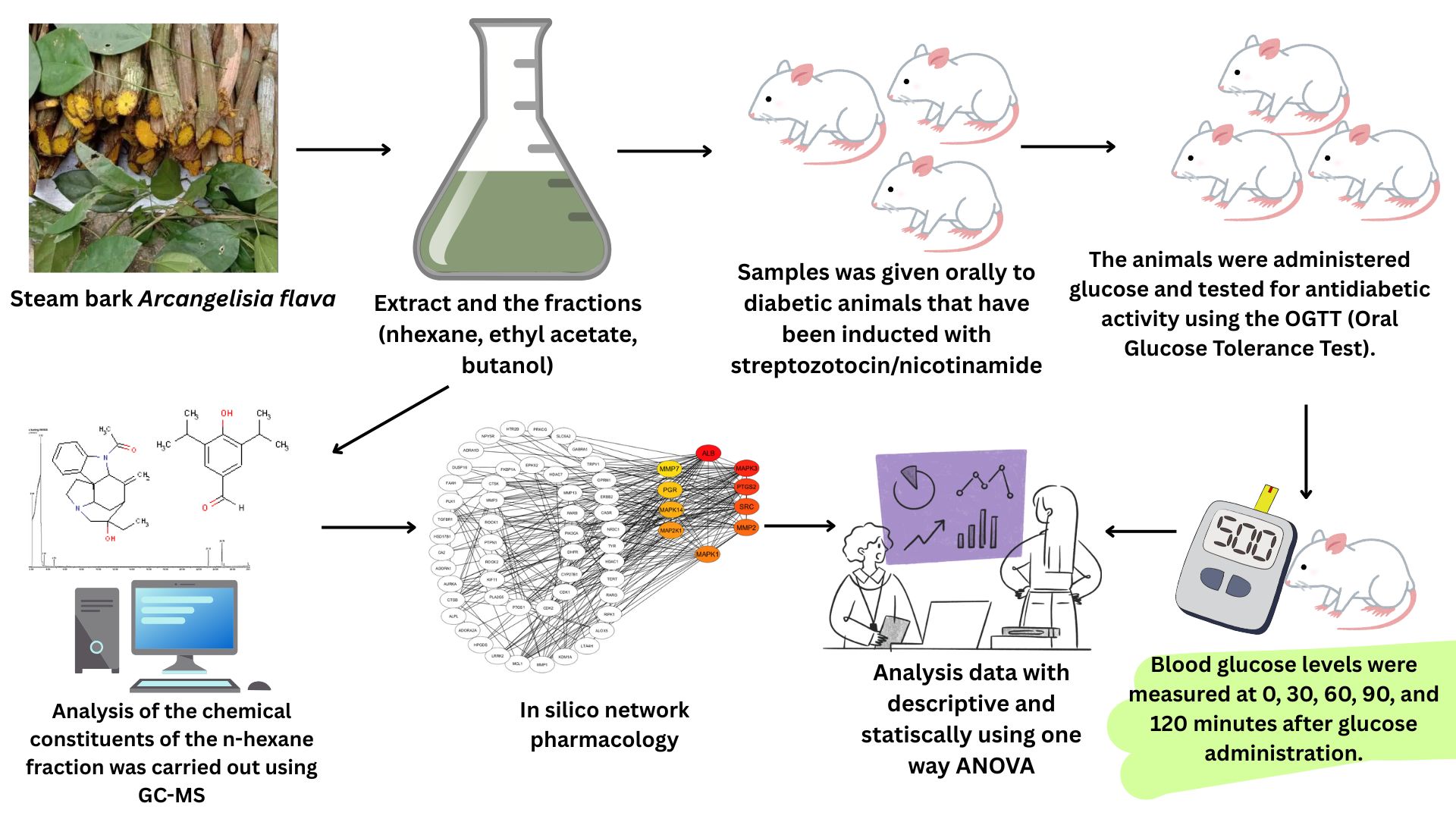
The Arcangelisia flava plant has previously been reported to reduce blood glucose levels in experimental animals. However, there have been no reports on the antidiabetic activity of its stem bark. This study aimed to evaluate the antidiabetic activity of A. flava extracts and fractions, identify their bioactive compounds, and explore the mechanistic pathways involved using the network pharmacology approach. The chemical constituents of the n-hexane fraction were analyzed using gas chromatography mass spectrometry (GC-MS). The in vivo antidiabetic test was conducted on Mus musculus induced with streptozotocin/niacinamide. Blood glucose levels were measured using the oral glucose tolerance test (OGTT) The antioxidant activity of the extracts and fractions was determined using the ABTS assay. The result showed that the GC-MS analysis of the n-hexane fraction identified 18 compounds belonging to seven chemical groups, namely aromatic hydrocarbons, ketones and alcohols, phenolic aldehydes, sulfur compounds, terpenes, fatty acid derivatives, and alkaloids. The highest percentage of blood glucose reduction was observed in the group treated with ethanolic extract 500 mg/kg BW (50.25%), followed by glibenclamide (43.53%), ethyl acetate fraction 125 mg/kg BW (42.82%), ethanolic extract 250 mg/kg BW (41.88%), n-hexane fraction 125 mg/kg BW (34.96%), butanol fraction 125 mg/kg BW (34.28%), and ethanolic extract 125 mg/kg BW (34.14%), respectively. The ABTS assay produced IC₅₀ values for vitamin C, ethanolic extract, n-hexane fraction, ethyl acetate fraction, and butanol fraction of 8.00, 49.80, 110.25, 10.20, and 18.44 µg/mL, respectively. Network pharmacology analysis of compound 7 and compound 17 from the n-hexane fraction revealed antidiabetic potential through inhibition of the AGE–RAGE signaling pathway in diabetic complications. The key target proteins involved included MAPK1, MMP2, MAPK14, MAPK3, PIK3CA, and TGFBR1. In conclusion, the extracts and fractions of Arcangelisia flava exhibit strong potential as antidiabetic and antioxidant agents. The n-hexane fraction, in particular, is presumed to exert its antidiabetic activity through inhibition of the AGE–RAGE signaling pathway, which plays a critical role in diabetic complications.
References
[1]. Setiawan A. Keanekaragaman Hayati Indonesia: Masalah dan Upaya Konservasinya. Indonesian Journal of Conservation, 2022, 11(01):13–21. doi: 10.15294/ijc.v11i1.34532.
[2]. Yunita F, Gunawan S, and Silaban H. The Journey of Indonesian Traditional Medicine. Tarumanagara Medical Journal, 2024, 6(2):241–252. doi: 10.24912/tmj.v6i2.33351.
[3]. Tan L, Wang Y, Ai G, Luo C, Chen H L C., Zeng H., Xie J, Chen J, and Su Z. Dihydroberberine, a Hydrogenated Derivative of Berberine Firstly Identified in Phellodendri Chinese Cortex, Exerts Anti-Inflammatory Effect via Dual Modulation of NF-κB and MAPK Signaling Pathways, International Immunopharmacology, 2019, 75:105802. doi: 10.1016/j.intimp.2019.105802.
[4]. Diliarosta S, Efendi A, Dillasamola D, Oktomalioputri B, and Ramadhani R. Reconstruction and Scientific Explanation of Akar Kuning (Arcangelisia flava Merr.) From West Sumatra as Ethnomedicine and Source of Science Learning. Pharmacognosy Journal, 2021, 13(1):206–211. doi: 10.5530/pj.2021.13.29.
[5]. Suzuki T, Kiyotani T, Maeda M, Katayama T, Tomita-Yokotani K, Syafii W, and Muladi S. Furanoditerpenes from Arcangelisia flava (L.) Merr. and Their Antifungal Activity, Phytochemistry Letters, 2011, 4(3):333–336. doi: 10.1016/j.phytol.2011.07.002.
[6]. Fatmawati, Subandrate, Safyudin, Athiah M, Romadhon MF, and Tariza AF. Xanthine Oxidase Inhibitory Activity of Arcangelisia flava, Acta Biochimica Indonesiana, 2022, 5(1):71. doi: 10.32889/actabioina.71.
[7]. Delica KM, Balagot KWM, Ramos RE, Lapuz RB, Collera JA, and Martinez CMJ. Phytochemical Screening, Antioxidant, and Antimicrobial Properties of Sequential Extracts of Stems of Arcangelisia flava, Malaysian Journal of Chemistry, 2024, 26(1):96–104. doi: 10.55373/mjchem.v26i1.96.
[8]. Setyani W, Setyowati H, Palupi DHS, Rahayunnissa H, and Hariono M. Antihyperlipidemia and Antihyperglycemic Studies of Arcangelisia flava (L.) Merr. Phenolic Compound: Incorporation of In Vivo and In Silico Study at Molecular Level, Indonesian Journal of Pharmaceutical Science and Technology, 2019, 6(2):84–94. doi: 10.24198/ijpst.v6i2.20211.
[9]. Annisa R, Salsabila IM, Astuti SM, Suryadinata A, Atmaja RRD, and Mutiah R. The Effectiveness Test of Film Forming Hydrogel (FFH) of Yellow Root Extract (Arcangelisia flava (L.) Merr.) on Healing Burns of Male White Mice (Mus musculus), Journal of Research in Pharmacy, 2025, 29(2):516–529. doi: 10.12991/jrespharm.1662042.
[10]. Wahyudi LD, Ratnadewi AAI, and Siswoyo TA. Potential Antioxidant and Antidiabetic Activities of Kayu Kuning (Arcangelisia flava). Agriculture and Agricultural Science Procedia, 2016, 9:396–402. doi: 10.1016/j.aaspro.2016.02.155.
[11]. Wahidin M, Achadi A, Besral B, Kosen S, Nadjib M, Nurwahyuni A, Ronoatmodjo S, Rahajeng E, Pane M, and Kusuma D. Projection of Diabetes Morbidity and Mortality till 2045 in Indonesia Based on Risk Factors and NCD Prevention and Control Programs, Scientific Reports, 2024, 14(1):5424. doi: 10.1038/s41598-024-54563-2.
[12]. Karim F, Susilawati S, Oswari LD, Dzakiyah D, and Anindita F. Uji Aktivitas Antidiabetes Akar Kayu Kuning (Arcangelisia flava), Jurnal Kedokteran dan Kesehatan: Publikasi Ilmiah Fakultas Kedokteran Universitas Sriwijaya. 2020, 7(3):35–40. doi: 10.32539/jkk.v7i3.10190.
[13]. Utami AR, Maksum IP, and Deawati Y. Berberine and Its Study as an Antidiabetic Compound, Biology, 2023, 12(7):973. doi: 10.3390/biology12070973.
[14]. Rahmah AM, Pratama RR, Solikhah I, Mansor H, Sukardiman, and Widyowati R. Antioxidant Activities of Aqueous and 70% Ethanol Extracts of Akar Kuning (Arcangelisia flava (L.) Merr.) Stem Using the DPPH Method. Pharmacy Education, 2024, 24(3):418–422. doi: 10.46542/pe.2024.243.418422.
[15]. Iacobini C, Vitale M, Pesce C, Pugliese G, and Menini S. Diabetic Complications and Oxidative Stress: A 20-Year Voyage Back in Time and Back to the Future. Antioxidants, 2021, 10(5):727. doi: 10.3390/antiox10050727.
[16]. Hana C, Pendong A, Suoth EJ, Fatimawali, and Ekawati T. Network Pharmacology Approach to Understanding the Antidiabetic Effects of Pineapple Peel Hexane Extract, Malacca Pharmaceutics, 2024, 2(1):24–32. doi: 10.60084/mp.v2i1.162.
[17]. Kasmawati H, Sida NA, Arfan A, Indrayanti WOD, and Rusman A. An in Vitro Approach: Antibacterial Activity of Sansevieria trifasciata Prain. Leaves with Chemometric Analysis, Jurnal Sains dan Kesehatan, 2024, 6(1):53–61. doi: 10.25026/jsk.v6i1.2087.
[18]. Afroz Shoily MS, Islam ME, Rasel NM, Parvin S, Barmon J, Aqib A H, Roy DN, and Parvin MS. Unveiling the Biological Activities of Heliotropium indicum L. Plant Extracts: Anti-Inflammatory Activities, GC–MS Analysis, and In-Silico Molecular Docking. Scientific Reports, 2025, 15(1):3285. doi: 10.1038/s41598-024-79559-w.
[19]. Furman, B. L. Streptozotocin-Induced Diabetic Models in Mice and Rats, Current Protocols, 2021, 1:e78. doi: 10.1002/cpz1.78.
[20]. Febrina M, and Sari SF. Pengaruh Pemberian Infusa Daun Kersen (Muntingia calabura L.) terhadap Kadar Glukosa Darah Mencit Putih (Mus musculus) yang Diberi Beban Glukosa. Jurnal Penelitian Farmasi Indonesia, 2019, 8(2):60–66. doi: 10.51887/jpfi.v8i2.783.
[21]. Saputra NT, Suartha IN, and Dharmayudha AAGO. Agen Diabetagonik Streptozotocin untuk Membuat Tikus Putih Jantan Diabetes Mellitus. Buletin Veteriner Udayana, 2018, 10(2):116–121. doi: 10.24843/bulvet.2018.v10.i02.p02.
[22]. Szkudelski T. Streptozotocin-Nicotinamide-Induced Diabetes in the Rat. Characteristics of the Experimental Model, Experimental Biology and Medicine, 2012, 237(5):481–490. doi: 10.1258/ebm.2012.011372.
[23]. Mitruka BM, and Rawnsley HM. Clinical, Biochemical and Haematological Reference Values in Normal Experimental Animals, Masson Publishing USA Inc., New York, 1977.
[24]. Novia, and Emelina. Uji Aktivitas Antidiabetes Infusa Rambut Jagung (Zea mays L.) pada Mencit (Mus musculus L.) dengan Metode Toleransi Glukosa, Indonesian Journal of Pharma Science, 2021, 3(2):63–70. doi: 10.22437/ijps.v3i2.16186.
[25]. Aprira, Winarsih L, and Helmiyetti. Penggunaan Ekstrak Buah Kecubung sebagai Bahan Pembunuh Hewan Percobaan Pengganti Chloroform, BIOEDUSAINS: Jurnal Pendidikan Biologi dan Sains, 2022, 5(2):342–348. doi: 10.31539/bioedusains.v5i2.3167.
[26]. Saad M, Kusuma E W, Susanti, I., and Handayani, D. U. In Vivo Antidiabetic Potential Test of Suruhan’s (Peperomia pellucida) Purified Extract Using Alloxan-Induced Wistar Rats, Jurnal Biologi Tropis, 2024, 24(4):561–567. doi: 10.29303/jbt.v24i4.7607.
[27]. Hikmah N, Trinovitasari N, Anwar I, and Sahumena MH. Chemometric Evaluation of Antioxidant Activity in Libo Fruit Extracts: Correlation with Phenolic and Flavonoid Content, Indonesian Journal of Pharmaceutical Education, 2025, 5(2):312–321. doi: c10.29303/jbt.v24i4.7607.
[28]. Tangkau, M. I., Fatimawali, and Suoth, E. Uji Aktivitas Antioksidan Ekstrak Etanol Batang Lengkuas Putih (Alpinia galanga) dengan Metode ABTS, Pharmacon, 2023, 12(3):358–366. doi: 10.35799/pha.12.2023.49216.
[29]. Nasri N, Kaban V E, Rani Z, Suci N, Tania G, and Ferendina I. Potential Antioxidant and Antibacterial Activity of Curry Leaf Ethanol Extract (Murraya koenigii) against Propionibacterium acnes, Journal of Pharmaceutical and Sciences, 2025, 8(4):2398–2408. doi: 10.36490/journal-jps.com.
[30]. Sailah I, Tallei TE, Safitri L, Tamala Y, Halimatushadyah E, Ekatanti D, Maulydia, N. B., and Celik, I. A Network Pharmacology Approach to Elucidate the Anti-Inflammatory and Antioxidant Effects of Bitter Leaf (Vernonia amygdalina Del.), Narra Journal, 2024, 4(3):e1016. doi: 10.52225/narra.v4i3.1016.
[31]. Delica KM, Balagot KWM, and Lapuz RB. Investigation of Chemical Components of Hexane Extract from the Stem of Arcangelisia flava via Phytochemical Test, GC-MS Analysis, FTIR Fingerprinting, and In Vitro Antioxidant Activity, Philippine Journal of Science, 2023, 152(5):1919–1929. doi: 10.56899/152.05.32.
[32]. Kulsum K, Syahrul S, Hasbalah K, and Balqis U. Phytocompounds of Nigella sativa Seeds Extract and Their Neuroprotective Potential via EGR1 Receptor Inhibition: A Molecular Docking Study, Narra Journal, 2023, 3(2):e173. doi: 10.52225/narra.v3i2.173.
[33]. Tolba SS, Mohammed HS, Ghareeb MA, and Mohamed AE. Antidiabetic Activity and GC-MS Analysis of n-Hexane Leaf Extract of Codiaeum variegatum (Euphorbiaceae), Azhar International Journal of Pharmaceutical and Medical Sciences, 2025, 5(1):128–140. doi: 10.21608/aijpms.2024.264259.1250.
[34]. Kadhim MJ, and Mohammed GJ. In Vitro Antibacterial, Antifungal and Phytochemical Analysis of Methanolic Extract of Fruit Cassia fistula, Oriental Journal of Chemistry, 2016, 32(3):1329–1346. doi: 10.13005/ojc/320307.
[35]. Ghosh SK, Pandey K, Ghosh M, and Sur PK. Mycochemistry, Antioxidant, Anticancer Activity, and Molecular Docking of Compounds of F12 of Ethyl Acetate Extract of Astraeus asiaticus with BcL2 and Caspase 3, Scientific Reports, 2025, 15(1):87775. doi: 10.1038/s41598-025-87775-1.
[36]. Bhati, R., Singh, A., Saharan, V. A., Ram, V., and Bhandari, A. Strychnos nux-vomica Seeds: Pharmacognostical Standardization, Extraction, and Antidiabetic Activity, Journal of Ayurveda and Integrative Medicine, 2012, 3(2):80–84. doi: 10.4103/0975-9476.96523.
[37]. Rakieten, N., Rakieten, M. L., and Nadhkarni, M. V. Studies on Diabetogenic Action of Streptozotocin (NSC-37917), Cancer Chemotherapy Reports, 1963, 29:91–98.
[38]. Rais, N., Ved, A., Ahmad, R., Parveen, K., Gautam, G. K., Bari, D. G., Shukla, K. S., Gaur, R., and Singh, A. P. Model of Streptozotocin-Nicotinamide Induced Type 2 Diabetes: A Comparative Review, Current Diabetes Reviews, 2022, 18(8):e171121198001. doi: 10.2174/1573399818666211117123358.
[39]. Chewchinda, S., Leakaya, N., Sato, H., and Sato, V. H. Antidiabetic Effects of Maclura cochinchinensis (Lour.) Corner Heartwood Extract, Journal of Traditional and Complementary Medicine, 2021, 11(1):68–74. doi: 10.1016/j.jtcme.2019.10.004.
[40]. Zhou F, Yin B, Xi Y, Zhang J, and Bai Y. Association between the Glucose Pattern in Oral Glucose Tolerance Test and Adverse Pregnancy Outcomes among Non-Diabetic Women, Journal of Health, Population and Nutrition, 2025, 44(1):131. doi: 10.1186/s41043-025-00889-0.
[41]. Annisa A, Fitrya, Puspa NR, and Caniago D. Uji Aktivitas Antidiabetes Ekstrak Etanol Akar Kabau (Archidendron bubalinum), Jurnal Penelitian Sains, 2021, 23(2):102–109. doi: 10.56064/jps.v23i2.635.
[42]. Hendra R, Agustha A, Frimayanti N, Abdulah R, and Teruna HY. Antifungal Potential of Secondary Metabolites Derived from Arcangelisia flava (L.) Merr.: An Analysis of In Silico Enzymatic Inhibition and In Vitro Efficacy against Candida Species, Molecules, 2024, 29(10):2373. doi: 10.3390/molecules29102373.
[43]. Okechukwu P, Sharma M, Tan WH, Chan HK, Chirara K, Gaurav A, and Al-Nema M. In-Vitro Anti-Diabetic Activity and In-Silico Studies of Binding Energies of Palmatine with Alpha-Amylase, Alpha Glucosidase and DPP-IV Enzymes, Pharmacia, 2020, 67(4):363–371. doi: 10.3897/pharmacia.67.e58392.
[44]. Mgbeje, B. I. A., Abu, C., Ugoanyanwu, F. O., and Ebong, P. E. Towards Establishing Chemical Markers for Antidiabetic Plants: A Comparative Analysis of the Chemical Fingerprints of Three Validated Antidiabetic Plants, Nauclea latifolia, Azadirachta indica and Moringa oleifera, Merit Research Journal of Medicine and Medical Sciences, 2020, 8(10):617–625.
[45]. Tan DC, Kassim NK, Ismail I S., Hamid M., and Bustamam MSA. Identification of Antidiabetic Metabolites from Paederia foetida L. Twigs by Gas Chromatography-Mass Spectrometry-Based Metabolomics and Molecular Docking Study, BioMed Research International, 2019, 2019:7603125. doi: 10.1155/2019/7603125.
[46]. Purwaningsih I, Maksum IP, Sumiarsa D, and Sriwidodo S. Isolation and Quantification of Palmatine from Fibraurea tinctoria Lour: In Vitro Antioxidant Activity and In Silico Antidiabetic Activity Evaluation, Drug Design, Development and Therapy, 2024, 18:3397–3414. doi: 10.2147/DDDT.S454091.
[47]. Mridula S, Masroor WS., Xavier, M., Hui, T. W., Chan, H. K., Chirara, K., and Nwabueze, O. P. Antioxidant and Anti-Advanced Glycation End Products Formation Properties of Palmatine, Journal of Pharmacy and Pharmacognosy Research, 2021, 9(3):366–378. doi: 10.56499/jppres20.940_9.3.366.
[48]. Shakeri, F., Kiani, S., Rahimi, G., and Boskabady, M. H. Anti-Inflammatory, Antioxidant, and Immunomodulatory Effects of Berberis vulgaris and Its Constituent Berberine, Experimental and Clinical, a Review, Phytotherapy Research, 2024, 38(4):1803–1837. doi: 10.1002/ptr.8077.
[49]. Donoso-Bustamante V, Osorio E, Arias-Santé MF, De Camargo AC, Rincón-Cervera MÁ, Amalraj J, Carrasco B, Palomo I, and Araya-Maturana R. Antioxidant Activity of Sinapic Acid Anilides: DPPH, ABTS, FRAP, Electrochemical and Theoretical Analysis, LWT, 2025, 222:117656. doi: 10.1016/j.lwt.2025.117656.
[50]. Cravotto C, Fabiano-Tixier AS, Claux O, Abert-Vian M, Tabasso S, Cravotto G, and Chemat F. Towards Substitution of Hexane as Extraction Solvent of Food Products and Ingredients with No Regrets, Foods, 2022, 11(21):3412. doi: 10.3390/foods11213412.
[51]. Uti DE, Atangwho IJ, Alum EU, Egba SI, Ugwu OPC, and Ikechukwu GC. Natural Antidiabetic Agents: Current Evidence and Development Pathways from Medicinal Plants to Clinical Use, Natural Product Communications, 2025, 20(3):1–23. doi: 10.1177/1934578X251323393.
[52]. Olatunde A, Mohammed A, Ibrahim MA, and Shuaibu MN. Influence of Methoxylation on the Anti-Diabetic Activity of ρ-Hydroxybenzaldehyde in Type 2 Diabetic Rat Model, Phytomedicine Plus, 2021, 1(1):100003. doi: c10.1016/j.lwt.2025.117656.
[53]. Hanif D, Fath M, Muchlisin MA, and Jamil AS. Network Pharmacology Analysis of Secondary Metabolite Compounds of Galangal Plant (Alpinia galanga) in Cancer Disease, Journal of Islamic Pharmacy, 2024, 9(1):43–49. doi: 10.18860/jip.v9i1.27094.
[54]. Kay AM, Simpson CL, and Stewart JAJ. The Role of AGE/RAGE Signaling in Diabetes-Mediated Vascular Calcification, Journal of Diabetes Research, 2016, 2016:6809703. doi: 10.1155/2016/6809703.