Utilization of Rice Waste (Oryza sativa L) for The Production of Silica Gel with Variations in Mass Ratio of Raw Materials and Reactant Solutions
Utilization of Rice Waste (Oryza sativa L) for The Production of Silica Gel
DOI:
https://doi.org/10.22437/chp.v10i1.49539Keywords:
Silica gel, rice straw, rice huskAbstract
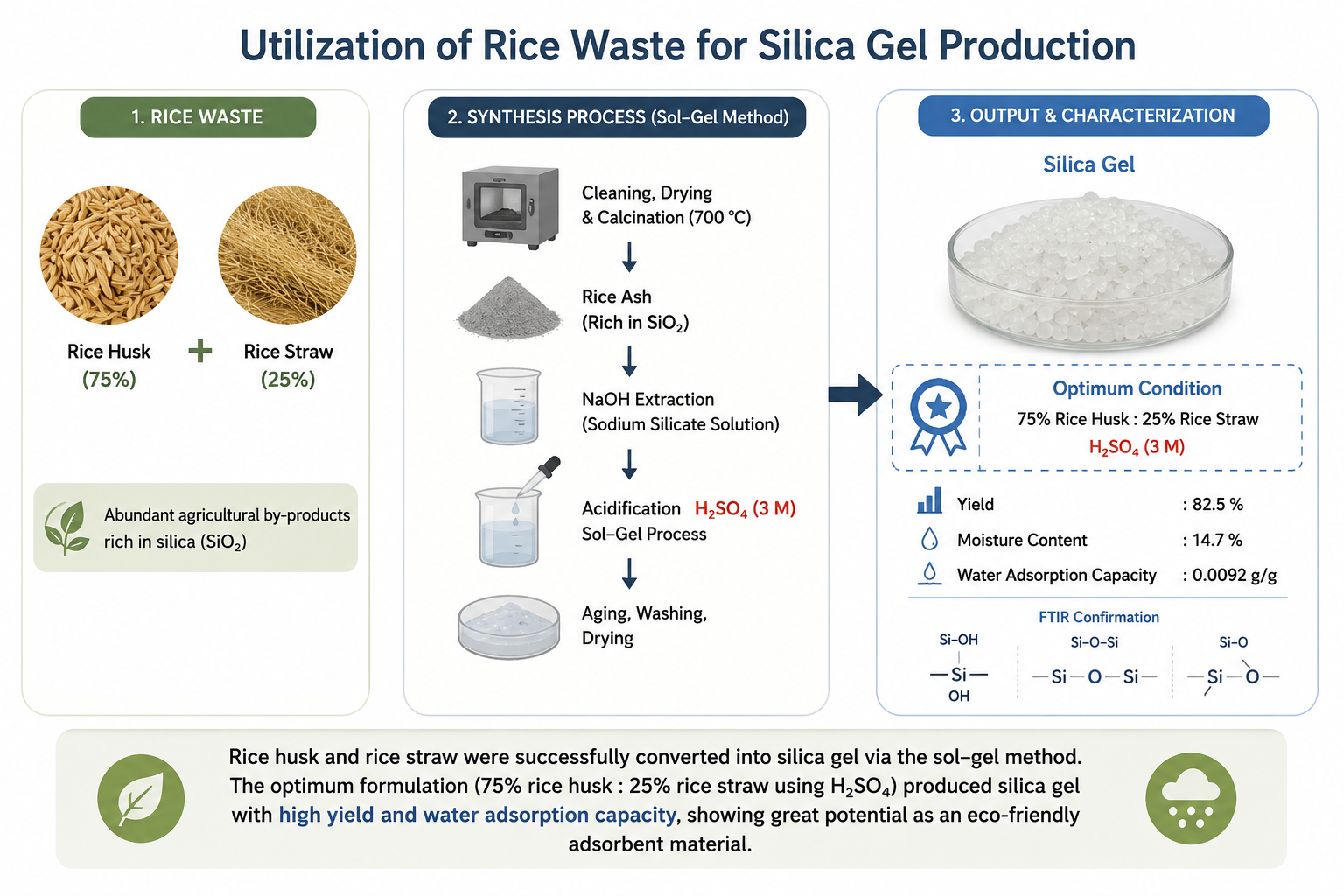
Rice is one of the major agricultural commodities that generates large amounts of biomass waste, particularly rice husks and rice straw. These by-products contain high silica content and have potential as raw materials for silica gel production. This study aimed to synthesize silica gel from rice husks and rice straw using the sol–gel method with different biomass ratios and acid activators. The ratios of rice husk to rice straw used were 100:0, 75:25, 50:50, 25:75, and 0:100 (w/w). The synthesis process was carried out using 3 M HCl and 3 M H₂SO₄ solutions as reactants. The obtained silica gel products were evaluated based on yield, moisture content, water adsorption capacity, and functional group characteristics using Fourier Transform Infrared (FTIR) spectroscopy. The results showed that the optimum silica gel was produced from a biomass ratio of 75 % rice husk and 25 % rice straw using H₂SO₄ as the reactant. The resulting silica gel exhibited a yield of 82.5 %, moisture content of 14.7 %, and water adsorption capacity of 0.0092 g/g. FTIR analysis confirmed the presence of silanol (Si–OH), siloxane (Si–O–Si), and siloxy functional groups, indicating successful silica gel formation. Overall, the synthesized silica gel demonstrated physicochemical properties consistent with standard silica gel characteristics and showed potential for application as an adsorbent material.
References
[1] Badan Pusat Statistik Provinsi Jawa Tengah. Luas Panen dan Produksi Padi di Provinsi Jawa Tengah. 2023. 67: 1–16.
[2] Alni W, Aprilia S, Arahman N, and Umar N. Synthesis and characterization of nanosilica from rice husk waste Sigupai varieties endemic to Aceh. Case Studies in Chemical and Environmental Engineering. 2025, 11: 101145. doi:10.1016/j.cscee.2025.101145
[3] Grimm AM, Dorsch LY, Kloess GH, Enke D, and Roppertz A. Combustion of rice husk and rice straw promoted by transition metals for energy-optimal synthesis of biogenic silica. Biomass and Bioenergy, 2021, 155: 106282. doi:10.1016/j.biombioe.2021.106282.
[4] Sun X, Dou Z, Shurson GC, and Hu B. Bioprocessing to upcycle agro-industrial and food wastes into high-nutritional value animal feed for sustainable food and agriculture systems. Resources, Conservation & Recycling, 2024. 201: 107325. doi:10.1016/j.resconrec.2023.107325.
[5] Rathore SS, Shekhawat K, Babu S, Upadhyay PK, Singh RK, Raj R, Tyagi V, Nagargade M, Singh A, Neel S, Patel A, Nawhal A, Ramnathan A and Singh A. Valorization of paddy straw through fermented organic manure: a circular economy approach for low carbon agriculture. Frontiers in Sustainable Food Systems. 2026. 9:1702102. doi: 10.3389/fsufs.2025.1702102
[6] Asri M, Kurniawan E, Sylvia N, Bahri S, and Jalaluddin J. Pemanfaatan limbah sekam padi sebagai bahan alternatif dalam pembuatan biopelet. Chemical Engineering Journal Storage (CEJS). 2022. 2 (2). doi:10.29103/cejs.v2i2.7232.
[7] Matin HHA, Syafrudin S, and Suherman S. Rice husk waste: Impact on environmental health and potential as biogas. KEMAS: Jurnal Kesehatan Masyarakat. 2023. 18 (3): 431–436. doi:10.29103/cejs.v2i2.7232.
[8] Nggolaon D, Silahooy S, Jaya GW, and Hattu N. Analisis dan karakterisasi senyawa silika (SiO₂) berbahan dasar batuan vulkanik di Pulau Ambon. Jurnal Kumparan Fisika, 2024. 7 (3): 98–105. doi:10.33369/jkf.7.3.98-105.
[9] Falk G, Shinhe GP, Teixeira LB, Moraes EG, and Novaes de Oliveira AP. Synthesis of silica nanoparticles from sugarcane bagasse ash and nano-silicon via magnesiothermic reactions. Ceramics International, 2019. 45 (17 Part A): 21618–21624. doi:10.1016/j.ceramint.2019.07.157.
[10] Novita L and Idris I. Effectiveness of silica gel from palm kernel shell ash as a moisture absorber in medicine packaging in bottles. IOP Conference Series: Earth and Environmental Science. 2022. 1041 (1): 012044. doi:10.1088/1755-1315/1041/1/012044.
[11] McLean JR, Smith AB, and Johnson CD. Structure, properties, and applications of silica nanoparticles: Recent advances in theoretical modeling, challenges, and future directions. Small, 2024. 20 (1): 202405299. doi:10.1002/smll.202405299.
[12] Hayati D, Pardoyo, and Azmiyawati C. The effect of acid type variation on the characteristics of nanosilica synthesized from rice husk ash. Journal of Chemistry, Science, and Applications. 2017. 20 (1): 1–4. doi:10.14710/jksa.20.1.1-4.
[13] Badan Standardisasi Nasional. Moisture content test (SNI 3751:2009). Jakarta, Indonesia. 2009. Retrieved from https://www.bsn.go.id
[14] Japanese Industrial Standards Committee. n.d. Test method for water absorption of building materials (JIS A 0701). Tokyo, Japan: Japanese Standards Association. Retrieved from https://www.jsa.or.jp/
15] Ternon C. Silica- and silicon-based nanostructures. Nanomaterials. 2022. 12 (8): 1270. doi:10.3390/nano12081270.
[16] Andriayani A and Daulay A. Mesopori silika: Sintesis, karakterisasi dan aplikasi. Yogyakarta, Indonesia: Deepublish Digital. 2023.
[17] Nandiyanto ABD, Oktiani R, and Ragadhita R. How to read and interpret FTIR spectroscopy of organic materials. Indonesian Journal of Science and Technology, 2019. 4 (4): 97–118. doi:10.17509/ijost.v4i1.15806.
[18] Riza M, Fachraniah F, and Syafruddin S. Pembuatan silika gel dari abu sekam padi dengan pereaksi asam kuat dan asam lemah dengan menggunakan variasi jumlah abu silikat. Jurnal Teknologi, 2022. 22 (2): 55. doi:10.30811/teknologi.v22i2.3116.
[19] Yuliati S, Fadarina F, Zamhari M, and Hajar I. Prototype of tray dryer unit for silica gel drying based on bagasse. Journal of Physics: Conference Series, 2020. 1500: 012055. doi:10.1088/1742-6596/1500/1/012055.
[20] Setyawan N, Hoerudin H, and Yuliani S. Synthesis of silica from rice husk by sol-gel method. IOP Conference Series: Earth and Environmental Science, 2021. 733: 012149. doi:10.1088/1755-1315/733/1/012149.
[21] Badan Standardisasi Nasional. 1991. Silica gel for general use (SNI 06-2477-1991). Jakarta, Indonesia. Retrieved from https://sni.bsn.go.id
[22] Lévêque L, Tahiri N, Goldsmith MR, and Verner MA. Quantitative Structure-Activity Relationship (QSAR) modeling to predict the transfer of environmental chemicals across the placenta’, Computational Toxicology, 2022. 21, doi: 10.1016/j.comtox.2021.100211.
[23] Nzereogu PU, Omah AD, Ezema FI, Iwuoha EI, and Nwanya AC. Silica extraction from rice husk: Comprehensive review and applications. Hybrid Advances. 2023. 4, 100111, , doi: DOI: 10.1016/j.hybadv.2023.100111.
[24] H. Ghaedi and M. Zhao, ‘Review on Template Removal Techniques for Synthesis of Mesoporous Silica Materials’, Energy & Fuels, 2022. 36(5): 2424–2446, doi: 10.1021/acs.energyfuels.1c04435