In silico and In vitro Study of The Anticancer Potential of Essential Oil from Sembung (Blumea balsamifera) Leaves against HeLa Cervical Cancer Cells
DOI:
https://doi.org/10.22437/chp.v10i1.49160Keywords:
Anticancer, Blumea balsamifera, molecular docking, MTT assayAbstract
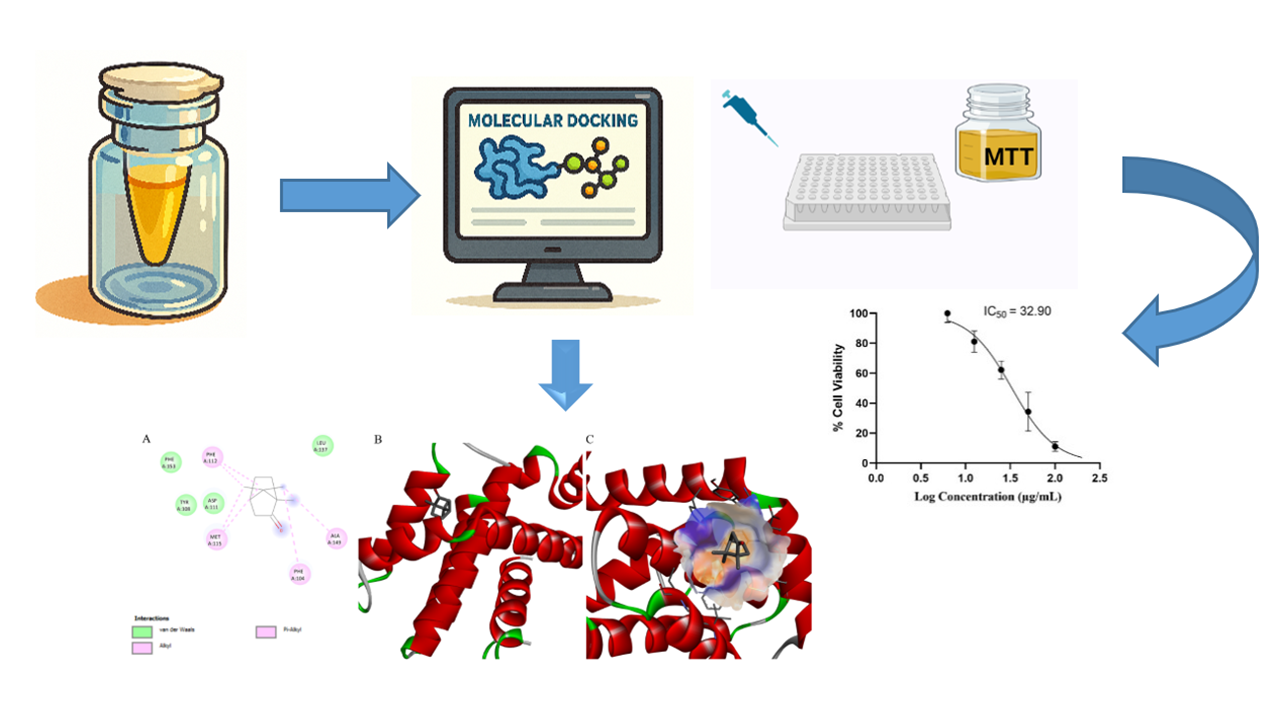
Blumea balsamifera (L.) DC. (sembung) is a medicinal plant widely recognized for its diverse pharmacological properties, including cytotoxic and anticancer activities. However, the anticancer potential of its leaf essential oil against cervical cancer remains poorly explored. This study aimed to evaluate the anticancer activity of B. balsamifera leaf essential oil against HeLa cervical cancer cells using integrated in silico and in vitro approaches. Molecular docking analysis against the anti-apoptotic Bcl-2 protein revealed favorable binding affinities for several major constituents, including camphor (-5.745 kcal/mol), caryophyllene (-7.077 kcal/mol), 7-epi-silphiperfol-5-ene (-7.311 kcal/mol), and γ-eudesmol (-7.083 kcal/mol), indicating potential interactions with apoptosis-related targets. Furthermore, cytotoxic activity assessed by the MTT assay demonstrated an IC₅₀ value of 32.90 µg/mL against HeLa cells, indicating moderate cytotoxic potency. These findings suggest that B. balsamifera leaf essential oil possesses promising anti-cervical cancer activity and may serve as a potential natural source for the development of apoptosis-targeting anticancer agents.
References
[1]. Widhiantara, G., and Jawi, I.M. Phytochemical composition and health properties of Sembung plant (Blumea balsamifera): A review. Veterinary World. 2021, 14(5), 1185–1196. DOI: 10.14202/vetworld.2021.1185-1196.
[2]. Norikura, T., Kojima-Yuasa, A., Shimizu, M., Huang, X., Xu, S., Kametani, S., Rho, S.-N., Kennedy, D. O., and Matsui-Yuasa, I. Anticancer activities and mechanisms of Blumea balsamifera extract in hepatocellular carcinoma cells. The American Journal of Chinese Medicine. 2008, 36(2), 411-424). DOI: 10.1142/S0192415X08005862.
[3]. Ismail, N. A., Matawali, A., Lee, P.-C., How, S.-E., Lee, B. H., Goh, L. P. W., and Gansau, J. A. Blumea balsamifera (L.) DC. Elicit Anti-Kinase, Anti-Phosphatase and Cytotoxic Activities against Acute Promyelocytic Leukemia Cells (HL-60). Tropical Journal of Natural Product Research. 2023, 5(4), 656-660. DOI: 10.26538/tjnpr/v5i5.8.
[4]. Nurlailiyah, F. A., Dwijayanti, D. R., Hermanto, F. E., Masruri, M., and Widodo, N. Cytotoxicity of Blumea balsamifera on A549 Lung Cancer Cells : Integrating in Vitro Analysis with Computational Study of AKT-1 Inhibition. Tropical Journal of Natural Product Research. 2025, 9(2), 495–503. DOI: 10.26538/tjnpr/v9i2.12.
[5]. World Health Organization. Global Cancer Observatory. 2022.
[6]. Permatasari, H. K., Wewengkang, D. S., Tertiana, N. I., Muslim, F. Z., Yusuf, M., Baliulina, S. O., Daud, V. P. A., Setiawan, A. A., and Nurkolis, F. Anti-cancer properties of Caulerpa racemosa by altering expression of Bcl-2, BAX, cleaved caspase 3 and apoptosis in HeLa cancer cell culture. Frontiers in Oncology. 2022, 12, 964816. DOI: 10.3389/fonc.2022.964816.
[7]. Leisching, G., Loos, B., Botha, M., and Engelbrecht, A.-M. Bcl-2 confers survival in cisplatin treated cervical cancer cells: Circumventing cisplatin dose-dependent toxicity and resistance. Journal of Translational Medicine. 2015, 13(1), 328. DOI: 10.1186/s12967-015-0689-4
[8]. Yumol, J., Gabrielli, B., Tayyar, Y., McMillan, N. A., and Idris, A. Smart drug combinations for cervical cancer: Dual targeting of Bcl-2 family of proteins and aurora kinases. American Journal of Cancer Research. 2020, 10(10), 3406–3414. PMID: 33163279
[9]. Abdul Rahman, S. F., Muniandy, K., Soo, Y. K., Hamdan, M. A., Shunmugam, L., and Idris, A. Co-inhibition of BCL-XL and MCL-1 with selective BCL-2 family inhibitors enhances cytotoxicity of cervical cancer cell lines. Biochemistry and Biophysics Reports. 2020, 22, 100756. DOI: 10.1016/j.bbrep.2020.100756.
[10]. Tuohetimulati, G., Zhu, M., Chen, J., and Niyazi, M. Expressions and clinical significance of Bcl-2, Bcl-xL and c-IAP1 protein in cervical cancer. International Journal of Clinical and Experimental Medicine. 2018, 11(11), 12361–12367.
[11]. Ferreira de Freitas, R., and Schapira, M. A systematic analysis of atomic protein–ligand interactions in the PDB. Medicinal Chemistry Communications. 2017, 8(10), 1970–1981. DOI: 10.1039/C7MD00381A.
[12]. Ramírez, D., and Caballero, J. Is It Reliable to Take the Molecular Docking Top Scoring Position as the Best Solution without Considering Available Structural Data?. Molecules. 2018, 23(5), 1038. DOI: 10.3390/molecules23051038.
[13]. Sharma, A., Vora, J., Patel, D., Sinha, S., Jha, P. C., and Shrivastava, N. Identification of natural inhibitors against prime targets of SARS-CoV-2 using molecular docking, molecular dynamics simulation and MM-PBSA approaches. Journal of Biomolecular Structure and Dynamics. 2022, 40(7), 3296–3311. DOI: 10.1080/07391102.2020.1846624.
[14]. Ivanova, L., and Karelson, M. The Impact of Software Used and the Type of Target Protein on Molecular Docking Accuracy. Molecules. 2022, 27(24), 9041. DOI: 10.3390/molecules27249041.
[15]. Niksic, H., Becic, F., Koric, E., Gusic, I., Omeragic, E., Muratovic, S., Miladinovic, B., and Duric, K. Cytotoxicity screening of Thymus vulgaris L. essential oil in brine shrimp nauplii and cancer cell lines. Scientific Reports. 2021, 11(1), 13178. DOI: 10.1038/s41598-021-92679-x.
[16]. Zulkipli, N. N., Rahman, S. A., Taib, W. R. W., Razali, R. M., Ismail, I., Ahmad, W. A. N. W., and Daud, C. K. D. C. The cytotoxicity effect and identification of bioactive compounds of Prismatomeris glabra crude leaf extracts against breast cancer cells. Beni-Suef University Journal of Basic and Applied Sciences. 2024, 13(1), 33. DOI: 10.1186/s43088-024-00490-0.
[17]. Kamran, S., Sinniah, A., Abdulghani, M. A. M., and Alshawsh, M. A. Therapeutic Potential of Certain Terpenoids as Anticancer Agents: A Scoping Review. Cancers. 2022, 14(5), 1100. DOI: 10.3390/cancers14051100.
[18]. Wu, Z. L., Li, N., Huang, J. L., Sang, H. Y., and Chen, X. Essential oil and its major compounds from oil camphor inhibit human lung and breast cancer cell growth by cell-cycle arresting. International Journal of Clinical and Experimental Medicine. 2016, 9(7), 12852–12861.
[19]. Madrid, A., Silva, V., Russo, A., Moller, A. C., Sánchez, E., Villena, J., Jara-Gutiérrez, C., and Montenegro, I. Selective cytotoxicity of Gomortega keule essential oil through a ROS-mediated pro-apoptotic mechanism. Frontiers in Pharmacology. 2025, 16, 1722619. DOI: 10.3389/fphar.2025.1722619.
[20]. Abdoul-Latif, F. M., Ainane, A., Aboubaker, I. H., Mohamed, J., and Ainane, T. Exploring the Potent Anticancer Activity of Essential Oils and Their Bioactive Compounds: Mechanisms and Prospects for Future Cancer Therapy. Pharmaceuticals. 2023, 16(8), 1086. DOI: 10.3390/ph16081086.
[21]. Bayala, B., Bassole, I. H. N., Scifo, R., Gnoula, C., Morel, L., Lobaccaro, J. M. A., Simpore, J., and Fancellu, A. Anticancer activity of essential oils and their chemical components – a review. American Journal of Cancer Research. 2014, 4(6), 591–607. PMID: 25520854.