
Phytolith Characteristics of Paddy Grains from Local Rice Around the Muaro Jambi Temple Compound
DOI:
https://doi.org/10.22437/biospecies.v19i2.52374Keywords:
Double-Peaked; Muaro Jambi Temple Compound; PhytolithAbstract
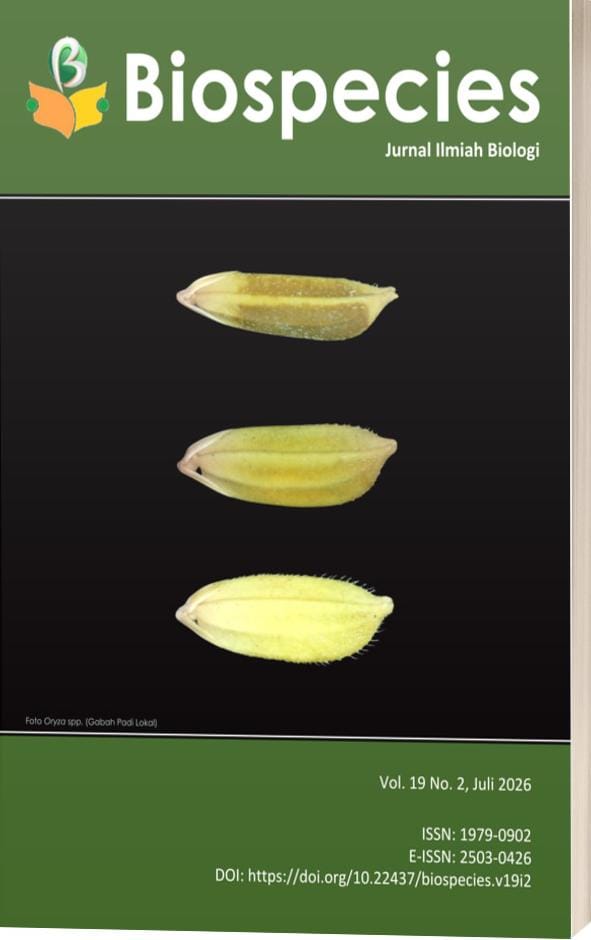
Phytoliths are microscopic silica deposits that form in plant tissue and have specific shapes depending on the species and parts of the plant, one of which is rice plants. This research aims to describe the morphology of grain phytoliths from rice plants (Oryza sativa) cultivated by the community around KCBN Muaro Jambi Temple Compound, Jambi Province. Rice grain samples were obtained through interview methods and observations of agricultural activities. Data analysis includes the process of observing grain characteristics, extraction using the LOI (Loss on ignition) method, phytolith observation using a Polaris microscope with 400x magnification, then documentation and measurement of phytolith findings. Data processing by looking at the average of each variable measured from phytoliths using a histogram graph. Phytolith characteristics were assessed based on the middle width of the double-peaked phytoliths, and the results showed that Jarum Mas rice had the greatest middle width, whereas Bujang Marinai rice had the smallest.
Downloads
Published
Issue
Section
License
Copyright (c) 2026 Rofi Surya Aryanto, Mahirta Mahirta, Eko Yulianto, M Dziyaul F. Arrozain

This work is licensed under a Creative Commons Attribution 4.0 International License.
Authors retain copyright and grant the journal the right of first publication with the work simultaneously licensed under a Creative Commons Attribution 4.0 International License that allows others to share the work with acknowledgment of the work’s authorship and initial publication in this journal.


